How to Cook and Boil Water in a Power Cut Safely (UK)
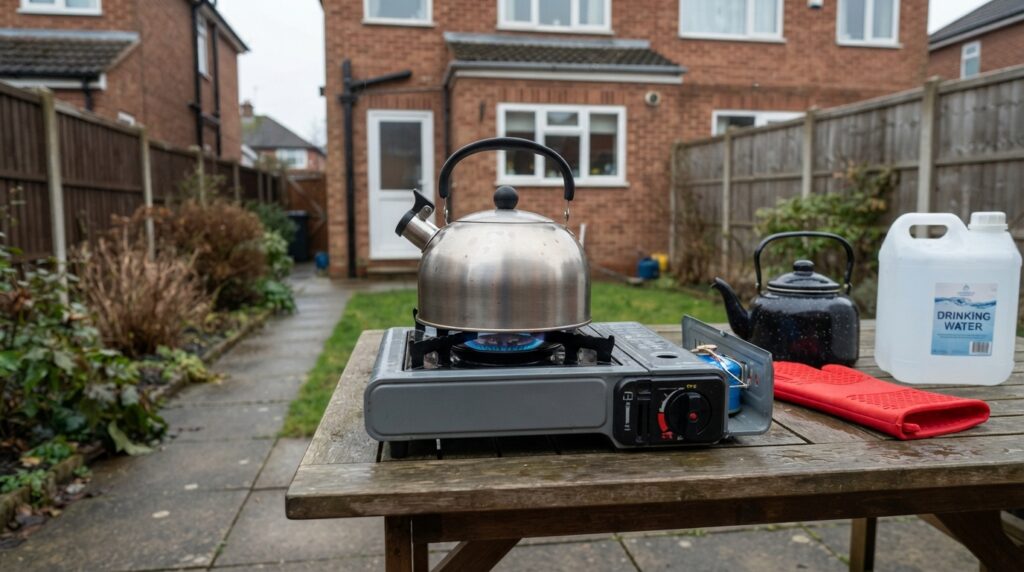
Electric and induction hobs, kettles and microwaves won’t work in a power cut, but the Food Standards Agency (FSA) says “gas cookers may continue to function”. Many gas hobs can be lit with a match if the electric ignition doesn’t work, but gas ovens usually won’t work. Be Ready says “gas ovens, boilers, heat pumps and your home internet won’t work without power”. Never use a camping stove or barbecue indoors, including in a garage or porch: the UK Chief Medical Officers warn of “a very high risk of carbon monoxide poisoning, which can kill”. If a power cut is forecast, boil water and fill a vacuum flask first, and keep food that needs no cooking.
Most UK kitchens run on electricity, even ones with a gas hob. So when the power goes off, so do hot meals and hot drinks. The government’s Be Ready campaign, launched on 22 October 2026, asks households to be ready for 3 days of disruption, which could mean 3 days without a kettle. Here’s what still works, how to light a gas hob without its spark, how to cook outdoors safely, and how to keep water hot without power.
What works in a power cut, and what doesn’t
| Appliance | Works in a power cut? |
|---|---|
| Electric or induction hob | No |
| Kettle, microwave, air fryer, slow cooker | No |
| Gas hob | Usually yes, lit with a match or lighter |
| Gas oven | Usually no |
| Camping stove or barbecue | Yes, but outdoors only |
The FSA says: “Electric/induction cookers will not work during a power cut, but gas cookers may continue to function.” Be Ready adds that gas ovens won’t work without power. Rangemaster’s manual for one of its gas range cookers, for example, says the grill and hotplate “may be lit using a match”, but “the ovens however cannot be used either manually or automatically until power is restored”.
How to light a gas hob in a power cut
Most modern gas hobs light with an electric spark. When the power’s off, the gas usually still flows, so you can light the burner yourself. Check your own hob’s manual first, but makers’ instructions are similar:
- Light your match or lighter first, then hold it close to the burner. Neff says to “use any type of lighter or flame (cigarette lighter, matches, etc.) and bring it close to the burner”.
- Push in and turn the control knob to release the gas.
- Keep holding the knob for a few seconds after it lights. This lets the flame safety device warm up, as Zanussi explains. Neff says 4 seconds and Miele says 8 to 10 seconds, so check your manual.
- If the flame goes out, turn the knob off. Neff says not to try to relight it “for at least 1 minute”, to let the gas clear.
Keep the kitchen ventilated while you cook, and make sure you have a working carbon monoxide alarm. A mains-only alarm won’t work in a power cut, so use a battery alarm or one with a battery backup. The NHS advises getting “a carbon monoxide alarm that makes a loud sound if there’s carbon monoxide present”.
Cooking outdoors: camping stoves and barbecues
The Chief Medical Officers’ power cut advice says: “If you have one, you could use a camping stove or barbecue outside or, if you are able to do so safely, light a campfire outside.” The FSA says to check the instructions, “as most are designed for outdoor use only”.
“Outdoors” means out in the open:
- Campingaz’s manual for its Camp Bistro 3 stove says “it is imperative NOT to use the stove in caravans, cars, tents, huts, sheds or any small enclosed areas”.
- Dorset and Wiltshire Fire and Rescue says: “Never use a camping stove, portable barbecue, lit charcoal or generator in an enclosed space”. That includes garages and porches.
- Scottish Fire and Rescue says: “never change gas cartridges indoors or near ignition sources.”
- Northern Gas Networks warns that barbecues can keep giving off carbon monoxide “even after they’ve cooled down”, so don’t bring a barbecue indoors to finish cooling, even when the flames are out.
Know the signs of carbon monoxide poisoning
The NHS lists symptoms including a headache, dizziness, feeling or being sick, feeling weak, tiredness and confusion, chest and muscle pain, and shortness of breath. Stop using the appliance if you can, and get everyone outside. Don’t go back in until you’ve had advice. Call NHS 111 if you think you have symptoms. Call 999 if someone is finding it hard to breathe, has suddenly become confused, feels weak, has chest or muscle pain, or has lost consciousness. The NHS says: “Do not drive to A&E.”
How to have hot water without power
The simplest trick is to boil water before the power goes. National Grid suggests you “boil some water and keep it in a thermos flask”, so “you can use it to make hot drinks or fill a hot water bottle if it gets cold”.
- Fill flasks when a storm is forecast. If you use flask water for a hot water bottle, let it cool a little first rather than using it straight from the boil. A good vacuum flask keeps water hot for a day or more. Thermos says its Stainless King flask keeps drinks hot for 24 hours, and Stanley claims 38 hours for its Classic bottle.
- Preheat the flask. Thermos suggests filling a food jar with boiling water and leaving it for five minutes before adding hot food, which it says keeps food hot for 1 to 3 hours longer.
- For baby formula, the rules are stricter. See our guide to making up baby formula in a power cut.
Food that needs no cooking
The easiest way to eat well in a power cut is to keep food that doesn’t need cooking. The Chief Medical Officers say “some food that you would usually cook can be safely eaten uncooked and will last well beyond 7 days”, such as tinned vegetables, tinned fish, tinned beans, oats, and pre-cooked rice and grains in pouches. The FSA says “some foods such as tinned foods will be safe to eat without heating through”.
Be Ready’s advice is to keep “food with a long shelf life that doesn’t need refrigeration or cooking”, and that “it’s best to buy food you’d usually eat”. Remember a manual tin opener, if your tins need one.
Cooking safely in a power cut
- Cook food through. The Chief Medical Officers say food “might take longer to cook than usual so make sure it is steaming hot and cooked through before you eat it”.
- Eat the fridge food first. The FSA says that if your fridge reaches 8°C or above, chilled food should be eaten within 4 hours, so cook that before anything from the freezer or the cupboard.
- Keep things clean. The FSA says to keep raw and cooked food separate. If the water’s off too, use alcohol-based hand sanitiser on your hands, and antibacterial sprays or wipes on surfaces.
- Switch things off. Be Ready says to turn off items such as irons, ovens, electric fires and fryers. County Durham and Darlington Fire and Rescue says this is particularly important for cooking appliances, as “your power could return at any time”.
The kit worth buying
Thermos Stainless King flask (1.2L)
Best for: hot water for a day without power
1.2 litres
5-year guarantee
Thermos says the Stainless King keeps drinks hot or cold for 24 hours. It’s stainless steel inside and out, with an insulated cup and a twist-and-pour stopper, and it weighs 670g. Filled from the kettle before a storm, 1.2 litres is enough for several hot drinks, or a hot water bottle.
Good for: power cuts; walks; car kits.
Less good for: a whole family’s hot drinks for a day, so you may want two. Thermos doesn’t say how it tests the 24 hours, or whether the flask is dishwasher safe. Stanley’s 1.4L Classic bottle claims longer (38 hours), but it’s heavier at 910g.
Thermos Stainless King food flask
Best for: keeping a hot meal hot
470ml or 710ml
Folding spoon in the lid
Thermos says its Stainless King food flask keeps meals hot for 9 hours and cold for 14. It has a wide mouth for soup, stew or porridge, and a folding spoon in the lid. Cook once on the gas hob or outdoor stove, and you’ll have a second hot meal later without lighting it again. Only fill it with food that’s fully cooked and steaming hot, as Thermos says never to rely on the jar to finish cooking. If the food isn’t still hot when you open it, reheat it until steaming hot or throw it away.
Good for: soup and stews; packed lunches; children.
Less good for: keeping food hot overnight, as 9 hours is much shorter than a drinks flask. Thermos advises preheating it with boiling water for the best results.
Campingaz Camp Bistro 3 stove (outdoor use only)
Best for: cooking outside when you have no gas hob
Boils in 5 min 30 sec
Piezo ignition
UK retailer Towsure lists the Camp Bistro 3 at 2,200W, with piezo ignition and a cartridge locking system. It lists a boil time of 5 minutes 30 seconds, without saying how much water, and a run time of up to 1 hour 15 minutes on a Campingaz CP 250 cartridge. It weighs 1.43kg.
Good for: homes with electric hobs; camping; cooking in the garden in a long power cut.
Less good for: anywhere indoors. Campingaz’s manual says it “should only be used outside premises”, never in sheds, tents or any small enclosed areas. Each cartridge lasts about 75 minutes, so you’ll need several for 3 days.
Frequently asked questions
Can I use my gas hob in a power cut?
Usually, yes. The FSA says gas cookers may continue to work. If the electric ignition doesn’t work, many hobs can be lit with a match or lighter. Check your manual, and keep the room ventilated.
Does a gas oven work in a power cut?
Usually not. Be Ready says gas ovens won’t work without power. Many gas hobs and grills can still be lit by hand.
Can I use a camping stove indoors in a power cut?
No. The Chief Medical Officers say “never use camping stoves or barbecues indoors” because of the very high risk of carbon monoxide poisoning. Use them outside in the open, never in a garage, shed, porch or tent.
How can I boil water without electricity?
On a gas hob, lit by hand if needed, or on a camping stove outdoors. Better still, boil water before a forecast power cut and keep it hot in a vacuum flask.
What can I eat in a power cut without cooking?
Tinned vegetables, tinned fish, tinned beans, oats, and pre-cooked rice and grains in pouches, according to the Chief Medical Officers. The FSA says tinned foods are safe to eat without heating.
Sources
- Food Standards Agency (GOV.UK) — Food safety in a power cut
- GOV.UK — UK CMOs: food and nutrition advice during a national power outage
- GOV.UK Be Ready — Power cuts and Be ready for emergencies
- Rangemaster — Range cooker manual; Miele — KM 2010 gas hob manual; Neff — Gas hob manual (PDF); Zanussi — My hob does not ignite
- NHS — Carbon monoxide poisoning; Northern Gas Networks — Essential guide to BBQ safety
- Dorset and Wiltshire Fire and Rescue — Power cuts; Scottish Fire and Rescue — Power cuts; County Durham and Darlington Fire and Rescue — Safety advice in the event of power disruption
- FSA — Hot holding (PDF); nidirect — Energy, power supply and utilities
- National Grid — Tips to prepare for a power cut
- Thermos — Stainless King flask 1.2L, Stainless King food flask and How to keep food hot in a food jar; Stanley — Classic Legendary bottle 1.4L
- Towsure — Campingaz Camp Bistro 3; Campingaz — Camp Bistro 3 manual
Related reading: how to make up baby formula in a power cut, how to store emergency drinking water, what size power bank you need for a power cut and which radio station to tune to in an emergency.
Compare vacuum flasks at Amazon UK.