9 Emergency Kit Items That Expire or Go Flat Sooner Than You Think (UK)
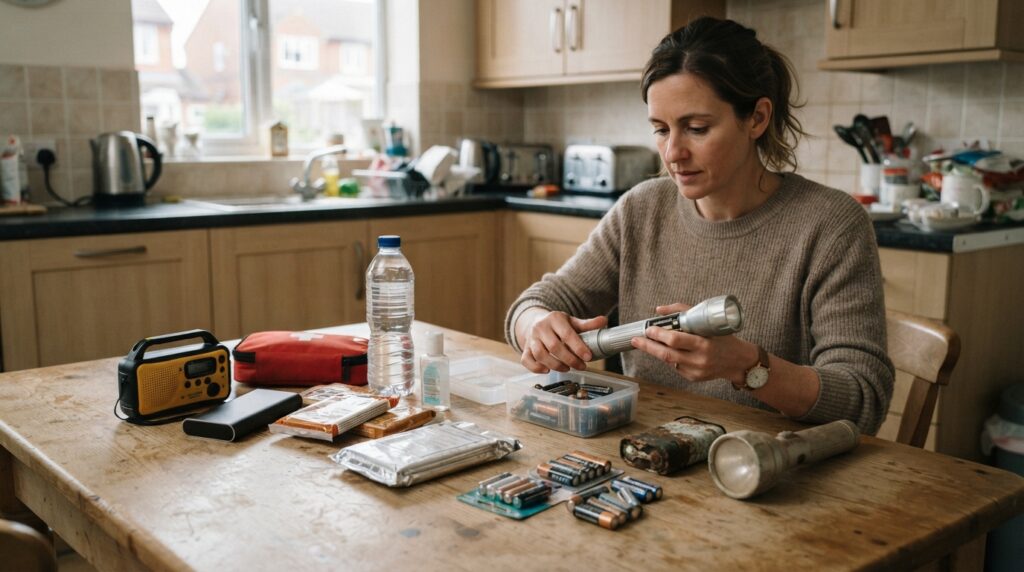
An emergency kit isn’t a “buy once and forget” job. The government’s Be Ready advice is to “set a reminder every six months to check expiry dates and swap out items that need replacing”. The items most likely to let you down are: power banks, which lose charge in storage (Anker says to recharge them every three months); batteries left inside torches and radios, which can leak; bottled water and tinned food past their best before dates; sterile first aid items; medicines; hand sanitiser, typically good for 2–3 years; opened baby formula; and wet wipes. An easy way to remember: check your kit when the clocks change in March and October.
Since the government’s Be Ready campaign launched on 22 October 2026, many of us have bought torches, power banks, bottled water and tins. The risk now is that the box goes in the loft and isn’t opened again until the lights go out. By then, the power bank may be flat, the torch batteries may have leaked and the plasters may not stick. Here are the 9 things to check, how long they last, and what to do about each.
At a glance
| Item | What goes wrong | What to do |
|---|---|---|
| Power bank | Loses charge in storage | Recharge every 3 months |
| Batteries in devices | Can leak and damage the device | Store them separately, next to the device |
| Bottled water | Best before date passes | Rotate into everyday use |
| Tins and dried food | Quality drops; damaged tins unsafe | Rotate; bin bulging or badly dented tins |
| First aid kit | Sterile items expire; plasters lose stick | Check dates every 6 months |
| Medicines | Expire; prescriptions run out | Return old ones to a pharmacy |
| Hand sanitiser | Alcohol evaporates over time | Replace after its expiry date |
| Baby formula | Opened powder lasts weeks; liquid hours | Keep sealed packs; check stage and dates |
| Wet wipes | Dry out once opened | Keep a sealed pack in the kit |
1. Your power bank
The Be Ready checklist asks for a charged power bank, and that’s the problem: they don’t stay charged forever. Anker says a lithium-ion power bank usually loses “around 2–3% per month” on its own, and that “it’s best to recharge it every three months”. Ugreen gives a wider range of 2–5% a month, and suggests recharging every two to three months.
- Top it up every three months, and before any storm warning.
- Store it indoors. Electrical Safety First says not to leave a power bank in a parked car, “where it could get cold in winter or hot in summer”.
- Check it for damage. Stop using it if it’s swollen, cracked or damaged.
2. Batteries left inside torches and radios
Alkaline batteries last a long time in their packet. Duracell says unused Duracell Plus AA batteries “can stay powered up to 10 years in ambient storage”, and Energizer says its MAX AA batteries hold power for “up to 10 years while in storage”. The weak point is batteries left inside a device for months. Energizer’s advice is to preserve battery life by “switching off a device and removing the batteries” if it won’t be used for a long time, and it warns that heat can cause “capacity loss, leakage or rupture”.
- Keep spare batteries in their packet, in the same box as your torch and radio, so you can find them in the dark.
- Store them at room temperature. Energizer says it’s “not necessary to store batteries in a refrigerator”.
- Don’t mix old and new batteries in the same device, Energizer advises.
- For longer storage, consider lithium. Energizer says its Ultimate Lithium AA batteries last “up to 25 years” in storage.
Be Ready also says “torches are safer than candles”, so your torch is worth checking properly.
3. Bottled water
Bottled water carries a best before date. GOV.UK explains that best before dates are about quality, not safety. Buxton, for example, says unopened bottles last “up until the Best Before Date written on the bottle”, and once opened, to drink the water within 3 days.
- Rotate it. Drink the oldest packs in everyday life and replace them, so your stock is always in date.
- Store it properly. Buxton says to keep it at “room temperature or cooler, out of direct sunlight” and “away from any solvents and chemicals”. That rules out a sunny conservatory or a garage shelf next to the paint.
For how much to keep and where, see our guide to storing emergency drinking water.
4. Tins and dried food
Most store-cupboard food carries a best before date rather than a use-by date. GOV.UK says: “After the best before date, the food is usually safe to eat but may not be of the same quality.” The UK Chief Medical Officers’ power cut advice also says food normally stored at room temperature “will continue to be safe to eat, even if the best before date has passed”.
Damaged tins are a different matter. The Food Standards Agency says “not to eat food from bulging, heavily rusted or deeply dented cans, even shop bought”. When you check your kit:
- Bin any tin that’s bulging, leaking, heavily rusted or deeply dented.
- Use up anything near its best before date and replace it.
- Make sure you still have a tin opener, if your tins need one.
5. Your first aid kit
The Health and Safety Executive says: “Many items, particularly sterile ones, are marked with expiry dates.” It advises replacing expired items, and checking with the maker if a sterile item has no date. St John Ambulance says out-of-date plasters can lose their stickiness, bandages can lose their sterility, and wipes “may dry out”.
Check the dates on dressings, wipes, eye wash and saline every six months. Our guide to what should be in a home first aid kit lists what to keep.
6. Medicines
Be Ready lists essential medication for your kit, and says: “It’s important to request prescriptions up to 5 working days before you need your medicine.” Don’t let a repeat prescription run down to the last few days going into winter.
- Check the dates on painkillers, allergy tablets and anything else in your kit.
- Return out-of-date medicines to a pharmacy for safe disposal. NHS Somerset says to “NEVER dispose of your unused or unwanted medicines down the toilet”.
- Check storage instructions. Some medicines need a fridge, which won’t work in a power cut. Ask your pharmacist what to do with yours.
7. Hand sanitiser
Hand sanitiser has an expiry date for a reason. UK first aid maker Steroplast says “the industry standard for when hand sanitisers expire is typically 2–3 years”, and that “the high alcohol content in the product is likely to evaporate over time”. Cuticura says its gels stay effective for at least 33 months if stored closed.
Replace it once it’s out of date. And the Chief Medical Officers say “washing your hands with soap and water is more effective at killing all germs than hand sanitiser”, so keep soap in your kit too.
8. Baby formula
Be Ready recommends ready-to-feed formula, “as you may not be able to boil water to make up powdered formula safely”. Check the best before dates on sealed bottles or cartons, and that they’re still the right stage for your baby as they grow.
Opened formula doesn’t last long. Aptamil says to use powdered formula “within four weeks of opening”, and the NHS says opened ready-to-feed formula should be kept in the fridge for no longer than 24 hours. So keep sealed packs in the kit, not an opened tin.
9. Wet wipes
Wet wipes are on the Be Ready checklist, but they dry out. Pampers says its wipes “indeed have an expiry date, which you can find on the packaging”, and recommends using them “within 3 months of opening”. Keep a sealed pack in your kit, and use and replace it at your six-monthly check.
Also worth checking
- Smoke alarms. Greater Manchester Fire and Rescue says to test alarms at least monthly, replace batteries yearly unless they’re 10-year sealed units, and replace the whole alarm after 10 years.
- Phone numbers and documents. Be Ready says to write important phone numbers on paper and keep printed copies of key documents. Update them when anything changes.
- Camping gas. If you keep a camping stove for outdoor use, Scottish Fire and Rescue says to “never change gas cartridges indoors or near ignition sources”. Never use a camping stove indoors.
The kit worth buying
Energizer Ultimate Lithium AA batteries
Best for: batteries that sit in a kit for years
-40°C to 60°C
Leak-proof
Energizer UK says each Ultimate Lithium AA “boasts up to 25 years’ shelf life in storage”, works from -40°C to 60°C, and is “guaranteed leak-proof, based on standard use”. That makes them a good fit for a torch or radio that might not be used for months, including in a cold loft or garage.
Good for: emergency torches and radios; car kits; anything stored for years.
Less good for: everyday use on a budget. They’re single-use and cost more than alkaline batteries.
ANSMANN Energy Check LCD battery tester
Best for: your six-monthly kit check
Button cells too
Result in 2–3 seconds
ANSMANN says this tester checks AAA, AA, C, D and 9V batteries, button and coin cells and several rechargeable types, and shows the remaining energy “in 10% steps within 2-3 seconds”, along with the voltage. It’s a quick way to sort the drawer of loose batteries most of us have.
Good for: checking spares before a storm; sorting loose batteries.
Less good for: 9V rechargeables, as ANSMANN lists only alkaline 9V batteries. The percentage reading also only moves in 10% steps.
Goal Zero Venture 75 power bank
Best for: a tough power bank with a built-in light
IP67 waterproof
50-lumen LED light
Goal Zero lists the Venture 75 at 19,200mAh, with 60W USB-C in and out, a 15W USB-A port, an IP67 rating and a built-in 50-lumen light. It claims about 5 smartphone recharges and a 1.5-hour recharge from a 60W USB-C charger. Its spec sheet gives a clear storage instruction: “Charge every 3-6 months”.
Good for: emergency kits; walking and camping.
Less good for: carrying light, as it weighs 577g. The light is dim at 50 lumens, and Goal Zero rates it for use from 0°C, so keep it indoors in winter.
Frequently asked questions
How often should I check my emergency kit?
The government’s Be Ready advice is to set a reminder every six months to check expiry dates and replace anything that needs it. Recharge power banks more often, about every three months.
Do power banks lose charge if you don’t use them?
Yes, slowly. Anker says lithium-ion power banks typically lose 2–3% a month on their own, and recommends recharging every three months.
Should I leave batteries in my emergency torch?
Energizer advises removing batteries from devices that won’t be used for long periods, to preserve battery life. Keep them in their packet in the same box as the torch, or use leak-proof lithium batteries.
Can you eat tinned food after the best before date?
Usually, yes. GOV.UK says food past its best before date is usually safe but may not be the same quality. Don’t eat from bulging, heavily rusted or deeply dented tins.
Does hand sanitiser expire?
Yes. Steroplast says hand sanitisers typically expire after 2–3 years, as the alcohol can evaporate over time. Replace it once it’s past its date.
Sources
- GOV.UK Be Ready — Be ready for emergencies
- Anker — How long does a power bank hold a charge?; Ugreen — Does a power bank drain when unused?
- Electrical Safety First — Power banks
- Energizer UK — Ultimate Lithium AA, MAX AA and Battery care; Duracell — Duracell Plus AA
- Buxton — Storage information
- GOV.UK — Best before and use by dates; Food Standards Agency — Botulism
- GOV.UK — UK CMOs: food advice during a power outage and water and sanitation advice
- HSE — What to put in your first aid kit; St John Ambulance — Do first aid kits expire?
- NHS Somerset — Medicines waste
- Steroplast — Antibacterial hand gel expiry; Cuticura — FAQs
- Aptamil — Advanced 1 First Infant Milk (pack details); NHS — How to use formula
- Pampers UK — Do nappies expire?
- Greater Manchester Fire and Rescue — Smoke alarms; Scottish Fire and Rescue — Power cuts
- ANSMANN — Energy Check LCD (PDF); Goal Zero — Venture 75
Related reading: how to store emergency drinking water, what should be in a home first aid kit, UK storm names for 2026/27 and our storm-proofing guide.
Compare long-life lithium batteries at Amazon UK.