Are Smart Radiator Valves Worth It? Smart TRVs Explained (UK, 2026)
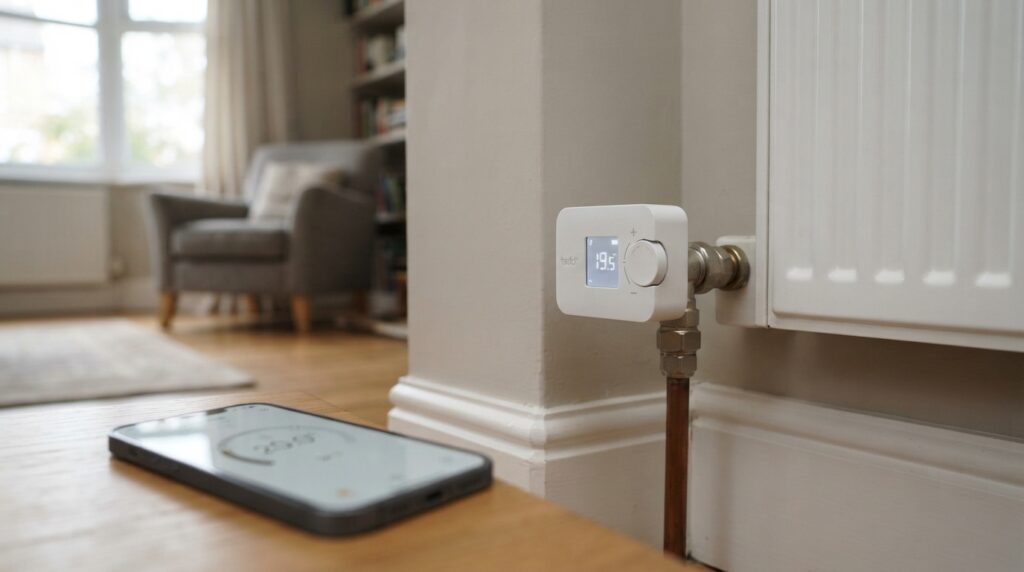
They can be, but don’t expect miracles. Smart radiator valves (smart TRVs) let you heat each room to its own schedule from your phone, which helps most in homes where several rooms sit empty for much of the day. The best independent UK evidence is a 2022 controlled field trial by Loughborough University researchers: homes with room-by-room (zonal) controls cut their gas use by 3.5% on average, and in a third of homes, gas use actually went up. An earlier test-house study found savings of about 12%. The Energy Saving Trust says adding ordinary TRVs to a system with a programmer and thermostat saves around £30 a year. Smart TRVs make the most sense if you have a big, unevenly used home and will actually set up the schedules.
Smart radiator valves are often sold on the promise of big savings, but a 2018 evidence review warned that claims about heating controls are “often biased, unsubstantiated, misleading, or incorrect”. The independent evidence is more modest. Here’s what smart TRVs actually do, what the research says, which systems work with a combi boiler, and when they’re worth the money.
What does a smart TRV do?
A normal thermostatic radiator valve (TRV) controls one radiator. The Energy Saving Trust (EST) explains that “TRVs work by sensing the air temperature around them” and “if the room is warmer than the setting on the TRV, the valve will close a little.” They usually have a 0–6 scale.
A smart TRV replaces the head of that valve with a battery-powered motorised one that connects to a hub and an app. That means you can:
- set a different temperature and timetable for each room;
- change settings remotely if your plans change, which the EST lists as one advantage of smart controls;
- if the smart system also controls the boiler, have the valves call for heat so the boiler only fires when a room needs warming.
What does the evidence say?
| Study | What it found |
|---|---|
| Loughborough University test houses (2015) | The house with zonal control used 11.8% less gas; the researchers estimated zonal control could cut space-heating gas demand by about 12% in most UK regions. This was a pair of matched, adjoining 1930s semi-detached test houses, both run on the same simulated occupancy schedule. |
| Controlled field trial in real homes (Lomas et al., 2022) | Mean gas demand fell by 3.5% compared with homes that kept their existing controls. Gas demand fell in two-thirds of the homes with zonal controls, and rose in one-third. |
| Review of the evidence (Lomas et al., 2018) | Moderate-quality evidence that smart thermostats on their own don’t save energy compared with standard thermostats and programmers. For most control types, evidence was low quality or missing. The same review found moderate-quality evidence that zonal controls, “when appropriately commissioned”, could save energy compared with whole-house controls. |
In other words, room-by-room control can save gas, but in real homes the average saving is small, and how people use it matters a lot. If you use smart TRVs to heat more rooms for longer because it’s easy, your bills can go up.
Compared with ordinary TRVs
The EST says adding ordinary TRVs to a system that already has a programmer and thermostat can save £30 a year in Great Britain and £40 in Northern Ireland, and that installing and using heating controls effectively could save £100 a year in Great Britain (£110 in Northern Ireland). If you have no TRVs at all, fitting basic ones is the cheapest first step.
Should you turn radiators off in rooms you don’t use?
Turn them down, rather than off. The EST suggests setting TRVs at 3 to 4 in the rooms you use most, and 2 to 3 for bedrooms and rooms you use less. Which? says turning radiators in unoccupied rooms to low settings “will suffice most of the time”, because “a little water will move around them and help your boiler to condense, and it will prevent damage from damp and freezing.” Smart Energy GB suggests turning TRVs in “non-living” rooms down to the midway point. This is exactly the job smart TRVs are good at: keeping spare rooms low and warming them only when needed.
Do smart TRVs work with a combi boiler?
Usually, yes. Drayton sells Wiser kits “suitable for combi boilers” and others for conventional boilers, and Hive says it works with gas combi boilers, though not some Worcester models. Check the brand’s compatibility guide. What matters is how the boiler is switched:
- Boiler interlock. Viessmann explains that TRVs should be installed with a room thermostat to provide boiler interlock, so the boiler switches off when no room needs heat. With a combi, that’s usually done by the room thermostat.
- Let the smart system control the boiler. tado calls the setup where tado° controls the boiler and its smart radiator thermostats control each room “the recommended setup for maximizing savings”. It adds that rooms without a smart radiator thermostat “will receive heat when the boiler is turned on”, so it suggests setting their ordinary TRVs to frost protection.
- Valve threads. tado’s head fits M30 x 1.5 valves, and the main brands include adaptors for other types (Hive supplies M30, M28 and Danfoss RA). Hive says some older valve types need the valve body replacing.
When smart TRVs are worth it
- Rooms used at different times, such as spare bedrooms or a home office. In the 2022 trial, savings came mainly from lower bedroom temperatures, especially in the evenings.
- Changing plans, such as shift or hybrid working. The EST says “you can make changes remotely if your plans change”.
- You’ll set them up properly. The 2018 review found zonal controls save energy “when appropriately commissioned”.
They’re less worthwhile in small flats where every room is used, open-plan homes, or if you already keep TRVs low in unused rooms and rarely change them.
The smart TRVs we’d consider
tado° Smart Radiator Thermostat X (starter kit)
Best for: Apple, Google and Alexa homes
Rechargeable battery (about once a year)
M30 x 1.5 plus 6 adaptors
tado says its Smart Radiator Thermostat X starter kit includes a Bridge X (a Thread border router), works with Matter, Thread, Alexa, Google Assistant and Apple Home, and has a rechargeable lithium-ion battery that charges by USB-C in about 2 hours and only needs charging about once a year. It fits M30 x 1.5 valves, with a set of six adaptors for other types.
Good for: people who want to avoid AA batteries; smart-home users.
Less good for: existing tado V3+ owners, as tado says the X range isn’t compatible with V3+. To control the boiler, you also need a tado Smart Thermostat X or Wireless Receiver X, and the USB-C cable isn’t included.
Drayton Wiser Radiator Thermostat
Best for: adding rooms to an existing Wiser system
5–30°C setpoint
Fits over 95% of valves (Drayton)
Drayton says the Wiser Radiator Thermostat gives more than two years of battery life with the included alkaline batteries under typical use, has a 5–30°C setpoint, uses Zigbee, and is compatible with over 95% of existing radiator valves, with adaptors supplied. Drayton says its support is backed by “over 75 years of engineering expertise” and UK-based teams.
Good for: homes that already have a Wiser thermostat or multi-zone kit.
Less good for: a standalone purchase. It has to be added to a Wiser thermostat kit or hub, so budget for one if you’re starting from scratch.
Hive Radiator Valve
Best for: existing Hive users
2 x AA alkaline batteries
Child lock
Hive says its Radiator Valve works with or without a Hive thermostat, runs on two AA alkaline batteries, uses Zigbee and has a child lock, with open-window detection if you add Hive window sensors. If you already have a Hive Hub for your thermostat, it’s a straightforward add-on.
Good for: homes with Hive heating already installed.
Less good for: anyone without a current Hive Hub, as it needs one (the original Hub 1 isn’t supported). Hive says not to use lithium or rechargeable batteries, and some older valve types need replacing.
Frequently asked questions
How much can smart radiator valves save?
A 2022 controlled field trial in UK homes found an average gas saving of 3.5% from zonal controls, and some homes used more gas. Savings depend heavily on your home and how you use the system.
Do smart TRVs work with a combi boiler?
Usually. Drayton Wiser and Hive both support combi boilers, with some exceptions, so check the brand’s compatibility guide. For the best results, let the smart system switch the boiler, so it only fires when a room needs heat.
Should I turn off radiators in unused rooms?
Turn them down rather than off. Which? says low settings help the boiler and prevent damp and freezing. The EST suggests 2 to 3 for less-used rooms.
Do I need a hub for smart radiator valves?
Usually yes. tado uses a Bridge X (included in its starter kit), Drayton Wiser needs a Wiser hub or thermostat kit, and Hive needs a Hive Hub.
Are smart TRVs better than normal TRVs?
They give more control and scheduling, but ordinary TRVs already save money. The EST says adding TRVs to a system with a programmer and thermostat saves around £30 a year.
Sources
- Energy Saving Trust — Take control of your heating and Thermostats and heating controls
- Beizaee et al. (2015), Energy and Buildings — Measuring the potential of zonal space heating controls to reduce energy use in UK homes
- Lomas et al. (2022), Energy and Buildings — Energy savings from domestic zonal heating controls: robust evidence from a controlled field trial
- Lomas et al. (2018), Renewable and Sustainable Energy Reviews — Do domestic heating controls save energy? A review of the evidence
- Which? — Avoid this radiator mistake that can increase your bills
- Smart Energy GB — Radiator valves
- Viessmann — What is boiler interlock?
- tado — Heating control setup and Smart Radiator Thermostat X starter kit
- GOV.UK — Approved Document L, Volume 1 (PDF)
- Drayton — Wiser; Hive — Boiler compatibility
- Drayton — Wiser Radiator Thermostat; Hive — Hive Radiator Valve
Related reading: what temperature to set your thermostat in winter, does closing internal doors save on heating? and how to bleed a radiator properly.
Compare smart radiator thermostats at Amazon UK.