Do Radiator Reflector Panels Actually Work? (UK)
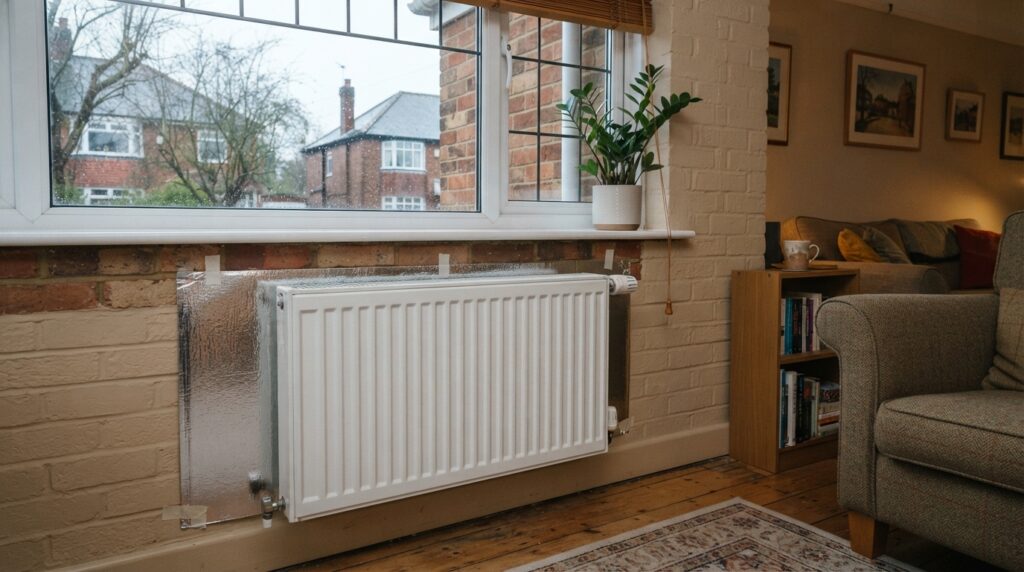
Yes, but only on the right radiators. Radiator reflector panels sit between the radiator and the wall and bounce heat back into the room instead of letting it warm the wall behind. According to the Energy Saving Trust, they’re most effective on radiators fixed to uninsulated external walls, where they can save around £18 a year in Great Britain, or £20 a year in Northern Ireland. On internal walls they’re not worth fitting, because any heat “lost” through the wall just warms another room in your house. Skip the kitchen foil, which the Trust explicitly warns doesn’t work — use proper foil-faced foam panels.
Every autumn the same TikTok clip does the rounds: someone taping tin foil to the wall behind a radiator and claiming a warmer room and a smaller bill. There’s a real principle underneath it. There’s also a lot that gets it wrong. Here’s what actually works and where it’s worth doing.
What a reflector panel actually does
A radiator warms the room in two ways: it radiates heat from its front surface, and it heats the air that rises up its back and front. What you don’t want is the back of the radiator warming a cold, uninsulated wall, because a lot of that heat then leaks straight to the outside. A reflector panel is a thin insulating panel with a shiny foil layer, fitted between the radiator and the wall. It reflects the radiant heat back into the room and, because it’s insulating in itself, slows the amount that gets into the wall at all.
When they actually save money
A cavity wall that’s been filled with cavity wall insulation is doing most of that job already. An older, uninsulated solid brick wall behind a radiator is the classic case where a panel pays off. If in doubt, hold your hand on the wall above and behind a radiator when the heating’s been on for a while: a wall that feels noticeably warm is losing heat you’re paying for.
How much you’ll actually save
The Energy Saving Trust puts the figure at £18 a year in Great Britain and £20 a year in Northern Ireland. That’s whole-house saving from fitting them to all the eligible radiators, not per panel. It’s a modest number, but the panels are also cheap, take an hour to fit, and last for years, so the payback is quick even if you only do the two or three radiators that qualify.
To put it in context, at Ofgem’s price cap for gas from October to December 2026 — 7.97p per kWh — £18 buys about 226 kWh of gas heating. That’s a couple of weeks of running for a typical UK household in winter, gained back over the year.
Why kitchen foil doesn’t cut it
The Energy Saving Trust is blunt: kitchen foil won’t work. There are two reasons. First, it’s too thin and floppy to stay flat — it crumples, and any crease is a hot spot conducting heat straight into the wall. Second, it has almost no insulating value in itself, so it’s only reflecting the radiant part of the heat and doing nothing about conduction. A proper panel is thicker, stays flat, and has a foam insulating layer behind the foil.
Fitting them
- Switch the heating off and let the radiator cool. Working behind a hot radiator is a good way to burn your knuckles.
- Measure the radiator, height and width, so you’re not cutting the panel down more than needed.
- Wipe the wall behind with a dry cloth so the adhesive strips or clips have something clean to grip.
- Slide the panel down behind the radiator, foil side facing the radiator. Some products stick to the wall, some clip over the radiator brackets. Clip-on versions are the renter-friendly choice, since they leave no marks.
- Don’t cover the pipes or valves, and don’t let the panel touch electrical fittings.
Foil-faced foam radiator reflector panels
Cheap, quick job for external-wall radiators
Cut to size with a knife or scissors
Some come with clips for renters
Look for a foil-faced foam panel rather than plain foil or bubble-foil laminate — the foam layer is what stops heat conducting into the wall as well as reflecting it. Multi-packs work out cheaper per metre if you’re doing several radiators. Check the panel is thick enough to stay flat but thin enough to fit the gap behind your radiator; if the gap is very tight, look for a slimline version. Clip-on kits attach to the radiator brackets, which is the sensible choice for renters or anyone who doesn’t want to stick anything to a painted wall.
Good for: uninsulated external walls; solid-wall Victorian and Edwardian houses; renters using clip-on versions.
Less good for: radiators on internal walls, where the Energy Saving Trust says they’re not worth fitting. They also can’t fix a radiator that’s just too small or blocked by furniture.
What panels won’t fix
A reflector panel won’t rescue a radiator that’s the wrong size for the room, sitting behind a sofa, or has a shelf on top deflecting all its convection. Our guide to things making your house colder covers those, and our bleed a radiator guide fixes the other common reason a radiator underperforms — trapped air at the top. Panels are one piece in a wider draught-proofing and heating-controls picture; our draught-proofing guide is the companion piece.
Frequently asked questions
How much do radiator reflector panels save?
Around £18 a year in Great Britain and £20 a year in Northern Ireland if fitted to radiators on uninsulated external walls, according to the Energy Saving Trust.
Should I put reflector panels behind every radiator?
No. The Energy Saving Trust says it’s not really worth fitting them to internal walls, because any heat lost through those walls just warms another room in the house. Focus on radiators on external walls that aren’t already insulated.
Does kitchen tin foil work as a radiator reflector?
The Energy Saving Trust says it won’t work — it’s too thin to stay flat and has no insulating value. Use purpose-made foil-faced foam panels instead.
Can renters fit radiator reflector panels?
Yes, clip-on versions attach to the radiator brackets rather than the wall, so they leave no marks. The Energy Saving Trust suggests checking with your landlord first if you’re using a stick-on version.
Sources
- Energy Saving Trust — Radiator reflector panels explained
- Ofgem — Energy price cap, 1 October to 31 December 2026
Related reading: our draught-proofing guide, things making your house colder and how to bleed a radiator.
Compare current foil-faced foam radiator reflector panels at Amazon UK.