Heated Airer vs Dehumidifier: The Cheapest Way to Dry Clothes Indoors in Winter (UK)
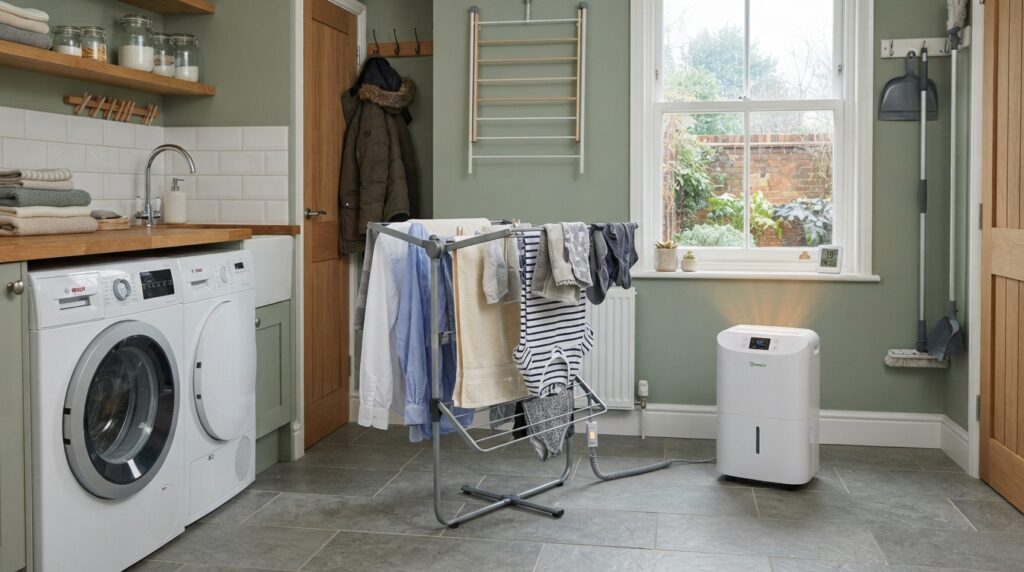
Both are far cheaper to run than a tumble dryer, and they solve different halves of the problem. A heated airer warms the clothes so water leaves them faster. A dehumidifier pulls that water back out of the air so it doesn’t end up on your windows and walls. At the October–December 2026 price cap of 26.32p per kWh, a 300W airer costs about 7.9p an hour, a typical 185W dehumidifier about 4.9p an hour, and an average tumble dryer cycle of around 3 kWh about 79p. On its own, a heated airer puts a load of washing’s water straight into your room — a cotton load can hold around 2 kg of it. If you only buy one, a dehumidifier in a small closed room with an ordinary airer is usually the better all-round choice. Both together is fastest.
Once the weather turns, the washing line stops being an option for months, and most British homes end up with clothes draped over radiators and chairs. That’s the expensive and damp way to do it. Here’s what each alternative actually costs and does, using this winter’s electricity price.
How much water is in a load of washing?
More than most people think. A 2025 full-scale study by Thevenet and colleagues measured a cotton laundry load holding around 2 kg of water to be evaporated — roughly two litres. Water came off fastest at the start, peaking at 360 grams an hour and staying above 100 grams an hour for the first two hours, then settling to around 50 grams an hour for a long tail between about 10 and 25 hours. Relative humidity in the test room climbed to around 80%, and the room itself cooled by between 0.5 and 3.8°C, because evaporation takes heat out of the air.
What each option costs to run this winter
These figures use the Ofgem price cap for 1 October to 31 December 2026, 26.32p per kWh on direct debit. The wattages are the examples Uswitch uses in its own comparison; check the actual wattage of any model you’re considering, as they vary. The four- and eight-hour columns are illustrative, since drying time depends on the load, the fabric and the room.
| Option | Power | Per hour | 4 hours | 8 hours |
|---|---|---|---|---|
| Heated airer | 300W | 7.9p | 31.6p | 63.2p |
| Dehumidifier | 185W | 4.9p | 19.5p | 39.0p |
| Both together | 485W | 12.8p | 51.1p | — |
| Tumble dryer | ~3 kWh per cycle | — | about 79p per cycle | |
Two things jump out. First, all of the indoor options are cheaper than a tumble dryer cycle over any sensible drying time. Second, running both together for four hours costs less than a tumble dryer, and it’s likely to be quicker than either on its own, because one speeds up evaporation while the other keeps the air dry enough for evaporation to continue.
The heated airer: faster drying, but the moisture stays in the room
A heated clothes airer
Speeds up drying for a few pence an hour
Low wattage compared with a tumble dryer
Folds away when not in use
A heated airer gently warms the clothes, which helps water leave them faster than on an ordinary airer. The running cost is low, but on its own it has one big weakness: all that water still goes into the room. Uswitch flags the damp and mould risk and recommends ventilation or a dehumidifier alongside. It also warns that an overloaded airer leaves clothes smelling musty, so spread items out and turn them. Check the wattage on the listing, and a cover can help trap warmth around the clothes.
Good for: quicker drying than an unheated rack; smaller homes without space for a tumble dryer; low running cost.
Less good for: damp-prone homes if used on its own, since it adds moisture to the air. Heavy items like jeans and towels still take a long time.
The dehumidifier: slower to start, but it takes the water away
A dehumidifier with a laundry mode
Dries the air so the washing can dry
Many have a dedicated laundry setting
Also tackles winter condensation
A dehumidifier doesn’t heat the clothes, but it keeps the air dry enough that water keeps leaving them, and it removes that water from your home rather than letting it settle on the windows. It works best in a small room with the door shut and the airer close by. Many models have a dedicated laundry setting for exactly this job. The bonus is that it’s useful all winter for condensation, not just on washing days. Check the extraction rate and tank size on the listing against your household’s laundry, and whether it’s a compressor or desiccant model, since compressor units lose effectiveness in a cold room.
Good for: damp-prone homes; drying washing without adding condensation; year-round use against damp.
Less good for: very cold rooms if it’s a compressor model. It also needs the tank emptying, and takes up floor space.
How to set it up for the fastest, driest result
- Pick one small room and close the door. A dehumidifier drying one small room works far better than one fighting a whole open-plan floor.
- Spin the washing hard first. Every bit of water the machine removes is water you don’t have to evaporate.
- Space items out on the airer so air reaches every surface, and turn them part way through.
- Put the dehumidifier close to the airer, with the airflow moving across the clothes.
- Keep washing off radiators, so the radiator can heat the room rather than the laundry.
If you already own a portable air conditioner with a dry mode, it can help in autumn and spring, but for winter laundry a dedicated dehumidifier is the more practical tool. Our dry mode versus dehumidifier guide explains why, and our dehumidifier guide covers choosing one.
Frequently asked questions
Is a heated airer cheaper than a tumble dryer?
Yes. At 26.32p per kWh, a 300W heated airer costs about 7.9p an hour, while an average tumble dryer cycle of around 3 kWh costs about 79p. The airer would have to run for about 10 hours to match one tumble dryer cycle.
Is it better to use a dehumidifier or a heated airer to dry clothes?
They do different jobs. A heated airer speeds up drying but adds moisture to the room; a dehumidifier removes the moisture so it doesn’t cause condensation. In a damp-prone home a dehumidifier is the safer single buy, and using both together is quickest.
Does drying clothes indoors cause damp?
It can. A study of indoor laundry drying found a cotton load held around 2 kg of water and pushed room humidity up to around 80%. Without ventilation or a dehumidifier, that moisture tends to condense on cold surfaces.
Why do clothes smell musty when dried indoors?
Usually because they took too long to dry. Uswitch notes that overloading an airer leads to a musty smell. Spacing clothes out, turning them, and keeping the air dry with a dehumidifier all shorten drying time.
Sources
- Uswitch — Heated clothes airers: how energy-efficient are they?
- Thevenet et al., ScienceDirect — Indoor laundry drying: full-scale determination of water emission rate and impact on thermal comfort
- Ofgem — Energy price cap, 1 October to 31 December 2026
Related reading: our winter condensation and mould guide, dehumidifier guide and why your house smells musty.
Compare current dehumidifiers with a laundry mode at Amazon UK.