Do Air Purifiers Cool a Room?
No — an air purifier does not cool a room. It draws air through a filter to remove particles like dust, pollen and smoke, then blows the cleaned air back out. It doesn’t remove any heat, so the room’s temperature doesn’t drop — and the motor actually adds a tiny amount of warmth. You might feel a faint draught from the outlet, which is where the confusion comes from, but that’s air movement, not cooling. The mix-up is usually a naming problem: “air purifier”, “air cooler” and “air conditioner” are three completely different machines. Where a purifier does genuinely help in summer is if hay fever or poor air quality stops you opening the windows at night — because it lets you keep the air clean indoors when you can’t ventilate.
This one comes down to knowing which machine does what — three similar-sounding products that do entirely different jobs. Here’s the honest picture, and the one real way a purifier helps you stay cool.
What an air purifier actually does
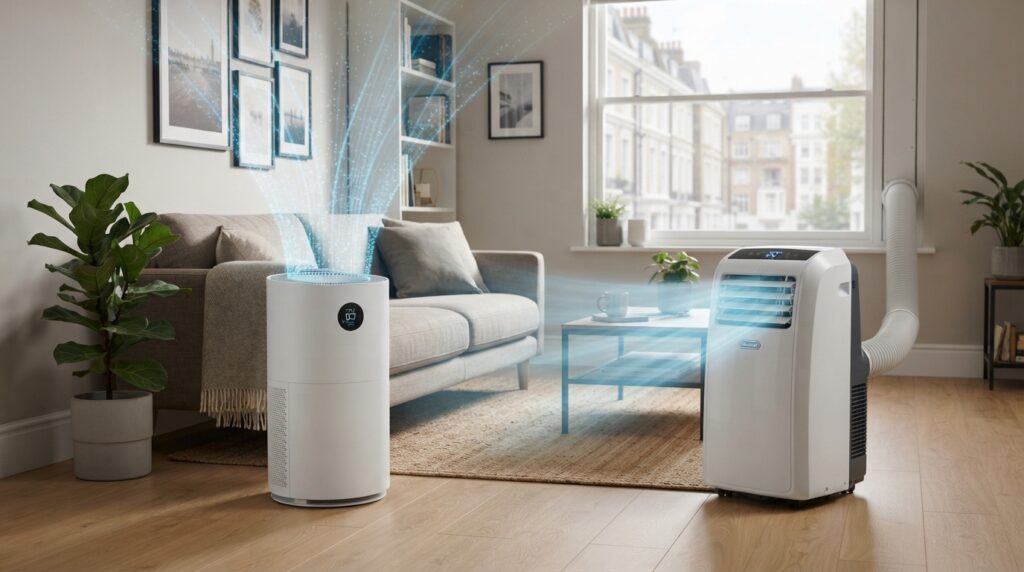
An air purifier is, mechanically, a fan and a filter. It pulls room air in, passes it through one or more filters — commonly a HEPA filter for fine particles and often an activated-carbon layer for odours and gases — and pushes the filtered air back into the room. Its entire job is cleaning the air: reducing dust, pollen, pet dander, smoke, mould spores and some odours.
Nothing in that process removes heat. There’s no refrigeration, no evaporation of water, no exhaust carrying warmth out of the building. The air comes out at essentially the same temperature it went in — very slightly warmer, if anything, because the motor generates a little heat. So the temperature of the room is unchanged.
Why people think it cools — the draught
The reason the myth persists is that a purifier moves air, and moving air feels cooler on your skin even when it isn’t — the same reason a fan makes you feel cooler without lowering the temperature. If you stand right in the outlet stream of a purifier running on high, you’ll feel a faint breeze, and your brain reads that as cooling.
But it’s a weak effect compared with an actual fan, because a purifier is designed to move air through a filter, not to project a strong airflow at you — the filter restricts the flow. If it’s airflow you want for comfort, a proper fan does it far better and cheaper.
The three machines people confuse
- Air purifier — cleans the air (removes particles). Does not cool. This page.
- Air cooler (evaporative cooler) — blows air over water so it evaporates, cooling the air a little. Works in dry heat, adds humidity, no exhaust needed. Genuinely cools a bit, but weakly in muggy UK weather — covered in our windowless cooling guide.
- Air conditioner — removes heat from the room and pumps it outside through a hose. The only one that genuinely lowers the temperature — our buying guide covers these.
Marketing muddies this further with “3-in-1” and “4-in-1” devices that combine a fan, a purifier and sometimes a humidifier — none of which cool. Read past the name to what the machine physically does.
Where a purifier genuinely helps in summer
Here’s the real overlap with cooling, and it’s worth knowing because it solves a specific problem.
The most effective free cooling in a UK home is night ventilation — opening the windows when it’s cooler outside to flush the day’s heat, as our window timing guide explains. But for some people, opening the windows isn’t an option:
- Hay fever and pollen. Summer nights are high-pollen, and opening the windows to cool the bedroom floods it with the exact allergen keeping a sufferer awake. A HEPA purifier running with the windows shut keeps the indoor air clear of pollen — so it doesn’t cool the room, but it makes a shut, shaded room far more liveable for an allergy sufferer who can’t ventilate.
- Poor outdoor air quality. On a busy road, near a pollution source, or during a period of poor air quality, opening windows brings the problem indoors. A purifier lets you keep windows shut and the air clean.
- Smoke. Wildfire smoke or nearby bonfires make ventilation undesirable; a purifier with a good filter helps.
So the honest framing is: a purifier is a complement to cooling for people who can’t ventilate, not a cooling device itself. If that’s you, run the purifier with the windows shut and lean harder on the no-ventilation cooling measures — shading, sealing, body cooling and, if needed, an air conditioner that works with the windows closed. Our no-AC cooling guide covers the passive side.
If you want both clean air and cooling
- A fan plus a purifier — the fan for the cooling airflow on your skin, the purifier for clean air. Cheaper and more effective than a combined unit that compromises on both.
- An air conditioner run with the windows shut — the right answer for a hay fever sufferer who needs the room genuinely cooler, since it cools without opening the windows. Many also have their own basic filter, though it’s not a substitute for a dedicated purifier. Our pregnancy guide and quiet bedrooms guide touch on running one for a shut room.
- A HEPA purifier specifically if allergens are the issue — HEPA filtration is what captures fine pollen and dust. Match the purifier’s rated room size to your room.
Frequently asked questions
Does an air purifier lower the room temperature?
No. It filters the air but removes no heat, so the temperature is unchanged — very slightly higher if anything, because the motor adds a little warmth. Any coolness you feel is just the draught from the outlet.
What’s the difference between an air purifier and an air cooler?
A purifier cleans the air and doesn’t cool. An air cooler (evaporative cooler) blows air over water to cool it a little — it genuinely lowers the air temperature, though weakly in humid weather. Only an air conditioner removes heat from the room properly.
Is there any point running a purifier in summer?
Yes, if hay fever or poor outdoor air quality stops you opening the windows to ventilate at night. It keeps the indoor air clean with the windows shut — it doesn’t cool, but it makes a sealed room far more liveable for an allergy sufferer.
Should I buy a fan or a purifier to keep cool?
A fan — it’s designed to move air at you and will feel far cooler than a purifier, for less money. Buy a purifier for air quality, not cooling; the two do different jobs.
Do combined fan-purifier units cool?
No — the fan element moves air (so you feel a breeze) and the purifier cleans it, but neither removes heat. They don’t lower the room temperature any more than a plain fan does.
Sources
- NHS — Hay fever
- Energy Saving Trust — Keeping your home cool in summer
- Met Office — Pollen forecast and advice
Related reading: our fan types guide and no-AC cooling guide.
For cooling comfort a fan beats a purifier — buy a purifier for clean air, not temperature. Compare current options at Amazon UK.