Best Air Conditioner for Student Halls (UK)
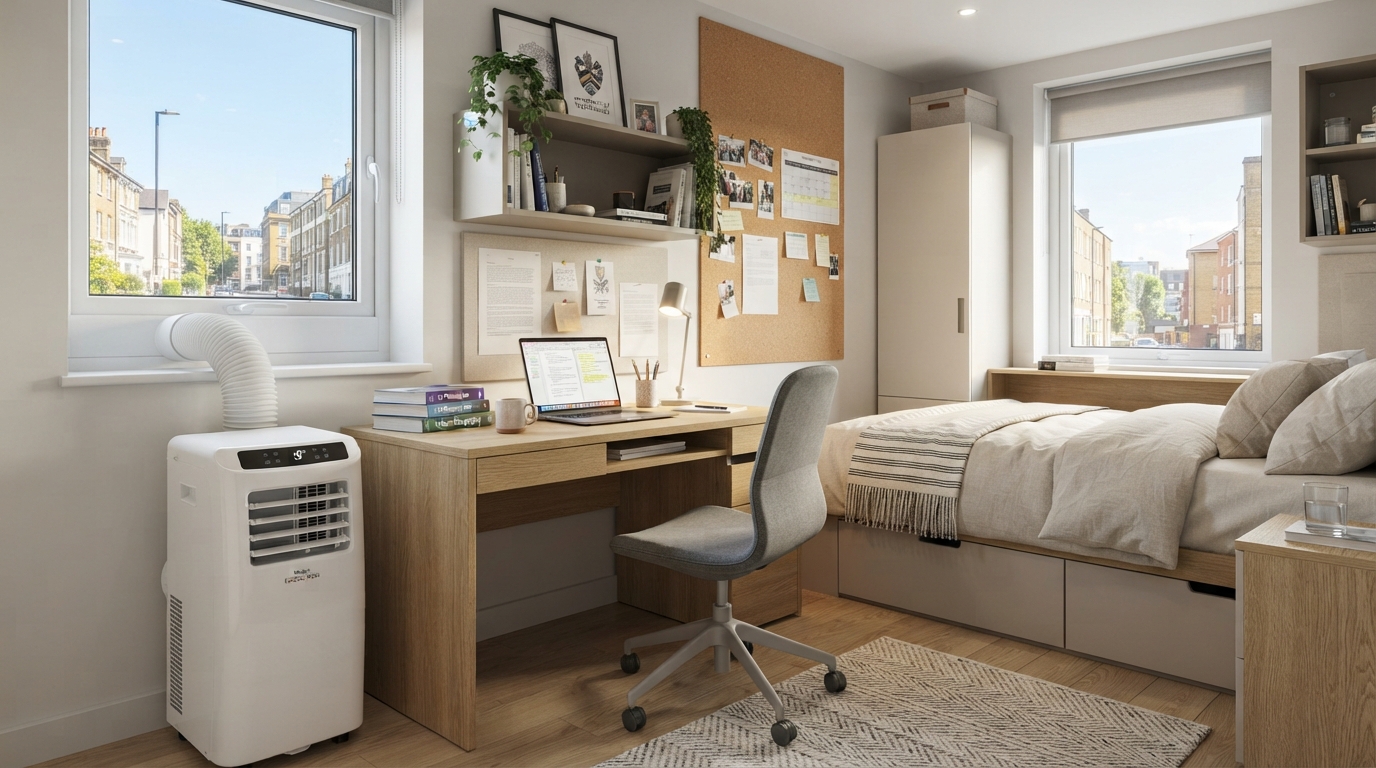
If your accommodation allows it, a compact single-hose portable air conditioner is the practical choice for a single halls room — smaller and cheaper than dual-hose units, simple to set up once and leave for the term, and easy enough for one person to carry when you move out. Budget, noise (thin walls, shared kitchens) and how easily it packs down for storage matter more here than raw cooling power. If portable AC is banned or your window won’t take a hose kit, an evaporative air cooler or a good desk/tower fan is the fallback — neither needs venting or a trailing hose, so they clear most halls’ rules more easily.
A single hot room with a thin mattress and a laptop running all night is exactly the situation these units are built for — but halls come with rules and constraints a normal rental doesn’t. Here’s how to choose sensibly.
Check the rules first — genuinely first
This matters more here than almost anywhere else on this site. University-managed halls and private student accommodation providers set their own policies, and they vary a lot: some are relaxed about fans and small appliances, others explicitly ban portable heaters and air conditioners, restrict total wattage per room, or require any electrical item you bring to pass a visual safety check. A few reasons providers restrict appliances:
- Fire safety — shared buildings with many residents have stricter rules than a single rented flat, and a cable running from a socket to a window is sometimes flagged specifically.
- Electrical load — older halls buildings can have limited circuit capacity per room.
- Window restrictors — halls windows are very commonly fitted with restrictors that only open a few centimetres, which can make fitting a hose kit awkward or impossible. Our window restrictors guide explains why they’re there and why you shouldn’t remove them yourself.
Ask before you buy — most accommodation offices will give you a straight answer, and it’s the only way to avoid an unusable purchase.
If AC is allowed: what actually suits a halls room
A compact single-hose portable air conditioner
Best fit for one room
Cheapest to buy
Set up once, leave for term
A single-hose unit draws air from the room, cools it, and vents warm exhaust out through a hose in the window — it’s the smallest, lightest and cheapest style of portable air conditioner, which matches a typical halls budget and room size. Set the hose kit up once at the start of term rather than moving it daily, and check it doesn’t foul the window restrictor.
Good for: a single small room; tightest budgets; the simplest setup for someone doing it themselves for the first time; being carried home or into storage at the end of term.
Less good for: very hot spells (single-hose units are slightly less efficient than dual-hose, since replacement air is drawn in through gaps rather than a second hose); and noise in a shared kitchen or thin-walled block — check reviews for noise level if roommates are close by.
If AC isn’t allowed, or the window won’t cooperate
An evaporative air cooler or a good fan
No hose, no venting
Usually lower wattage
Easiest to clear with accommodation rules
An evaporative cooler (sometimes called a “swamp cooler”) blows air through a wet pad so it comes out cooler and more humid — it doesn’t vent anything outside and needs no hose, so it sidesteps the restrictor and cable-through-window issues entirely. It’s genuinely useful in dry heat but less effective in humid weather, and it needs topping up with water. A capable pedestal or tower fan is the simplest fallback of all, and moves air rather than genuinely cooling it — our fan types guide covers the options.
Good for: rooms where portable AC is banned or impractical; simplest possible setup (plug in, nothing to fit); usually quieter and lower-wattage than AC.
Less good for: genuinely hot, humid nights (an evaporative cooler struggles, and a fan alone doesn’t cool the air); and an evaporative cooler needs a water reservoir refilled regularly.
Setting it up without upsetting anyone
- Don’t drill or permanently fix anything. A halls room is like a tenancy — use a window kit that clips or wedges in place rather than anything screwed to the frame, and avoid tape residue on paintwork. Our renter-safe setup guide covers window-venting options that don’t risk your deposit.
- Mind the cable route. Trailing a cable across a walkway or under a door is both a trip hazard and often against fire-safety rules — plan a route straight from socket to unit.
- Keep the noise down for flatmates. Shared kitchens and thin partition walls mean a noisy compressor is a bigger issue in halls than in a house — run it on a lower fan speed overnight if it has one, and check reviews before buying.
- Empty the condensate tray regularly if your unit has one, especially before you leave the room for a weekend — an overflowing tray on halls carpet is exactly the kind of thing that costs you your deposit.
What happens at the end of term
Unlike a permanent home, you’ll need to pack the unit away — for the Christmas and Easter breaks if you’re keeping the room, or for good at the end of the year. Drain it fully, run it on fan-only for an hour to dry the inside out, and store it somewhere dry rather than a damp box in a cold corridor cupboard. Our full winter storage guide covers doing this properly so it isn’t mouldy or seized up next time you need it — and if you won’t be bringing it back, a working unit sells easily to next year’s incoming students.
Frequently asked questions
Are portable air conditioners allowed in university halls?
It depends entirely on your provider. Many allow them, some restrict or ban them for fire-safety or electrical-load reasons. Always check your accommodation agreement or ask the accommodation office before buying.
What if my window has a restrictor fitted?
Very common in halls. A hose kit needs enough gap to fit through, which a heavily restricted window may not give you — check before buying, and never remove a safety restrictor yourself. An evaporative cooler or fan avoids the issue entirely.
Will an air conditioner affect my deposit?
Used carefully it shouldn’t — avoid drilling or taping anything to the frame, empty the tray regularly so it doesn’t overflow, and remove all traces when you leave. See our renter-safe setup guide for the detail.
What’s cheaper to buy — a fan, an evaporative cooler, or AC?
Generally a fan is cheapest, an evaporative cooler sits in the middle, and a portable air conditioner costs more but cools the air rather than just moving it. Check current prices before deciding, since this shifts by season and model.
Sources
- Electrical Safety First — Electrical safety in the home
- NHS — Heat exhaustion and heatstroke
- Energy Saving Trust — Keeping your home cool in summer
Related reading: our small rooms and flats guide and window restrictors guide.
Check your accommodation’s rules first, then compare compact, single-hose options at Amazon UK.