Do Blackout Blinds Actually Keep a Room Cooler?
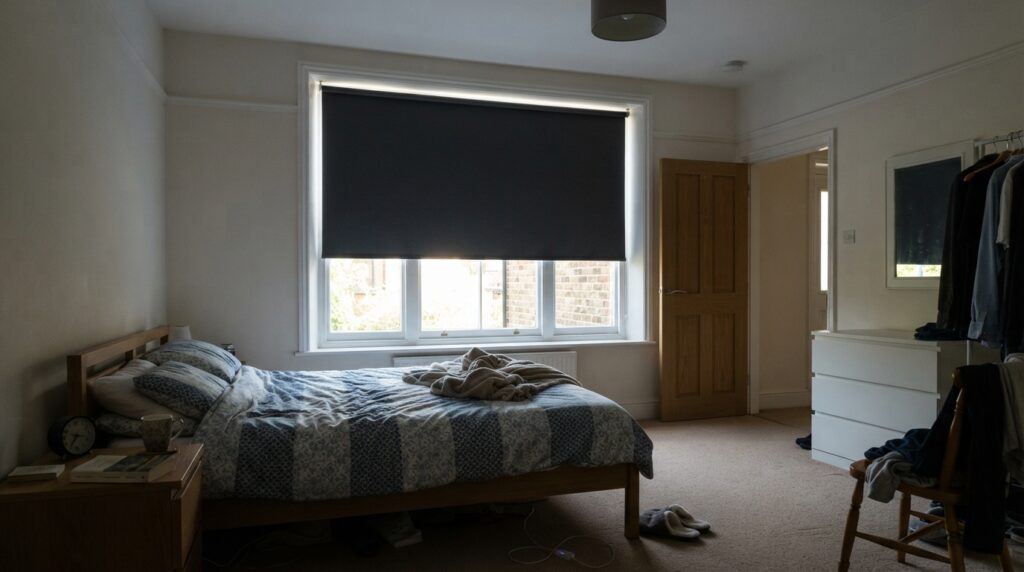
Yes, but less than most people assume, and only if you close them before the room heats up. Here’s the limitation nobody mentions on the packaging: once sunlight has passed through the glass, the energy is already in the room. An internal blind absorbs it and then re-radiates much of that heat inward. It helps — meaningfully — but external shading is substantially more effective, because it stops the energy before it gets through the glass at all. “Blackout” also describes light, not heat: a blind can be completely opaque and still perform poorly thermally.
Blackout blinds are the most common answer to a hot bedroom, and they’re a reasonable one. This is what they can and can’t do.
The physics, briefly
Solar energy arrives as radiation. It passes through glass, hits whatever is behind it, and is absorbed — becoming heat.
If that’s an internal blind, the blind gets hot. It’s now a warm object inside your room, radiating heat into the space and warming the air around it by convection. You’ve intercepted the light, but most of the energy is still on your side of the glass.
An external shade absorbs that energy outside the building, where it’s carried away by moving air. That’s the difference, and it’s why awnings, shutters and external blinds outperform anything fitted inside.
Our external shading guide covers the options and whether the expense is justified.
So what do internal blinds actually achieve?
More than nothing, and worth doing:
- They stop direct sun falling on floors, furniture and beds, which are the surfaces that store heat and radiate it back at you all evening.
- A reflective backing genuinely helps. A blind with a white or metallised outward face reflects a portion back through the glass before it’s absorbed. This is the single most important feature to look for, and it’s what separates a thermal blind from a merely opaque one.
- Fitted close to the glass, they trap a layer of still air, which slows convective transfer. That’s why fit matters as much as fabric.
- They work in winter too, retaining heat rather than blocking it — genuinely dual-purpose, which improves the value calculation.
What to look for
Judging blinds on thermal performance rather than appearance:
- A reflective or light-coloured outward face. The side facing the glass is the side that matters. A dark blind absorbs more and gets hotter.
- A close fit to the recess. Gaps at the sides let air circulate between blind and glass, carrying heat into the room and defeating the still-air layer. A blind fitted inside the recess with minimal side gaps outperforms a wider one hung outside it.
- Honeycomb or cellular construction if you’re buying specifically for thermal performance. These trap air in cells rather than relying on a single layer, and are usually the best-performing internal option.
- Full coverage of the glass, including the top, where hot air collects.
Note that “blackout” is a light-blocking specification. It tells you the fabric is opaque, not that it performs well thermally. Look for thermal or reflective claims specifically.
Thermal or reflective-backed blinds
Works both seasons
Close recess fit
Summer and winter
What to look for: a stated thermal or reflective backing rather than only a blackout rating, a close fit within the window recess, and full coverage including the head of the window. Honeycomb and cellular constructions generally outperform single-layer roller blinds for heat, at a higher price. Measure the recess carefully — fit matters as much as fabric here.
Good for: bedrooms where sleep matters and external shading isn’t practical; renters, since nothing external is altered; and anyone who wants a measure that also helps in winter.
Less good for: rooms with severe solar gain — a west-facing room with large glazing or an unshaded roof lantern needs external shading, and an internal blind alone will disappoint. They also block the light entirely, which is a real cost in a room you use during the day.
Timing is most of the benefit
The commonest mistake, and it’s free to fix.
Close them from mid-morning, before the room heats. Closing a blind at 6pm in a room that has been in full sun since eleven achieves very little — the energy has been arriving for seven hours and is already stored in the walls, floor and furniture.
The corollary: open them at night, along with the windows, once outside is genuinely cooler than inside. That’s when the room sheds its stored heat. Our window timing guide covers judging the crossover, which usually isn’t when people assume.
What outperforms them
Roughly in order of effectiveness:
- External shutters or awnings. The most effective retrofit available. Note that fitting anything to the outside of a building may need permission if you’re leasehold, and consent if the property is listed or in a conservation area — our leasehold guide and heritage guide cover both.
- External blinds or brise-soleil.
- Solar control window film. Applied to the glass, reflecting a portion before it enters. Cheaper than external shading, permanent, and it reduces winter solar gain too — which cuts both ways.
- Deciduous planting or a tree on the sunny side. Shades in summer, admits light in winter. Slow, but genuinely effective and free to run.
- Internal thermal blinds — where this article lands.
Blinds and air conditioning together
If you run a portable unit, shading is what makes it work rather than an alternative to it.
An air conditioner in an unshaded south or west-facing room is fighting continuous solar gain, running constantly and costing accordingly. Shade the glass and the heat load drops, so the unit cycles rather than running flat out — which means lower bills, less noise, and often a smaller unit being sufficient.
Doing it the other way round — buying a bigger machine instead of closing the curtains — is the expensive route to the same place.
Frequently asked questions
Are blackout blinds better than blackout curtains?
Fit matters more than format. A blind fitted tightly in the recess with a reflective backing usually beats a loose curtain, because it traps a still-air layer against the glass. A close-fitting floor-length thermal curtain that overlaps generously at the sides performs comparably. Both should stop above a radiator rather than hanging over it.
Does the colour matter?
On the side facing the glass, yes — lighter and more reflective is better, because it sends energy back out rather than absorbing it. The room-facing side can be whatever you like.
Will they help in winter?
Yes. Glass is the weakest thermal element in most rooms, and a close-fitting blind adds a layer of still air against it. Close at dusk, open during the day to admit solar gain — the opposite of the summer routine.
What about roof windows and skylights?
Upward-facing glass has the highest solar gain of any orientation, so shading matters most there. External or integral blinds designed for roof windows outperform anything you can hang underneath.
Sources
- GOV.UK — Approved Document O: Overheating (shading and solar gain)
- Energy Saving Trust — Windows and doors
- UKHSA — Adverse Weather and Health Plan (keeping homes cool)
- NHS — Heatwave: how to cope in hot weather
Related reading: our external shading guide and thermal curtains guide.
Related guides



Compare blackout and thermal blinds at Amazon UK. Prices and stock move fast in a heatwave, so it is worth checking before you commit.
Browse blinds →