How to Bleed a Radiator Properly (And in What Order)
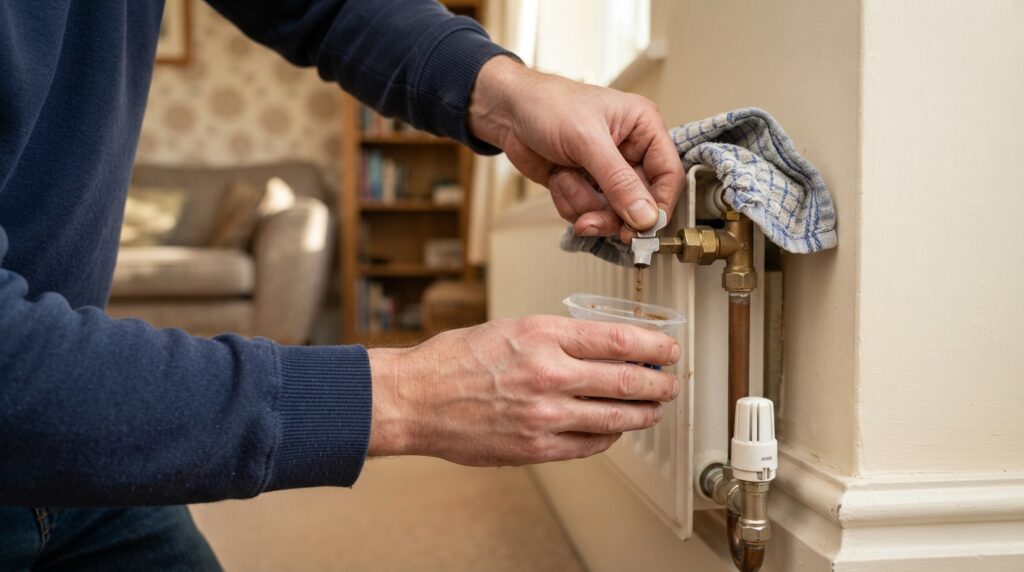
Turn the heating off and let everything cool first — bleeding a hot system risks scalding and doesn’t work as well. Then work downstairs first, and within each floor from the radiator furthest from the boiler back toward it, finishing with the upstairs ones. Open each valve a quarter turn until the hissing stops and water appears, then close it. Afterwards, check your boiler pressure and top up if it’s dropped — this is the step people skip, and it’s why the heating sometimes works worse afterwards.
Bleeding radiators is a genuinely useful thing to know how to do, and most guides skip the two details that matter: the order, and what to do afterwards.
How to tell a radiator needs bleeding
The diagnostic distinction that matters:
- Cold at the top, warm at the bottom → trapped air. Bleeding fixes it.
- Cold at the bottom, warm at the top → sludge and debris settled in the base. Bleeding won’t help; this needs an engineer, and possibly a system flush.
- Cold all over while others are hot → usually a seized thermostatic radiator valve. Pull off the plastic head and check the pin moves freely. Free, and very common.
- Gurgling or banging → air in the system, and worth bleeding.
Our cold room guide covers the full diagnosis if bleeding doesn’t solve it.
Why air gets in
Several routes: air dissolved in the water coming out of solution, small amounts drawn in at pump seals or valves, hydrogen produced by corrosion inside the system, and air introduced whenever the system is drained or topped up.
A small amount is normal. Needing to bleed the same radiator every few weeks is not — that suggests a leak drawing air in, or a corrosion problem, and is worth an engineer’s opinion.
What you need
- A radiator bleed key — a few pounds from any hardware shop. Some modern valves take a flat-blade screwdriver instead
- A cloth and a small container to catch water
- An old towel for the floor
The order — and why it matters
Doing this in a sensible order means you push the air progressively toward the outlets rather than chasing it around the system.
The standard approach:
- Start downstairs. Ground floor before upstairs.
- Within each floor, start with the radiator furthest from the boiler and work back toward it.
- Then go upstairs and repeat the same pattern — furthest first, working back.
- Finish with the radiator nearest the boiler on the top floor.
Air rises, so upstairs radiators — and particularly the highest one in the house — collect the most. Doing them last means you’re not pushing air from downstairs up into radiators you’ve already done.
If you only have one problem radiator and the rest are fine, you can just do that one. The order matters when you’re doing the whole house.
The method
- Heating off, system cool.
- Put the towel down and hold the container under the bleed valve — the small square or slotted fitting at the top of one end of the radiator.
- Insert the key and turn anticlockwise, about a quarter turn. No further. You should hear hissing as air escapes.
- Wait for the hiss to stop and water to appear — usually a dribble rather than a jet. The water is often dirty, hence the towel.
- Close the valve promptly, turning clockwise. Snug, not forced — overtightening damages the seat.
- Wipe up and move on to the next radiator in the order.
The step everyone forgets: check the pressure
This is why some people find their heating worse after bleeding.
Every radiator you bleed releases some water as well as air, which lowers the pressure in a sealed system. Bleed eight radiators and the pressure can drop enough that the boiler won’t fire properly, or shuts down on a low pressure fault.
After you’ve finished: look at the pressure gauge on the boiler. Most combis want somewhere around 1 to 1.5 bar when cold — check your manual for the figure for your model. If it’s low, top up using the filling loop, following the boiler’s instructions. This is a job most people can do, but the manual is the authority, not general advice.
Then turn the heating back on and check every radiator heats evenly. You may find one or two need a second bleed once the system has circulated.
Our boiler prep guide covers pressure and the wider autumn check.
If bleeding doesn’t fix it
- Still cold at the top after bleeding twice → possibly a blocked bleed valve, or air being drawn in continuously. Engineer.
- Cold at the bottom → sludge. Needs flushing, not bleeding.
- Cold all over, others hot → seized TRV or a closed lockshield valve at the other end.
- Upstairs hot, downstairs cold (or vice versa) → possibly a balancing issue across the system, or a pump or diverter valve problem.
- Pressure keeps dropping after topping up → a leak somewhere, or a failing expansion vessel. Get it looked at; repeatedly topping up masks a real fault.
Balancing: the next level
Worth knowing exists, because it’s the answer when bleeding doesn’t help and some rooms just never get as warm as others.
Balancing means adjusting the lockshield valve at the opposite end of each radiator so flow is distributed properly across the system. Radiators nearest the boiler tend to get more than their share otherwise.
It’s fiddly and involves measuring temperature differences across each radiator. Some confident DIYers do it; many people have a heating engineer do it as part of a service. If your house has always had one room that never warms up, it may well be a balancing issue rather than anything broken.
When to do it
Every autumn, as part of the pre-winter test run — turn the heating on for half an hour on a mild September day, see which radiators have cold tops, and bleed those. Finding it then means you’re not discovering it on the first frost.
Also worth doing after any work on the system, after topping up the pressure, and any time you hear gurgling.
Frequently asked questions
Should the heating be on or off?
Off, and cooled. Hot water scalds, and air settles better in a static system. Some guides say to run the heating first to move air to the top, then turn it off and let it cool before bleeding — that’s a reasonable refinement.
How often should I need to do this?
Once a year as routine maintenance is typical. Every few weeks on the same radiator suggests a fault — a leak drawing air in, or corrosion — and is worth an engineer’s opinion.
The water coming out is black. Is that bad?
Dark water indicates corrosion products in the system. A little is normal in an older system; heavily black, sludgy water suggests the inhibitor has depleted and the system may benefit from treatment. Mention it at your next service.
Do I need to bleed towel rails and underfloor heating?
Heated towel rails have bleed valves and are bled the same way — they’re often the highest point in a bathroom and collect air readily. Underfloor heating is a different system with its own air separation arrangements; leave that to an engineer.
What if I don’t have a bleed key?
Many modern valves accept a flat-blade screwdriver. Keys are inexpensive and available from any hardware shop or supermarket — worth having one in the house rather than improvising with pliers, which damages the valve.
Sources
- Energy Saving Trust — Thermostats and heating controls
- Energy Saving Trust — Boilers (system pressure and maintenance)
- Gas Safe Register — Gas Safe Register (finding a registered engineer)
- HSE — Gas safety in the home
Related reading: our boiler prep guide and cold room guide.
Related guides



Compare current prices, stock and reviews on portable air conditioners at Amazon UK. Prices and stock move fast in a heatwave, so it is worth checking before you commit.
Browse air conditioners →