Hay Fever Season 2027: Getting Your Home Ready Before Spring
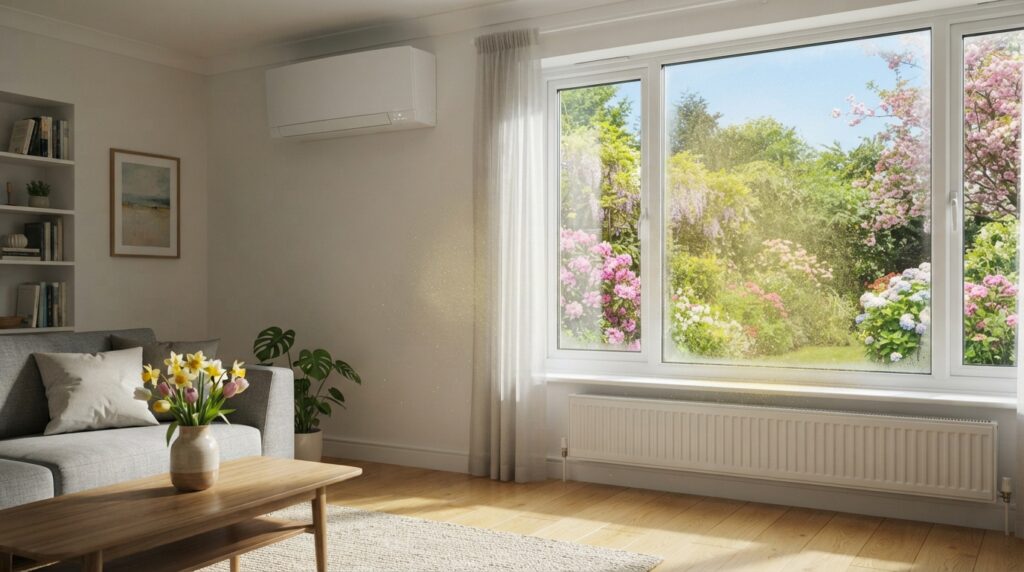
The frustrating bit about hay fever is that the obvious way to cool a house — opening windows — is the worst thing for pollen. That conflict peaks in June, when grass pollen and the first proper warm spell arrive together. Preparing in late winter means you can keep windows shut through the worst weeks without the house becoming unbearable: get filtration sorted, get cooling sorted, and know your pollen type before the season starts.
Adult-onset hay fever is more common than people expect, and plenty of people first develop it in their forties or fifties. If last summer was miserable, February and March are the right time to fix it rather than June.
Know which pollen affects you
This determines your worst weeks, and most people don’t know it.
- Tree pollen — roughly late March to mid-May. Birch is a common culprit.
- Grass pollen — roughly mid-May to July, with two peaks. This affects the largest number of people.
- Weed pollen — roughly late June to September.
If your symptoms start in April, that’s tree pollen and your cooling problem is limited. If they start in late May and run through June, you’re squarely in the window where pollen season and the first heatwave overlap — which is the situation this guide is really about.
The Met Office publishes a pollen forecast during the season, broken down by region and pollen type. Worth using rather than guessing.
The core conflict, and why it needs solving in advance
Standard UK summer cooling advice is to ventilate when the outside air is cooler — typically evening and early morning. Standard hay fever advice is to keep windows shut, particularly in the early morning and evening when pollen counts are often highest.
These are directly incompatible, and in June you’re forced to choose between a hot house and a pollen-filled one.
The way out is to have a way of cooling that doesn’t require open windows. That’s a purchase and an installation, which is why it belongs in February rather than in the middle of a bad week in June — and why it’s worth reading our buying timing guide before prices and stock move.
What an air conditioner does and doesn’t do for pollen
Be clear about this, because listings overstate it.
What it genuinely does: lets you keep windows closed while staying comfortable. That’s the real benefit, and it’s a substantial one — it removes the choice you’d otherwise have to make.
It also reduces humidity as part of cooling, which helps with comfort and with dust mites, a separate common indoor allergen.
What it doesn’t do: filter pollen meaningfully. The mesh pre-filter in a portable air conditioner catches dust and hair, not fine particles at pollen scale. Our air purification guide covers why “air purifying” claims on air conditioner listings usually describe a standard mesh screen.
If you want actual pollen filtration, that’s a dedicated HEPA air purifier, run in the bedroom. The two appliances do different jobs and work well together — the air conditioner keeps you comfortable with the windows shut, the purifier reduces what’s in the air.
The late-winter checklist
- Buy and install cooling before April. Full stock, normal pricing, and time to fit the window kit properly. Our seal kits guide covers the fit — and a well-sealed kit matters doubly here, since gaps admit pollen as well as warm air.
- Prioritise the bedroom. Pollen counts are often highest early morning and evening, which brackets your sleep. A cool bedroom you can keep sealed is the highest-value single room.
- Consider a HEPA purifier for the bedroom if pollen is genuinely disruptive rather than mildly annoying.
- Service what you have. Clean or replace air conditioner filters, and check any purifier filters — see our maintenance guide. A filter that sat damp over winter is a mould risk, covered in our storage guide.
- Fit or check fly screens if you’ll want any ventilation. They don’t stop pollen, but they let you ventilate at genuinely low-pollen times without other problems.
- Plan the garden. If you’re planting in spring, some grasses and trees are worse than others for pollen. Late winter is when those decisions get made.
- Talk to a pharmacist in early spring, not mid-season. Antihistamines are often more effective started before symptoms peak.
Household habits that genuinely help
- Dry washing indoors during high-pollen weeks. Laundry on a line acts as a pollen trap, and you then bring it inside and sleep in it. This is one of the highest-impact changes and it costs nothing — though be aware of the damp implications, covered in our condensation guide.
- Shower and change before bed on high-count days. Pollen on hair and clothes ends up on your pillow.
- Keep bedroom windows shut, particularly early morning and evening.
- Vacuum with a HEPA-filtered cleaner and damp-dust rather than dry-dusting, which redistributes particles.
- Wipe down pets after they’ve been out — they carry a surprising amount in.
- Keep car windows shut and use recirculate; check the cabin filter, which is often years old.
The picks
MeacoCool MC Series 9000
Best bedroom option
51–55 dB
~£349
App control
Right-sized for most UK bedrooms up to around 25m², quiet enough to sleep next to, with an easily accessible washable filter. The point of this purchase for a hay fever sufferer is that it lets you keep the bedroom sealed and still sleep comfortably in June — not that it filters pollen, which it doesn’t.
Pro Breeze 7000 BTU
Smaller rooms, lowest running cost
53 dB
~£296
~19p/hr
For a smaller bedroom up to around 20m², and the cheapest of our picks to run — which matters if you’ll be running it most nights through May and June rather than only during a heatwave.
Why 2027 is worth preparing for properly
Two reasons beyond the usual.
NOAA has El Niño at a greater than 90% chance of reaching very strong for autumn and winter 2026–27, and global temperature typically peaks in the year after an El Niño peaks — putting 2027 in an elevated window. Our Summer 2027 guide covers this properly, including the caveat that El Niño’s direct UK signal is weak.
And separately: UK heat has been arriving earlier. May 2026 brought a heatwave from the 24th to the 27th, with 31.5°C recorded at Kew Gardens. That’s squarely inside grass pollen season, which is exactly the overlap this guide exists to solve.
Frequently asked questions
Can you develop hay fever in middle age?
Yes — adult-onset hay fever is common, and plenty of people first develop it in their forties or fifties. If you’ve started reacting to something you never used to, that’s not unusual and a pharmacist can advise.
Does an air conditioner filter pollen?
Not meaningfully. The standard mesh filter catches dust and hair, not particles at pollen scale. Its value is letting you keep windows shut comfortably. For actual filtration you want a dedicated HEPA purifier.
When should I start taking antihistamines?
A pharmacist can advise, but starting before your season peaks is often more effective than waiting for symptoms. That’s another argument for planning in late winter rather than reacting in June.
Is it worth a purifier as well as an air conditioner?
If pollen genuinely disrupts your sleep, yes — they do different jobs and work well together. Site the purifier away from the air conditioner’s direct airflow so it samples room air rather than the unit’s output.
Compare current prices, stock and reviews on portable air conditioners at Amazon UK. Buying before spring means normal prices and full availability.
Sources
- NHS — Hay fever (symptoms, treatment, avoidance advice, when to see a GP)
- Met Office — Pollen forecast (regional forecast and pollen calendar)
- Met Office — Pollen season (tree, grass and weed pollen timing)
- Asthma + Lung UK — Hay fever and asthma
- NOAA Climate Prediction Center — ENSO Diagnostic Discussion
- UKHSA / GOV.UK — Heat mortality monitoring report, England (May 2026 heatwave)
Related reading: our allergies and asthma guide and air purification guide.