Best Air Conditioner for a Loft Conversion Bedroom (UK)
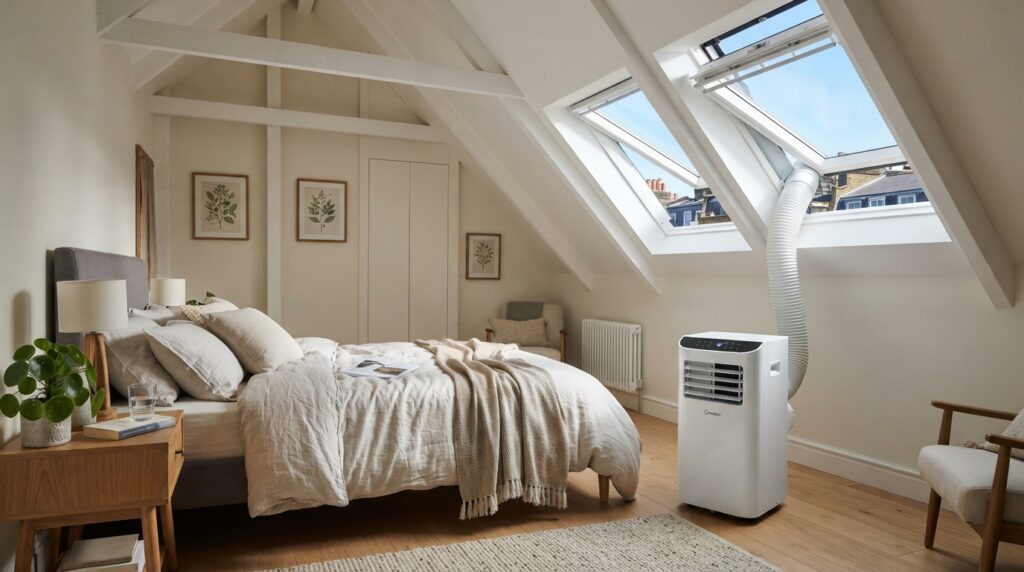
A compact, single-hose portable air conditioner is generally the most practical fit for a loft conversion bedroom — the low headroom and often limited floor space around the eaves rule out anything bulky. The genuine catch is venting: many loft conversions only have a roof window (often a Velux-style window that opens on a hinge rather than sliding), and a standard window kit isn’t always straightforward to fit to that kind of window, so check exactly how your specific roof window opens and whether a hose kit will actually seal against it before you buy, rather than assuming it’ll just work like a normal wall window. Noise is also worth weighing more carefully than usual, since a loft bedroom is often a smaller, more enclosed space than a typical room, and a ceiling fan may not physically fit near the sloped eaves — making the unit’s own air circulation more important than it would be in a regular room. For the reasons your loft bedroom runs hotter in the first place, see our loft conversion heat guide.
If you already know why your loft conversion bedroom runs hotter than the rest of the house, this page picks up from there — what to actually buy, and the practical snags specific to a loft space that are worth knowing before you order anything.
Why compact and single-hose usually wins here
A compact, single-hose portable air conditioner
Fits low headroom and tight floor space
Simpler venting than dual-hose
Easier to reposition around sloped ceilings
Loft conversion bedrooms typically have less usable floor space than their square footage suggests, once you account for the sloped ceiling reducing standing and storage room around the edges. A compact, single-hose unit takes up less of that limited space and is generally easier to position and move than a larger dual-hose model, which matters more here than the small efficiency gap between the two styles in genuinely hot conditions.
Good for: tight floor space around sloped eaves; simpler single-hose venting; easier to reposition as needed.
Less good for: the very hottest days, where a dual-hose unit’s slight efficiency edge would show more — though for most UK summers this is a minor trade-off against the space saved.
Check your roof window before you buy, not after
Noise matters more in a small, enclosed loft room
A loft bedroom is often smaller and more enclosed than other rooms in the house, with less air volume to disperse sound and sometimes softer furnishings that don’t absorb noise as well as a larger, more open room might. This makes the unit’s noise level, and specifically the difference between continuous and cycling noise, worth paying closer attention to than usual — particularly if the room is used for sleeping, where a compressor cycling on and off through the night is more likely to be noticeable at close range in a small space.
The unit’s own air circulation matters more here
In a typical room, a separate ceiling or pedestal fan often works alongside an air conditioner to keep air moving. In a loft conversion bedroom, a ceiling fan frequently doesn’t physically fit near the sloped eaves where headroom is lowest, and a pedestal fan takes up floor space that’s already limited. This makes an air conditioner’s own built-in air circulation — how well it moves cooled air around the room on its own, without a separate fan helping — more important in a loft bedroom than it would be in a room where a fan is an easy addition.
Check the electrical circuit before assuming it’ll cope
Loft conversions are sometimes wired on a single new circuit added during the conversion, which may already be running lighting, sockets and other loft-specific electrics. A portable air conditioner draws meaningful power while running, and if you’re at all unsure whether your loft’s circuit has the capacity for it alongside everything else already on it, that’s a question for a qualified electrician rather than something to find out by tripping a breaker on the hottest day of the year.
Watch for the hose kinking against a sloped ceiling
A loft bedroom’s sloped ceiling can create an awkward routing path between the unit and the roof window, especially if the unit needs to sit some distance away from the window to leave you headroom to move around it. A hose that’s bent too sharply or kinked to make that route work loses efficiency, since a restricted hose makes the unit work harder to expel the same amount of warm air — a similar effect to a clogged filter. Where the room allows it, position the unit as directly in line with the window as possible and avoid tight bends in the hose; most kits have some flexibility in length and a swivel fitting at the window end, which helps, but there are limits to how sharply a hose can bend before it meaningfully restricts airflow.
A unit doesn’t fix poor insulation on its own
Buying the right air conditioner solves the immediate problem, but if your loft conversion’s insulation is genuinely thin, as covered in our loft conversion heat guide, no air conditioner works in isolation forever — it’ll simply run more, and more often, fighting a room that keeps regaining heat through the roof. If you’re planning any wider loft renovation work, improving roof insulation alongside buying a unit tackles the problem from both directions, rather than relying on cooling power alone to compensate.
Frequently asked questions
Will a standard window kit fit a Velux-style roof window?
Not always — it depends on exactly how your specific roof window opens and the gap it leaves. Check carefully before buying, and be prepared that some adaptation, similar to fitting a sash window, may be needed.
Is a single-hose or dual-hose unit better for a loft conversion?
Single-hose is usually the more practical choice for the limited floor space and lower headroom typical of a loft bedroom, even though a dual-hose unit is marginally more efficient in the very hottest conditions.
Do I need an electrician to run an air conditioner in a loft conversion?
Not necessarily, but if you’re unsure whether the loft’s electrical circuit has the capacity for it alongside existing lighting and sockets, that’s worth checking with a qualified electrician before relying on it.
Sources
- Energy Saving Trust — Keeping your home cool in summer
- Health and Safety Executive — Electrical safety
Related reading: our loft conversion heat guide and sash window and period property guide.
Compare current compact, single-hose options at Amazon UK.