Best Air Conditioner for a Sash Window or Period Property (UK)
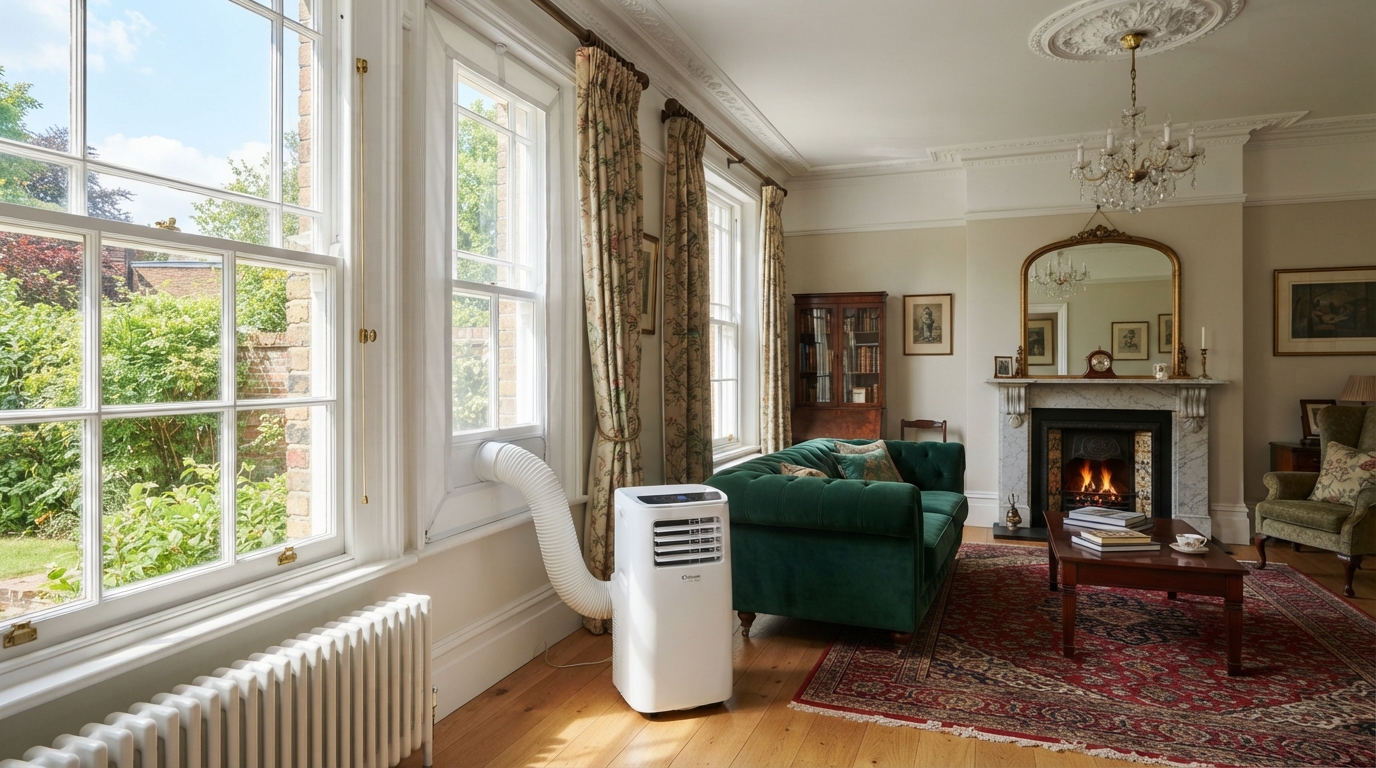
The unit itself doesn’t need to be anything special — a standard single or dual-hose portable air conditioner works fine in a period property. The real challenge is venting the hose through a sash window, because standard window kits are designed for horizontally-opening casement windows, and a sash window slides vertically. Propping a sash window open a few inches leaves a horizontal gap along the bottom, which a casement-style bracket kit generally isn’t shaped to seal against properly. The practical fix is usually a universal or adjustable venting kit designed to seal against a flat horizontal gap, or a simple cut board or panel insert sized to your specific window opening. If your property is listed or in a conservation area, that’s a separate legal question from the venting mechanics covered here — our listed building consent guide covers that side.
Sash windows are one of the most common points of confusion when fitting a portable air conditioner in an older property, and it’s a purely mechanical problem rather than anything to do with the unit’s specification — here’s how to think it through.
Why standard window kits don’t fit a sash window properly
The window kit that comes with most portable air conditioners is designed around a casement window — one that opens outward or inward on a hinge, leaving a rectangular gap the bracket is shaped to fit into and seal against, usually adjustable across a horizontal range. A sash window works completely differently: it slides up and down within its frame, so propping it open leaves a long, thin horizontal gap along the bottom rather than the kind of opening a casement bracket expects. Forcing a standard kit into that gap rarely seals well, which means warm air leaks back in around the edges and the unit works harder than it should for the same result.
What actually works instead
A universal or adjustable venting kit rated for horizontal gaps
Designed for sliding sash and similar windows
Adjustable to fit varying gap widths
Works alongside most single or dual-hose portable units
Rather than the bracket-style kit designed for casement windows, look specifically for a universal or adjustable venting panel described as suiting sliding sash, uPVC vertical sliders, or similar window types — these are designed to seal against a horizontal gap rather than assuming a hinged opening. Measure your specific window’s width and the gap you’re comfortable leaving before buying, since sash window widths vary considerably between properties.
Good for: genuine sash and other vertical-sliding windows; adjustable across a reasonable range of widths; no permanent alteration to the window itself.
Less good for: unusually narrow or very wide sash openings, where a custom-cut panel may seal better than an adjustable universal kit.
A custom-cut panel is often the neatest solution
For a genuinely tidy fit, some owners have a thin board or acrylic panel cut to the exact width and height of their sash window’s opening, with a hole for the hose, and simply rest it in the gap when propping the window open — removed entirely when not in use, with no lasting mark on the window or frame. This avoids relying on an off-the-shelf kit’s adjustability altogether and can give a noticeably better seal, at the cost of a bit more upfront effort to get the measurements and cut right. Thin plywood, MDF offcuts or rigid foam board are all reasonably easy to cut accurately with ordinary tools; whichever you choose, measure twice and start the hose hole slightly undersized so you can enlarge it gradually to a snug fit, rather than risking an oversized hole you can’t easily correct.
A better seal also means a lower running cost
Whichever venting method you use, the quality of the seal around the hose matters more than it might seem. Any gap left around a poorly fitted kit or an improvised panel lets warm outdoor air leak back in and lets some of the cooled indoor air escape, which makes the unit run longer to hold the same temperature. Taking the time to get a proper, snug seal — whether that’s a well-fitted universal kit or a carefully measured custom panel — genuinely pays for itself in lower running costs over a full summer, on top of simply cooling the room more effectively in the first place.
What about the legal side?
Period properties often have other cooling challenges too
Beyond the window-venting mechanics, older properties often come with single-glazed sash windows, which do relatively little to keep summer heat out compared to modern double glazing. If heat gain through the glass itself is a significant part of the problem, not just where to vent a hose, our secondary glazing guide covers a period-appropriate way to improve on that without necessarily replacing the original windows.
Frequently asked questions
Will a standard air conditioner window kit fit a sash window?
Usually not well — standard kits are designed for hinged casement windows and don’t seal properly against the horizontal gap a sash window leaves when propped open. A universal adjustable kit or a custom-cut panel generally works much better.
Do I need permission to vent an air conditioner through a sash window?
It depends on your property — if it’s listed or in a conservation area, that’s worth checking separately. A temporary, removable panel that doesn’t alter the window is generally lower-risk, but see our listed building consent guide for the specifics.
Is a custom-cut panel better than a universal kit?
It can give a neater, better seal since it’s sized to your exact window, but it takes more upfront effort to measure and cut correctly. A universal adjustable kit is a simpler starting point for most people.
Sources
- Historic England — Energy efficiency in traditional homes
- Energy Saving Trust — Keeping your home cool in summer
Related reading: our listed building consent guide and secondary glazing guide.
Compare current portable air conditioners and universal window kits at Amazon UK.