How Long Do Portable Air Conditioners Last? (UK)
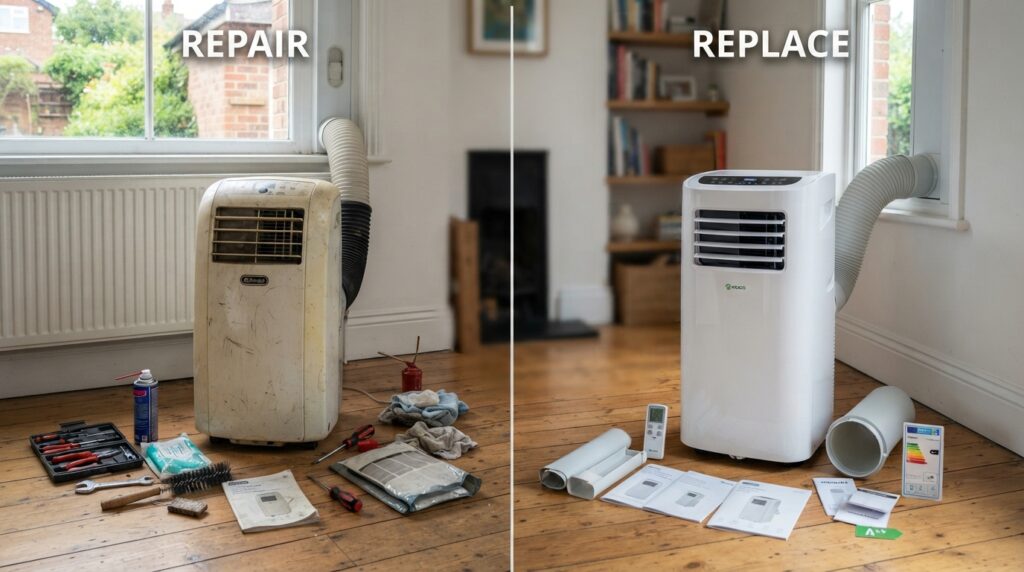
There’s no single honest number here — a portable air conditioner’s real-world lifespan depends far more on how it’s used, maintained and stored than on any fixed figure a box or listing might quote. The single biggest factor is the compressor, the sealed component that does the actual cooling and is expensive or impossible to repair if it fails. What genuinely extends a unit’s working life: light-to-moderate seasonal use rather than near-constant running, regular filter cleaning, keeping it away from dust and pet hair, and proper off-season storage rather than leaving it damp in a cold shed. Watch for the warning signs below rather than a calendar date, and you’ll get a realistic read on when a unit is genuinely reaching the end of its life.
“How long will this last?” is one of the fairest questions to ask before buying — and one of the hardest to answer with a single number, because it genuinely depends on the factors below more than the model itself.
The compressor is what actually limits the lifespan
Inside every air conditioner is a sealed refrigerant circuit, and the compressor is the heart of it — the component that does the actual work of cooling. It’s also the part that’s essentially never economical to repair if it fails: a failed compressor usually means the unit is done, since replacing one costs close to (or more than) buying a new unit. Everything else on a portable air conditioner — the fan, the filter, the casing, the control board — is either replaceable or far less critical to the unit’s core function. So when people ask how long a unit “lasts,” what they’re really asking is how long the compressor keeps working reliably, and that’s driven by the factors below rather than a fixed clock.
What actually determines how long yours will last
- How hard it’s worked. A unit run occasionally through a few warm weeks each summer has an easier life than one run near-continuously through long, hot stretches, or used year-round in a room that needs cooling regardless of season (a server cupboard, a south-facing home office).
- Filter maintenance. A clogged filter restricts airflow across the coil, forcing the compressor and fan to work harder for the same cooling effect — this is one of the most controllable factors, and cleaning the filter regularly is genuinely one of the best things you can do for longevity. Our maintenance guide covers how and how often.
- Dust and pet hair. A dusty room or a home with pets means the filter and internal coil clog faster, so the unit works harder between cleans — more frequent filter checks help in these environments.
- Off-season storage. Leaving a unit damp, uncleaned, or in a cold, humid shed over winter shortens its working life through corrosion, mould in the internals, and cold-affected compressor oil. Our winter storage guide covers doing this properly.
- Build quality of the specific model. This varies between manufacturers and price points, and isn’t something we’ll put a figure on here — but it’s a genuine factor, which is one reason checking reviews for reliability (not just cooling performance) is worth doing before you buy.
Signs a unit is genuinely reaching the end of its life
Rather than a date, watch for these signs — they’re a far more reliable indicator than an assumed lifespan:
- Declining cooling power despite a clean filter. If you’ve cleaned the filter and coil and it still isn’t cooling like it used to, that points to something internal — often refrigerant-related — rather than routine maintenance.
- Unusual noises — grinding, knocking or a new persistent rattle from the compressor area, rather than the normal hum and occasional click of the compressor cycling.
- Error codes that recur even after following the manual’s troubleshooting steps.
- Ice forming on the coil repeatedly despite normal conditions — see our freezing-up guide, since this sometimes points to a genuine fault rather than a fixable setup issue.
- Persistent water leaks not explained by the everyday causes in our leaking-water guide.
Repair or replace?
When a unit does develop a genuine fault, the decision usually comes down to a few practical questions:
- Is it still under warranty? Warranty lengths vary by manufacturer and model — check the documentation for your specific unit rather than assuming a standard figure. If it’s covered, contact the manufacturer or retailer first.
- What’s the likely repair cost versus a new unit? A compressor fault on an out-of-warranty unit, especially a budget model, often costs close to the price of replacing it entirely — at which point a repair rarely makes financial sense.
- Are parts even available? Older or discontinued models can be hard to source parts for, which tips the decision toward replacement.
If you do replace it, dispose of the old one properly rather than binning it — our disposal and recycling guide covers the routes, including selling or donating it if it’s simply nearing the end of its life rather than fully broken.
Getting the most out of the one you have
- Clean the filter every couple of weeks during heavy use, more often in a dusty home.
- Keep the area around the unit clear so air can flow freely in and out.
- Store it properly over winter rather than leaving it running down in a cold garage.
- Address small issues (a slow leak, a minor noise) early rather than letting the unit run compromised for a whole season.
Frequently asked questions
What’s the average lifespan of a portable air conditioner?
There’s no reliable single figure — it depends heavily on how intensively it’s used, how well it’s maintained, and how it’s stored between seasons. A well-maintained unit used moderately and stored properly will outlast a neglected one used hard and left damp over winter by a wide margin.
What usually fails first on a portable air conditioner?
The compressor is the component whose failure typically ends a unit’s working life, since it’s rarely economical to replace. Filters, fans and hoses are comparatively minor, replaceable parts.
Does regular maintenance really make a difference?
Yes, genuinely — a clean filter and coil mean the compressor and fan don’t have to work as hard for the same cooling effect, which is one of the most controllable factors in how long a unit lasts.
Sources
- Energy Saving Trust — Keeping your home cool in summer
- Recycle Now — What to do with electrical items
Related reading: our full maintenance guide and disposal and recycling guide.
Regular filter care is the single best thing you can do for a longer-lasting unit. Compare current options at Amazon UK.