Cooling Help for People With Limited Mobility or a Disability
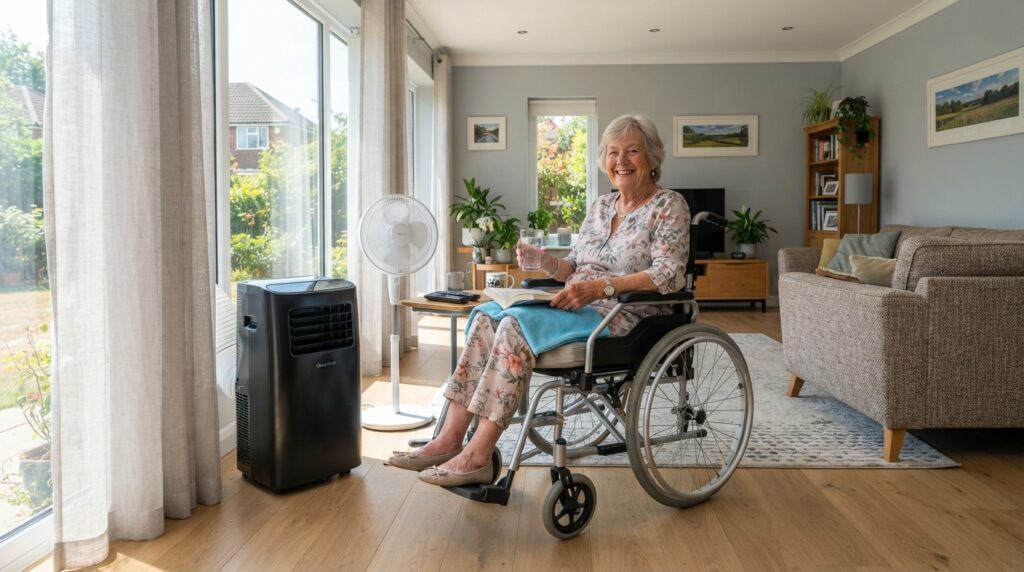
For someone with limited mobility or a disability, heat can be more than uncomfortable — it can be a genuine health risk, because the usual ways people cope (moving to a cooler room, adjusting clothing, getting up for a cold drink, opening and closing windows through the day) may be harder or not possible, and some conditions and medicines affect how the body handles heat. So the aim is cooling that works reliably without constant management: a unit or fan with simple, reachable controls or a remote, timer or voice control; a setup with no trip hazards from hoses and cables; and, where opening blinds and windows is difficult, automation or a helping hand to do the passive things. There’s also real financial and practical support worth knowing about — from the Priority Services Register to Disabled Facilities Grants — that many people don’t realise they can access.
This guide is about making cooling manageable and reliable for someone who can’t easily fuss with it through the day — and about the support that exists. It’s written to be practical; the health specifics belong with the professionals signposted throughout.
Why heat can be a bigger risk
Staying cool in a British home usually assumes a level of moving about — drawing the blinds before the sun hits, opening windows at the right time, closing up in the morning, fetching cold drinks, moving to the coolest room. For someone with limited mobility, chronic illness or a disability, some of that may be difficult or impossible, so the heat builds with fewer ways to escape it. On top of that, some health conditions and some medications genuinely change how the body regulates temperature or manages hydration — which is exactly why heatwave health advice singles out disabled and less-mobile people, alongside older people, as more at risk. That’s a matter for a GP or pharmacist to advise on individually; the point here is that reliable, low-effort cooling matters more, not less, for these households.
Cooling that doesn’t need constant management
The priority is a setup that holds a comfortable temperature without someone having to keep adjusting it:
- Thermostatic control. An air conditioner set to a target temperature (around 24°C is sensible) maintains it on its own — unlike a plain fan, which needs no management but doesn’t lower the temperature. Our set-temperature guide covers getting the settings right once, so it can be left.
- A remote control, and large, simple buttons. Being able to adjust it from a chair or bed matters. Some units have clearer displays and simpler controls than others — worth prioritising over features that add complexity.
- Timers and scheduling so the room is cool at the times it’s needed without anyone having to switch it on — pre-cooling before the hottest part of the day, for instance.
- Voice and smart control. For someone with limited hand mobility or reach, being able to turn cooling on or adjust it by voice, or through a phone or smart speaker, can be genuinely enabling. A voice-controlled fan or a smart-controlled air conditioner removes the need to reach a switch — and a smart plug can add scheduling and voice control to a fan safely (note the load warnings in that guide before using one on an air conditioner).
Safety and the physical setup
Other practical points:
- Weight and moving it. Portable units are heavy (often 25–35kg) and awkward to shift — a real issue if it needs moving between rooms or storing. A lighter unit, a fixed install, or leaving it set up in the main room avoids the problem. If it does need moving, get help rather than lifting it alone, and our guide to the easiest portable air conditioners for older adults is a good place to compare simpler units.
- Draining. Set up continuous drainage so nobody has to lift and empty a heavy water tank — and so the unit doesn’t shut off unattended.
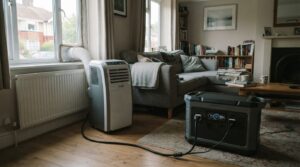
- Plug it straight into the wall, not a trailing extension lead, as our overnight running guide explains — both an electrical-safety and a trip-hazard point.
Making the free measures happen anyway
Shading and ventilation do most of the cooling, but they usually need someone to open and close things at the right times. Where that’s difficult, there are ways to keep the benefit:
- Motorised or remote-control blinds can be operated from a chair or on a timer, so the room is shaded without reaching the window.
- Set the room up once for the day. If opening and closing through the day isn’t practical, a helper can shade and seal the room in the morning and set the cooling, so it holds through the day — the pre-cool-and-coast approach in our no-AC cooling guide.
- A carer, family member or neighbour doing the daily open-up-at-night, close-in-the-morning routine makes a big difference, especially during a heatwave.
- Choose the coolest accessible room to spend the hottest hours in — a north-facing, ground-floor room ideally, so there are no stairs and no direct sun.
Financial and practical support worth knowing about
This is the part many people miss, and some of it is specifically relevant to disability:
- The Priority Services Register. Free, and genuinely valuable. Run by energy network operators and suppliers, it provides extra support — including advance warning of planned power cuts and priority help during unplanned ones — for people with a disability, a long-term health condition, or reliance on powered medical equipment. In a heatwave, a power cut that takes out cooling or medical equipment is a serious matter, so register with both the network operator and the energy supplier (separate lists), ideally before you need it. Our power cut guide covers the wider situation.
- Disabled Facilities Grants. Local councils administer these grants for adaptations that help a disabled person live safely and independently at home. They’re means-tested and assessed case by case by an occupational therapist. They’re primarily for things like ramps, stairlifts and bathroom adaptations — but whether temperature control could form part of an assessment is a question for an OT and your council, not something to assume the answer to. If someone in the household has a condition genuinely affected by heat, it is worth raising rather than assuming it’s a no. Start with the council’s adult social care team. Our grants guide covers this in more detail.
- Charitable grants. Some charities provide grants for household essentials, often linked to a specific condition, occupation or circumstance. Turn2us runs a free grants search worth a look if money is tight.
- Occupational therapy assessment. An OT can advise on the home environment and what support is available — a route in via your GP or the council’s adult social care team.
Check-ins matter
During a hot spell, a regular check on a less-mobile relative, friend or neighbour — are they cool enough, drinking enough, is the cooling working — is one of the most valuable things anyone can do, because the people most at risk are often least able to sort it themselves or raise the alarm. Watch for the signs of heat exhaustion, keep an eye on the Heat-Health Alerts, and our guide to keeping older relatives cool covers much that applies here too.
Frequently asked questions
What’s the best cooling for someone who can’t move around much?
Cooling that holds a temperature on its own with minimal management — an air conditioner set to a target and left, ideally with a remote, timer or voice control, and no trailing hoses or cables to trip on. A fixed installation removes the hose-and-cable hazard entirely.
Can I get help paying for cooling?
Possibly. Register on the Priority Services Register (free) for extra support in power cuts. Disabled Facilities Grants from your council are means-tested and assessed by an occupational therapist — whether temperature control could feature is worth raising rather than assuming not. Turn2us lists charitable grants. Our grants guide has the detail.
Are trailing hoses and cables really a problem?
Yes — they’re a genuine falls risk, especially with a walking aid or wheelchair. Route and secure cables, keep hoses clear of walkways, or choose a fixed installation that has no trailing hose. Keep controls and a phone within reach.
Does the heat affect medicines or conditions?
It can, and it’s individual — some conditions and medicines affect how the body handles heat, and some medicines have storage limits a hot room can exceed. Ask a pharmacist or GP, follow the leaflets, and never stop a prescribed medicine because of the weather without advice. Our food and medicine safety guide covers storage.
What can family or carers do?
Set the room up each day (shade, seal, cooling on), do the open-at-night, close-in-the-morning routine, check in during hot spells, make sure controls and drinks are within reach, and help register on the Priority Services Register. Regular check-ins are one of the most valuable things.
Sources
- NHS — Heat exhaustion and heatstroke
- Ofgem — Priority Services Register
- GOV.UK — Disabled Facilities Grants
- Turn2us — Grants search
- UKHSA — Adverse Weather and Health Plan
Related reading: our keeping older relatives cool guide and grants guide.
A unit with a remote and a thermostat holds a comfortable temperature without constant adjusting. Compare current options at Amazon UK.