Are There Noise Restrictions on Air Conditioning Units? (UK)
Yes — and they come from two separate directions. First, planning: the permitted development rules that let you install an outdoor unit without a full application come with a noise condition, and if the unit is too loud at the neighbouring property it can fall outside permitted development and need permission. Second, and independently, statutory nuisance: under environmental protection law a council can act against a noisy unit regardless of its planning status — a neighbour complains to environmental health, and if the noise is judged a nuisance the council can serve a notice requiring it to be abated. There are no simple “you’re allowed X decibels” numbers to quote, because it’s assessed against the background noise level at the affected property. A portable unit indoors only makes noise in your own home, so this mostly concerns fixed outdoor units.
Air conditioning noise is one of the commonest sources of neighbour friction as units become more popular, so it’s worth understanding both regimes before you install — and knowing your options if it’s a neighbour’s unit troubling you.
First: does this even apply to your unit?
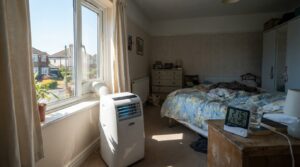
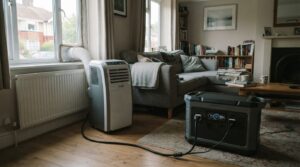
The noise rules that matter here are almost entirely about fixed outdoor units — the condenser of a split system, or an external heat pump — because those make noise that carries to neighbouring properties. A portable air conditioner sits inside your own room and vents through your own window; the only person it disturbs is you (and possibly your own household through a wall). So if you’re using a portable unit, this is mostly not your concern — our quiet bedrooms guide covers keeping a portable’s noise down for your own comfort.
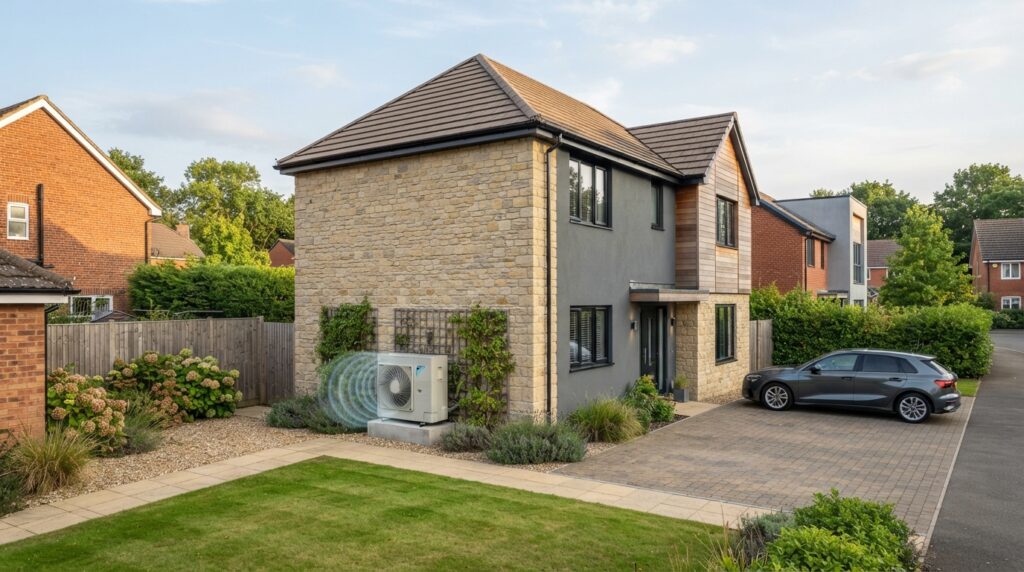
Where it matters is a fixed installation with an outdoor unit near a boundary or a neighbour’s window.
The planning noise condition
In England, installing an outdoor air conditioning or heat pump unit on a house can fall within permitted development — no full planning application — but only if a set of conditions is met, and one of those conditions is about noise. In broad terms, the unit’s noise as experienced at the nearest neighbouring habitable room has to stay within a limit, and installations are expected to be assessed to a recognised methodology to demonstrate that.
We deliberately don’t quote a specific decibel figure, for the same reason we don’t on our air conditioning planning guide: the assessment is made relative to the existing background noise at the affected property, not against a single universal number, and the detailed rules are fact-specific and change. What matters practically is:
- If the unit is too loud at the neighbour, it falls outside permitted development and would need a planning application — which could be refused.
- A competent installer should assess this before siting the unit, using the recognised methodology, and keep the paperwork.
- Conservation areas, listed buildings, flats and Article 4 areas change the permitted development position anyway — our planning guide covers those.
- The devolved nations have their own regimes.
Statutory nuisance: the separate, ongoing route
This is the one that catches people out, because it applies even if the installation had planning permission or was permitted development. Under the Environmental Protection Act 1990, noise that unreasonably interferes with someone’s use and enjoyment of their home can be a statutory nuisance, and local authorities have a duty to investigate complaints.
How it works in practice:
- A neighbour complains to the council’s environmental health team about the noise.
- The council investigates — often asking the complainant to keep a diary, and sometimes monitoring the noise — and forms a judgement about whether it amounts to a statutory nuisance. That judgement considers things like how loud it is relative to the surroundings, the time of day (night-time running weighs more heavily), how often and how long it runs, and the character of the area.
- If they decide it is a nuisance, they can serve an abatement notice requiring it to be stopped or reduced — which might mean anti-vibration measures, re-siting, restricted running hours, or in some cases removal.
- Ignoring an abatement notice is an offence and can lead to prosecution and fines.
The key point: “it’s permitted development” is not a defence against a nuisance complaint. A unit can be entirely lawful to install and still be required to quieten down if it’s genuinely disturbing a neighbour.
If you’re installing a unit — avoiding the problem
Almost all noise disputes are avoidable with sensible siting and a quiet unit. Before installation:
- Site it away from neighbours’ windows and boundaries — especially bedroom windows, since night-time noise is judged most harshly. A unit at low level on a rear elevation away from the boundary is far less likely to cause trouble than one high on a party wall.
- Use anti-vibration mounts. A lot of “noise” is actually vibration transmitted into the building structure. Proper anti-vibration feet or pads make a real difference, and are cheap insurance.
- Choose a quiet unit. Manufacturers publish sound power/pressure figures — a quieter model is worth the premium if the siting is at all tight.
- Consider running hours. A schedule that avoids the quietest overnight hours, where practical, reduces the risk of complaint.
- Get the installer to do a noise assessment and keep the records, so you can demonstrate the permitted development condition was met.
- Talk to your neighbours first. Not a legal requirement, but the single most effective way to avoid a dispute — people tolerate a unit they were consulted about far more readily than one that appeared overnight.
If it’s a neighbour’s unit disturbing you
- Talk to them first. Many people don’t realise their unit is a problem, and a friendly word — perhaps suggesting anti-vibration mounts or a service — resolves most cases. A rattling or droning unit is often a fault or a loose mounting rather than normal operation.
- Keep a record. Note when the noise happens, how long, and how it affects you. A diary is what environmental health will ask for.
- Complain to environmental health if talking doesn’t work. The council has a duty to investigate potential statutory nuisance, and can act regardless of the unit’s planning status.
- Raise planning separately if relevant. If you think the unit was installed without required permission, or breaches its permitted development noise condition, that’s a planning enforcement question for the LPA — a different route to the nuisance one, and you can pursue both.
A note on domestic heat pumps
The same framework applies to air-source heat pumps, which are becoming far more common and have the same kind of outdoor unit. If anything the issue is more prominent for heat pumps because they typically run through the night in winter, when background noise is lowest and disturbance is judged most seriously. The siting, anti-vibration and quiet-unit points all apply equally — our heat pump guide covers them in a heating context.
Frequently asked questions
Is there a legal decibel limit for an air conditioning unit?
Not a single universal number. Planning conditions and nuisance assessments are made relative to the background noise at the affected property and the time of day, not against one fixed figure — which is why an installer assesses it case by case.
My neighbour’s AC keeps me awake — what can I do?
Talk to them first; it’s often a fault or loose mounting they’d want to fix. If that fails, complain to your council’s environmental health team, who can investigate it as a potential statutory nuisance and act regardless of the unit’s planning status. Keep a diary of the disturbance.
Does having planning permission mean my unit can’t be complained about?
No. Statutory nuisance is separate from planning — a lawfully installed unit can still be required to quieten down if it’s genuinely disturbing a neighbour. Planning permission is not a defence against a nuisance notice.
Do noise rules apply to a portable air conditioner?
Not in this sense — a portable unit only makes noise inside your own home, so it doesn’t affect neighbours. The rules here concern fixed outdoor units. For your own comfort, see our quiet units guide.
How do I avoid a noise dispute when installing one?
Site the outdoor unit away from neighbours’ windows and boundaries, use anti-vibration mounts, choose a quiet model, have the installer do a noise assessment, and — most effective of all — talk to your neighbours before it goes in.
Sources
- Planning Portal — Air source heat pumps and outdoor units
- GOV.UK — Noise nuisances: how councils deal with complaints
- Legislation.gov.uk — Environmental Protection Act 1990, Part III (statutory nuisance)
- GOV.UK — Resolving neighbour disputes
Related reading: our planning permission guide and noisy neighbour AC guide.
Anti-vibration mounts cut a lot of the noise that travels into the building. Compare current options at Amazon UK.