My Neighbour’s Air Conditioning Is Too Noisy: What Can I Actually Do?
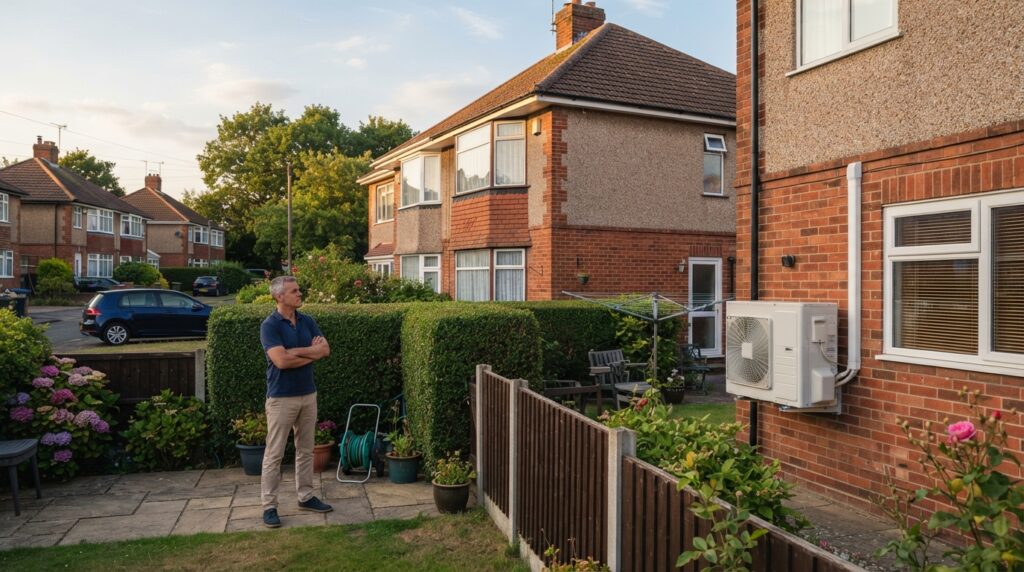
You have real options, and they escalate. Start with a conversation — a genuinely large proportion of these are resolved by the neighbour simply not realising, and a fault or loose mounting is often the cause. If that fails, your council’s environmental health team is the main route: noise that unreasonably interferes with your enjoyment of your home can be a statutory nuisance under the Environmental Protection Act 1990, and councils have a duty to investigate. Keep a written log from the start — it’s the evidence everything else depends on.
As air conditioning becomes more common in British homes, so does this problem. Outdoor condenser units run for hours, often overnight, often close to a boundary in a terraced or semi-detached street that was never designed with them in mind.
Understand what you’re actually hearing
Useful before you complain, because it affects what the fix is.
- A steady hum or whoosh is normal fan and airflow noise. Annoying, but usually within what the unit is designed to produce.
- A rattle, buzz or vibration usually means something is wrong — loose mountings, a failing fan bearing, or the unit bolted directly to a wall without anti-vibration mounts. This is the most common cause of a genuinely intrusive unit, and it’s often cheap for the neighbour to fix.
- Structure-borne vibration travels through the building fabric rather than the air. This is why a unit can be barely audible in the garden yet clearly felt through a bedroom wall. It’s also the hardest type to live with and the most likely to be treated seriously.
- Cycling — the compressor starting and stopping repeatedly — is more disruptive than continuous noise, because changes draw attention in a way steady sound doesn’t.
Noting which of these it is genuinely helps, both in the conversation and in any complaint.
Step 1: Talk to them
Unglamorous, but it resolves a lot of these, and formal routes will ask whether you tried.
Points worth making calmly:
- They may genuinely not know. The noise is often much worse at your boundary than inside their house, and structure-borne vibration may be inaudible to them entirely.
- A rattle usually means a fault. Framing it as “I think your unit might have developed a problem” is both more likely to be true and easier to hear than a complaint.
- Anti-vibration mounts are cheap. Rubber mounts or an isolated bracket often solve structure-borne noise for very little money.
- Timing may be negotiable. Running it hard in the evening and letting it idle overnight is often acceptable to them and transformative for you.
If the conversation goes badly or you’d rather not, a short polite letter creates a written record — which matters later.
Step 2: Keep a log
This is the single most important practical step, and people usually start it too late.
Record for each incident:
- Date and time it started and stopped
- What you could hear, and where in your home
- What effect it had — woke you, couldn’t use the garden, couldn’t concentrate
- Whether windows were open or closed
Do this consistently for several weeks. Councils will usually issue their own diary sheets, but starting before you contact them means you arrive with evidence rather than an assertion. Phone recordings can help but rarely capture low-frequency vibration well — the written log carries more weight.
Step 3: Contact environmental health
Your local council’s environmental health team is the main formal route, and it’s free.
Under the Environmental Protection Act 1990, noise emitted from premises can amount to a statutory nuisance if it unreasonably and substantially interferes with the use or enjoyment of a home, or injures health. Councils have a duty to investigate complaints of statutory nuisance.
What generally happens:
- You complete their diary sheets over a set period.
- An officer assesses — sometimes by visiting, sometimes with monitoring equipment installed in your home.
- If satisfied it’s a statutory nuisance, the council serves an abatement notice requiring it to stop or be limited.
- Breaching an abatement notice is a criminal offence and can lead to prosecution and a fine.
Be realistic about the threshold. “Statutory nuisance” is a legal test, not simply “I find it annoying.” Officers assess reasonableness, taking into account the character of the area, timing, duration and frequency. A unit audible in a garden during the day is less likely to qualify than one keeping you awake nightly.
Step 4: The other routes
Planning enforcement. If the unit was installed without required planning permission, or breaches a condition, that’s a separate matter for the council’s planning enforcement team. Permitted development rights for domestic air conditioning units carry conditions, and these are tighter for flats, listed buildings and conservation areas. Our planning permission guide covers the general position.
Freeholder, management company or landlord. In a flat or leasehold property, the lease frequently restricts alterations and nuisance. This is often faster than the council route. If your neighbour rents, their landlord may act.
Housing association or council landlord. If the neighbour is a social tenant, their tenancy agreement will contain nuisance provisions.
Private legal action. Possible under common law nuisance, and individuals can also take a case to a magistrates’ court over statutory nuisance without the council. Both carry cost and risk, and are genuinely a last resort — take proper legal advice first.
Mediation. Some councils offer or fund community mediation, and it’s worth asking. It preserves the relationship in a way enforcement doesn’t, which matters when you’ll be living next door for years.
What you can do at your end
Not a substitute for resolving it, but worth doing in the meantime:
- Secondary glazing or acoustic glazing on the affected window is the most effective single measure, though not cheap.
- Heavy curtains help modestly with airborne noise.
- Swap rooms if a different bedroom is further from the unit — an imperfect but immediate fix.
- Sealing gaps reduces noise ingress as well as draughts — our draught-proofing guide covers the gaps, though note that sealing a window means you’ll want another way to stay cool, which is the frustrating irony of this situation.
- Fencing or planting between the properties gives modest reduction; a solid barrier close to the source is more effective than distant screening.
If you’re the one installing
Worth reading from the other side, because most of these disputes are avoidable at installation:
- Site the outdoor unit away from boundaries and away from neighbours’ bedroom windows.
- Insist on proper anti-vibration mounts. Never bolt a condenser rigidly to a party wall or a lightweight structure.
- Check the manufacturer’s noise rating and any night mode.
- Tell your neighbour before you install and ask them to say if it’s a problem. Enormously easier to relocate a unit before it’s commissioned.
- Consider a portable unit instead. No outdoor unit, no boundary noise, no planning question — see our buying guide.
Frequently asked questions
Is there a legal decibel limit for domestic air conditioning?
There’s no single national domestic limit expressed as a number. Statutory nuisance is assessed on reasonableness — character of the area, time of day, duration, frequency and effect — rather than a fixed threshold. Planning conditions on a specific installation may set limits.
Does it matter that it’s only in summer?
Duration and frequency are part of the assessment, so seasonal noise may be weighed differently from year-round. But summer is also when you most want windows open and to use the garden, which is relevant to interference with enjoyment of your home.
How long does the council process take?
Varies widely. Diary periods are often several weeks, and monitoring may follow. Ask about timescales at the outset and keep records of your contact as well as the noise.
Will complaining make things worse with my neighbour?
It’s a genuine consideration, which is why the informal conversation first matters and why mediation is worth asking about. Councils generally don’t reveal complainants’ identities, though in a dispute over a specific unit it’s often obvious.
Do I have to declare a noise dispute when I sell?
Standard conveyancing forms ask about disputes and complaints affecting the property, including ones you’ve made. This is worth being aware of before escalating formally, and worth taking your conveyancer’s advice on.
Sources
- GOV.UK — Noise nuisances: how councils deal with complaints (statutory nuisance, abatement notices)
- GOV.UK — How to resolve neighbour disputes (escalation steps, mediation)
- Legislation.gov.uk — Environmental Protection Act 1990, Part III (statutory nuisance)
- Citizens Advice — Complaining about your neighbour
- GOV.UK Planning Portal — Air conditioning units: planning permission
Related reading: our noise restrictions guide and quiet units guide.
Related guides




Compare current prices, stock and reviews on portable air conditioners at Amazon UK. Prices and stock move fast in a heatwave, so it is worth checking before you commit.
Browse air conditioners →