Portable vs Split System Air Conditioning: Which Is Right for You?
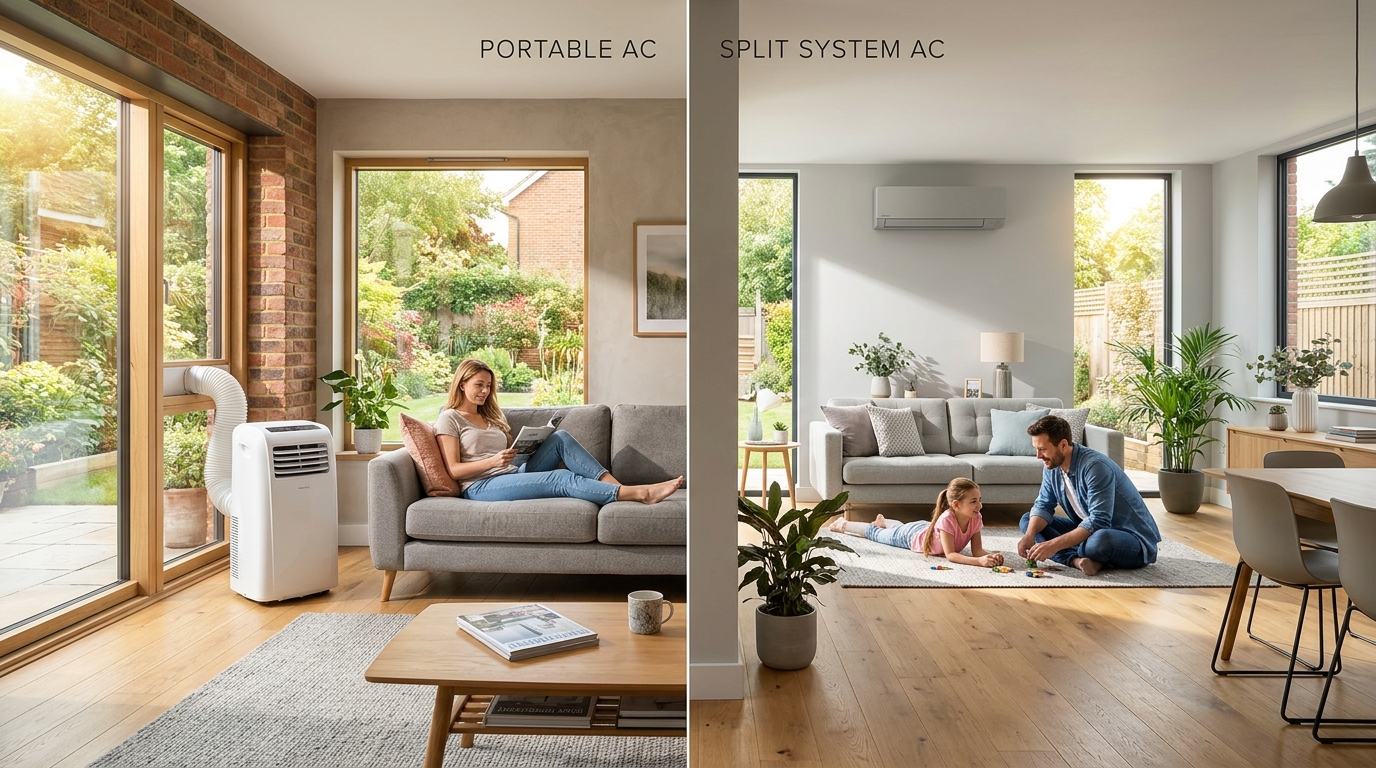
A split system wins on everything except cost, permissions and portability — it’s much quieter indoors, more efficient, more powerful, and doesn’t block a window. A portable unit wins on exactly those three things, which for a lot of people are decisive: it’s a fraction of the price, needs no installation or planning, and you can take it when you move. The honest rule of thumb: if you own your home, plan to stay, and want one or more rooms cool for years, a split system usually justifies itself. If you rent, want flexibility, or need cooling for a few weeks a year, a portable unit is the sensible choice.
These are genuinely different products for different situations. Here’s how to tell which one is yours.
How they differ physically
A portable unit is a single box (mono-block) with the whole refrigeration circuit — including the compressor — inside it, in your room. Hot air is expelled through a hose out of a window.
A split system separates the indoor unit (a wall-mounted head) from the compressor and condenser, which sit outside, connected by refrigerant pipework through the wall.
That single difference — compressor inside vs outside — drives almost everything else.
Side by side
| Portable | Split system | |
|---|---|---|
| Indoor noise | Compressor in the room | Compressor outside — much quieter |
| Cooling performance | Good for one sealed room | Stronger, more consistent |
| Efficiency | Lower | Higher |
| Upfront cost | Low | Much higher (unit + install) |
| Installation | Plug in, vent a hose | Certified installer, fixed |
| Planning/permissions | None for a portable | May apply; freeholder consent if leasehold |
| Window | Blocks one while running | Window stays free |
| Takes it when you move | Yes | No — it stays |
| Multiple rooms | One unit, one room | Multi-split can serve several |
| Winter heating | Reverse-cycle models available | Nearly all heat too, efficiently |
Where the split system genuinely wins
- Noise. The compressor is outside, so indoors you hear only a quiet fan. For a bedroom this is transformative — no portable unit competes.
- Performance. More cooling, more consistently, and it handles larger and open-plan spaces a portable can’t.
- Efficiency. Lower running cost for the same cooling, which over years of use offsets some of the higher purchase price.
- The window stays usable. No hose, no blocked opening, no security compromise.
- Multiple rooms. A multi-split system runs several indoor heads from one outdoor unit.
- Winter. Almost all split systems are heat pumps that heat as well as cool, efficiently — our heat pump guide covers that.
- It adds to the property rather than being something you store each winter.
Where the portable wins
- Cost. A fraction of the price, with no installation bill.
- No installation, no permissions. Plug it in, vent the hose. No certified installer, no planning question, no freeholder consent.
- Renters can use it. Nothing is altered, so it needs no landlord permission in most cases — our renter’s guide covers it.
- It moves with you. When you leave, it comes too.
- No commitment. If UK summers give you a few uncomfortable weeks a year, a portable matches that without the outlay of a permanent system.
- Flexibility. Cool whichever room needs it this year.
What a split system actually involves
Worth knowing before you assume it’s the obvious upgrade:
- A certified installer. Refrigerant work requires certification — F-Gas for fluorinated refrigerants, and specific competence for A3 flammable refrigerants like R290, which falls outside F-Gas. Our installation law guide covers it. This is not a DIY job.
- Possible planning considerations for the outdoor unit — conditions on size, siting and noise, removed for listed buildings and limited in conservation areas and for flats. Our planning guide covers it.
- Freeholder consent if you’re leasehold — the outdoor unit fixes to the building. Our leasehold guide covers it.
- A more disruptive fit — pipework through the wall, an outdoor unit sited and mounted.
- Servicing — fixed systems benefit from periodic professional maintenance.
The decision
Lean split system if: you own your home, you’re staying put, you want a bedroom genuinely quiet or an open-plan space cooled, you’ll use it for years, and you’d value the winter heating. The cost amortises over a long life.
Lean portable if: you rent, you might move, you want flexibility over which room, you get a few genuinely hot weeks a year rather than a cooling season, or the upfront cost of a split system isn’t justified for the use you’ll get.
The picks
MeacoCool MC Series Pro 9000
The portable that gets closest
16–26m²
52 dB low fan
App control, 2yr warranty
If you’ve weighed it up and a portable is the right call, this is a strong one — Meaco publish 52 dB on low fan, a 16–26m² range and a two-year warranty, with app control for pre-cooling. It won’t match a split system for quiet, but for a plug-in unit with no installation it’s about as close as the format gets.
Good for: renters, movers, and anyone wanting one room cool without installation, planning or a big outlay.
Less good for: anyone whose real requirement is split-system quiet or open-plan performance — no portable delivers that. Trusted Reviews measured 58.5 dB fan-only, so it’s audible, and it needs venting and storing. If you own and you’re staying, price a split system before buying this.
Frequently asked questions
Is a split system worth the extra cost?
If you own, you’re staying, and you’ll use it for years — often yes, because it’s quieter, more efficient and heats in winter, and the cost spreads over a long life. For a few hot weeks a year in a home you might leave, no.
Can I install a split system myself?
No — the refrigerant work legally requires certification. Our installation law guide covers what’s involved.
Which is cheaper to run?
A split system, generally — it’s more efficient. But it costs far more upfront, so the total picture depends on how much you’ll use it and for how many years.
I rent — can I have a split system?
Only with the landlord’s (and, if leasehold, the freeholder’s) written permission, since it’s a fixed alteration. Most renters use a portable for exactly this reason.
Sources
- GOV.UK — Fluorinated gases (F-gases): rules
- Planning Portal — Do you need permission?
- Energy Saving Trust — Home appliances and energy use
- Trusted Reviews — MeacoCool MC Series Pro 9000 review
Related reading: our installation law guide and heat pump guide.
If a portable is the right call for your situation, compare current specifications at Amazon UK.