Do You Need an Extension Hose for Your Portable Air Conditioner?
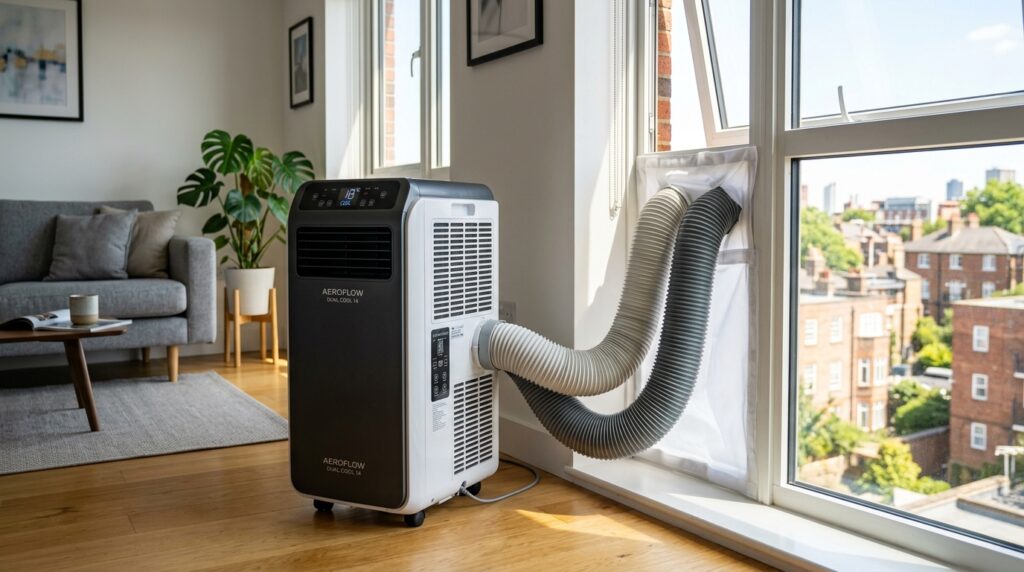
Almost certainly not, and extending is usually a mistake. Manufacturers commonly warn against lengthening the exhaust hose, and there are three good reasons: a longer hose increases back pressure so the unit works harder for less cooling, it radiates more heat back into the room you’re cooling, and it may void your warranty. If you’re reaching for an extension, the real problem is usually that the unit is in the wrong place. Move the unit closer to the window — even if it looks awkward — rather than moving the window closer to the unit.
This is one of the few pages where the right advice is to not buy the thing you came looking for.
Why longer is worse
1. Back pressure
The unit’s fan has to push exhaust air through the hose and out. Every extra metre, and every bend, adds resistance. More resistance means less air moved, which means less heat rejected — so the compressor runs longer for the same result.
The supplied hose length isn’t arbitrary; it’s what the unit was designed and tested around.
2. It radiates heat into your room
The one people underestimate. That hose carries hot exhaust air, and it gets genuinely hot to the touch. Every metre of it sitting inside your room is a radiator working directly against the machine.
Double the hose length and you’ve roughly doubled the surface area heating the room you’re trying to cool.
3. Condensation and sagging
A longer hose sags. Water condenses inside it, pools in the low point, and can drip or run back toward the unit — a common cause of a “leak” that isn’t a leak. Our leaks guide covers it.
4. Warranty
Many manuals explicitly state not to extend or replace the hose with a longer one. If the compressor fails after months of running against elevated back pressure, an extension is an obvious thing for a manufacturer to point at. Check your manual before modifying anything.
What to do instead
The impulse to extend almost always comes from one of these situations. Each has a better fix.
“The window is too far from where I want the unit”
Move the unit. Position it near the window and accept it looks less tidy. Cooling performance beats furniture arrangement, and you’ll have it there for a few weeks a year.
If the unit genuinely can’t go near the window, consider whether a different room or a different window works better.
“I want to vent into a different room”
Don’t. Venting into another room inside the house dumps the heat back into the building — and with a single-hose unit, that hot air is then drawn back toward the room you’re cooling as replacement air. You’d be moving heat around rather than removing it.
The exhaust has to go outside the thermal envelope: a window, a wall vent, or a properly ducted route.
“My window is high up or awkward”
This is a venting problem, not a hose-length problem. A cut panel or fabric kit usually solves it — our seal kits guide covers the options, and our skylight guide covers roof windows specifically, where the hose having to rise is a genuine obstacle.
“There’s no window at all”
A permanent wall vent is the answer, not a longer hose. Our windowless room guide covers that — and note it needs permission if you rent or hold a lease.
When extending is defensible
Rarely, and with caveats:
- Your manual explicitly permits it and states a maximum length — some do. Follow that figure.
- You’re replacing a damaged hose with the same length and diameter — that’s a repair, not an extension.
- A very short extension, insulated, where no repositioning is possible. Accept some performance loss.
If you do extend: keep it as short and straight as possible, avoid sags, insulate it, and check the coupling diameter matches your unit — these vary between manufacturers and a poor coupling leaks hot air into the room.
Better uses of the same money
Foil-faced pipe insulation for the hose you have
Fixes the actual problem
Noticeable effect
Cheap
If your hose run is longer than ideal and you can’t shorten it, insulating it addresses the heat it radiates back into the room — which is the main penalty. Foil-faced pipe insulation or a purpose-made hose cover, taped along its length.
Good for: any unavoidable long run; loft rooms and awkward layouts; it also reduces condensation on the hose surface.
Less good for: back pressure, which it doesn’t touch — a long hose still makes the fan work harder. And a heavily insulated hose is stiffer and more awkward to route and store. Shortening the run is still better if you can.
A proper window seal kit
Bigger gain than any hose change
Fits UK casements
Removable
If you’re spending money to improve performance, spend it here. With a single-hose unit the room sits under slight negative pressure, so gaps around the window kit are actively drawing warm outside air in. Sealing properly does more than any hose modification.
Good for: every single-hose setup, and the effect is larger than people expect.
Less good for: a badly positioned unit — it doesn’t fix a hose stretched across a room. Measure your frame profile before ordering, since sizing is the commonest reason these get returned.
Hose housekeeping
- As short and straight as the room allows
- No tight bends — they restrict flow and crease the material permanently
- Don’t coil surplus behind the unit to tidy it. That’s the worst thing you can do with it
- Check both couplings are properly seated — they work loose and leak hot air back into the room
- Store it loosely coiled, not folded — a crease taken over eight months becomes permanent. Our storage guide covers it
Frequently asked questions
How much performance do I lose with a longer hose?
Manufacturers rarely publish figures, and it depends on length, diameter and bends — so we won’t invent a number. The direction is certain: longer and more bent means worse. Treat the supplied length as the design intent.
Can I use standard ducting instead?
Check your manual first. Diameter must match the coupling, and flexible ducting varies in how much resistance it adds. Many manuals prohibit substitution.
Can I vent into the loft or a cupboard?
No. Venting into a loft dumps heat and moisture into your roof space, which risks condensation and damage to timbers and insulation. A cupboard achieves nothing at all. It has to go outside.
My hose is split. Can I tape it?
As a short-term fix, taped tightly, yes. Long-term, replace it with the correct part from the manufacturer — a leaking hose is dumping hot air straight back into your room.
Sources
- Energy Saving Trust — Home appliances and energy use
- GOV.UK — Approved Document F: Ventilation
- Legislation.gov.uk — Consumer Rights Act 2015 (modifications and warranty)
- Citizens Advice — Problems with something you’ve bought
Related reading: our seal kits guide and troubleshooting guide.
If hose routing is the obstacle, a better window seal kit will do more than a longer hose. Compare options at Amazon UK.