Can You Dry Washing Outside in Winter? (UK)
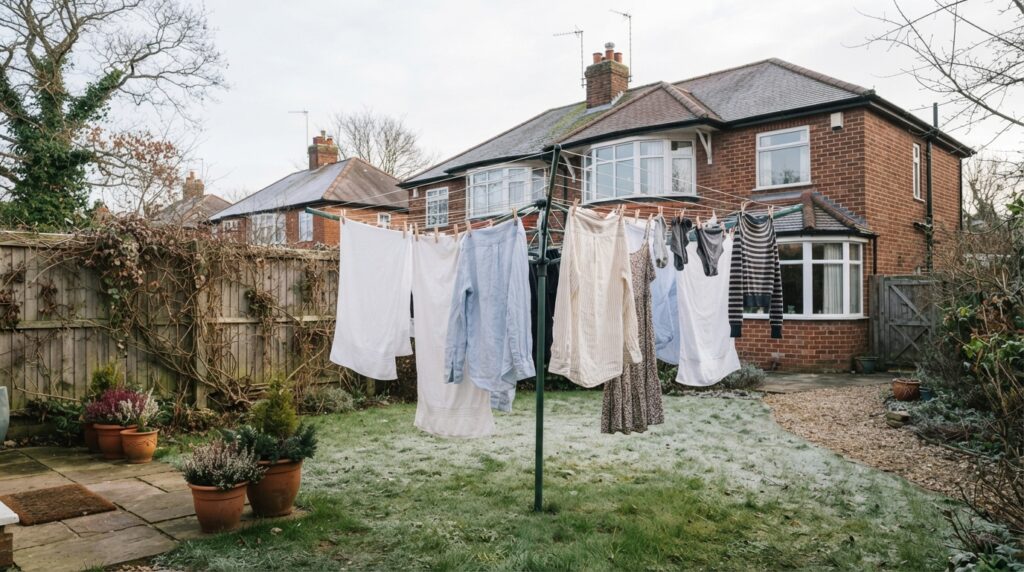
Yes, on the right day. Washing dries by evaporation, and the Royal Meteorological Society (RMetS) says clothes can dry faster on a cold, dry day than on a warm, humid one. Even frozen washing can dry slowly, because ice can turn straight into water vapour when the air is dry enough. Pick a dry, breezy day, give the load an extra spin, hang it out in the morning and bring it in before the evening dew or frost. It costs nothing and keeps moisture out of your home: the University of Manchester says one load of wet washing contains almost two litres of water. By our sums from Currys’ energy figures, at the October to December 2026 price cap a full 9kg load costs about £1.37 in a condenser tumble dryer, or about 57p in a heat pump dryer.
It’s easy to give up on the washing line once October arrives, then spend the winter with damp clothes draped over radiators or the tumble dryer running every other day. That isn’t always necessary. Here’s what the science says, how to spot a good drying day, and what it costs if you dry indoors instead.
How washing dries, and why cold isn’t the main problem
Clothes dry when water molecules in the fabric gain enough energy to escape into the air as vapour. The RMetS explains that colder air means less energy, so fewer molecules escape and drying slows down: “The lower the temperature, the lower the average energy.” That’s why a winter load takes longer than a summer one.
But temperature is only part of it. The moisture has to go somewhere, so humid air slows drying, while moving air speeds it up by carrying moisture away from the fabric. The RMetS says clothes can dry faster on “a cold and dry day than on a warm and humid day”, especially in direct sunlight. A crisp, breezy winter morning can beat a muggy summer afternoon.
Can washing dry if it freezes?
Yes, but slowly. The RMetS explains that even below freezing, as long as the air is dry enough, ice can sublimate, turning straight into water vapour without melting first. Its tip for the depths of winter: shake off any snow or ice from frozen laundry and let the sun do the work.
The bigger risk is the evening. The RMetS warns that dew or frost can settle on clothes overnight, so bring the washing in before it gets dark.
What a good winter drying day looks like
- Dry air. The RMetS’s “humidity is key” tip is the one to watch in winter. On a damp, misty or drizzly day, the air can’t take much more moisture, so washing won’t get far.
- A breeze. Wind carries moisture away and speeds up evaporation even on cooler days.
- Some sun. The RMetS says sunlight is strongest roughly between 10am and 2pm, and solar radiation can still dry laundry in winter.
- An early start. Hang it out in the morning to make the most of the daylight, and watch for breaks in the weather.
The Royal Meteorological Society’s ten tips, in short
- Timing: hang laundry out in the morning to catch the strongest sun.
- In a spin: an extra spin cycle removes more water before it goes out.
- Let the wind blow: peg things securely so they can flap in the breeze.
- Move it around: a portable airer lets you follow the sun or the wind.
- Switch things up: turn items so they dry evenly, expose as much surface as possible, and hang thick parts at the top.
- Depths of winter: shake off snow or ice and let the sun dry frozen laundry.
- Cover up: a covered spot with open sides keeps off rain and snow while letting air flow.
- Humidity is key: watch the humidity, and bring clothes in overnight to avoid dew or frost.
- Material matters: synthetic or blended fabrics such as polyester and nylon generally dry faster than cotton or wool, and darker clothes absorb more heat, so give the best spots to thick, light-coloured natural fabrics.
- Wrinkle free: smooth garments as you hang them and peg at the seams to cut down on ironing.
Why it’s worth the effort: the moisture
Every load you air-dry indoors puts its water into your home’s air. The University of Manchester quotes Professor David Denning of the National Aspergillosis Centre: “One load of wet washing contains almost two litres of water, which is released into the room.” Hartlepool Borough Council says drying clothes indoors can add 10 to 15 litres of moisture a week.
That moisture can end up as condensation on cold windows and walls, which is why the government’s guidance on damp and mould suggests drying laundry outdoors where possible. Watford Borough Council specifically advises against drying clothes on radiators, because it “releases a lot of moisture into the air quickly”. Our guide to winter condensation, damp and mould covers what to do if it’s already a problem.
What drying indoors costs instead
Using Currys’ figures for 9kg machines and the October to December 2026 price cap rate of 26.32p per kWh:
| Method | Energy | Cost at 26.32p/kWh |
|---|---|---|
| Vented tumble dryer | 5.34kWh per full load | About £1.41 a load |
| Condenser tumble dryer | 5.2kWh per full load | About £1.37 a load |
| Heat pump tumble dryer | 2.16kWh per full load | About 57p a load |
| Heated airer (Lakeland Dry:Soon 3-tier) | 300W | About 7.9p an hour |
| Dehumidifier on laundry mode (Meaco Arete One 20L) | Meaco claims laundry dries in 4 hours 45 minutes (load size not stated) | Meaco says 28p |
| Washing line | None | Free |
Say you do around two loads a week (roughly what Currys assumes) and get one of them dry outside each week from December to February. That’s about 13 loads, worth roughly £18 with a condenser dryer, or about £7 with a heat pump dryer, assuming the unit rate stays at 26.32p after the price cap changes on 1 January. Not a fortune, but it’s money for nothing, and the moisture stays outside. For a wider comparison, see our appliance running costs guide.
The best of both: start outside, finish inside
Winter washing won’t always come in bone dry, and it doesn’t need to. Every bit of water that evaporates on the line is water you don’t have to pay to remove, or mop off your windows. Bring it in before dusk and finish it on an airer. If you’re drying indoors, Hartlepool Borough Council suggests a room with a slightly open window and the door closed, so the moisture goes out rather than round the house. A dehumidifier in the same room does the same job without the cold draught.
Brabantia Lift-O-Matic 50m rotary airer
Best for: making the most of a breezy day
Height adjusts 129 to 187cm
Metal ground spike and cover
Brabantia lists 50 metres of line and a height that adjusts to your working height, from 129 to 187cm. This version comes with a metal ground spike and a cover. Plenty of line means you can space things out, which helps the breeze reach every item.
Good for: gardens with a lawn or soil to take the spike; big family loads; setting the line at a comfortable height.
Less good for: flats and balconies, as it needs setting into the ground; very wet days, because it gives no shelter from rain.
Lakeland Dry:Soon 3-tier heated airer
Best for: finishing off what the line started
Up to 15kg load
About 7.9p an hour
Lakeland’s instruction booklet lists the power as 300W and the maximum load as 15kg, which works out at about 7.9p an hour at the current cap rate. It also suggests laying laundry flat for faster drying. It’s a cheap way to finish off half-dry washing brought in from the line.
Good for: small homes without a tumble dryer; finishing a load after a few hours outside.
Less good for: moisture: the water still evaporates into your room, so open a window or use a dehumidifier. The booklet says to switch it off after 24 hours and let it cool for about two hours, and a cover isn’t included (Lakeland sells one separately).
Meaco Arete One 20L dehumidifier
Best for: drying indoors without the damp
Laundry mode
4.8-litre tank
A dehumidifier pulls the moisture out of the air as the washing dries, so it ends up in a tank rather than on your windows. Meaco says the Arete One uses 216W at 20°C and 60% humidity, which it puts at about 6p an hour at 26.32p per kWh. It has a laundry mode, and Meaco claims it can “dry your laundry in just 4 hours 45 minutes for only 28p”, though it doesn’t say how big a load or in what conditions. It also has a built-in humidistat you can set from 40% to 70%. Our dehumidifier guide compares it with other models.
Good for: drying indoors on wet days; whole-house condensation control all winter.
Less good for: cold, unheated rooms. Meaco’s own figures show it extracts 3.4 litres a day at 10°C and 60% humidity, against 8.5 litres at 20°C, and its operating range starts at 5°C.
Frequently asked questions
Is it worth hanging washing out in winter?
On a dry, breezy day, yes. The RMetS says clothes can dry faster on a cold, dry day than a warm, humid one. Even if the washing only gets part-dry, it saves energy and keeps moisture out of your home.
What temperature is too cold to dry washing outside?
There isn’t a single cut-off. Humidity and wind matter as much as temperature. Below freezing, wet washing may freeze on the line, but the RMetS says it can still dry slowly as the ice turns straight into vapour, as long as the air is dry enough.
Does frozen washing dry?
Yes, slowly, if the air is dry. The ice sublimates, turning into water vapour without melting, but on a short winter day it may still come in damp. Shake off any snow or ice and leave it in the sun.
Should I bring washing in at night?
Yes. The RMetS advises bringing clothes in overnight to avoid dew or frost. Bring it in before dusk and finish it indoors if needed.
Is it bad to dry clothes on radiators?
It adds a lot of moisture to your home quickly. Watford Borough Council advises against it for that reason, and Hartlepool Borough Council says not to dry clothes on radiators. An airer in a ventilated room, or with a dehumidifier, is better.
Sources
- Royal Meteorological Society — Ten ways to dry laundry outside all year round
- University of Manchester — Why drying washing indoors can pose a health threat
- Hartlepool Borough Council — Damp and condensation leaflet
- GOV.UK — Understanding and addressing the health risks of damp and mould in the home
- Watford Borough Council — Mould, damp and condensation: your prevention guide
- Currys — How much does it cost to run a tumble dryer?
- Ofgem — Energy price cap unit rates and standing charges
- Lakeland — 3-tier heated airer instruction booklet
- Lakeland — Dry:Soon 3-tier heated airer cover
- Meaco — MeacoDry Arete One 20L
- Brabantia — Rotary dryer Lift-O-Matic, 50 metre
Related reading: our air con dry mode vs dehumidifier, best dehumidifiers for a damp home and 10 ways to lower your heating bill.
Compare the Brabantia Lift-O-Matic rotary airer at Amazon UK.