How to Stop a Real Christmas Tree Dropping Needles When the Heating’s On (UK)
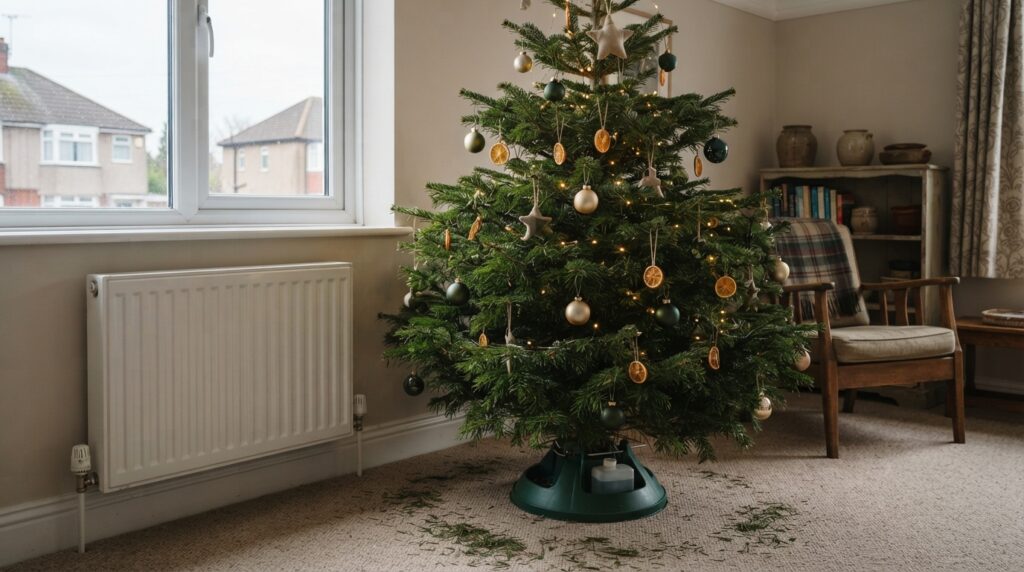
Water it, keep it away from heat, and start with the right tree. The Scottish Fire and Rescue Service says heat and lack of water will dry out a tree, and Forestry England says constant heat or fluctuating temperatures can dry it out “very quickly”. So: make a fresh cut across the base just before it goes in the stand (half an inch, says the British Christmas Tree Growers Association; the RHS says 2.5cm). Use a stand that holds water and check it every day. Keep the tree away from radiators, fires and heat vents: there’s no official UK distance, but the US Fire Administration says at least 3 feet, about a metre. Turn off underfloor heating under it, or stand it on a mat. And choose a Nordmann, Fraser or Korean fir rather than a Norway spruce, which the RHS says is quick to drop. Looked after properly, the growers’ association says a tree can last up to four weeks, but for fire safety the Scottish Fire and Rescue Service suggests not leaving a real tree up for longer than two weeks.
A real tree looks perfect at the farm or garden centre, then a week later there’s a carpet of needles under it. In a centrally heated UK home, that’s usually a water problem made worse by heat. Here’s what the growers’ association, the RHS, Forestry England and the fire services advise, step by step.
Why central heating makes trees drop needles
A cut tree keeps drinking through its trunk, and the warmer the room, the faster it dries. The US National Christmas Tree Association puts it simply: “Lowering the room temperature will slow the drying process, resulting in less water consumption each day.” Forestry England reminds us that a tree’s natural habitat at this time of year “is out in the cold air”, and that “constant heat or fluctuating temperatures can dry your tree out very quickly”. The Scottish Fire and Rescue Service adds the safety angle: “Heat and lack of water will dry out the tree, which will more easily be ignited by heat, flame or sparks.”
So everything below comes down to two things: keep water going in, and slow down how fast it dries out.
Start with a tree that holds its needles
Species makes a big difference. Here’s how the RHS describes the common UK choices:
| Tree | What the RHS says about needles |
|---|---|
| Nordmann fir | “Very slow to drop”, but more expensive than Norway spruce |
| Korean fir | “Excellent needle-holding quality” |
| Fraser fir | “Good needle-holding properties”, with a pine fragrance |
| Blue spruce | Holds its needles better than Norway spruce |
| Norway spruce | “Quick to drop its needles” |
Forestry England says the same: choose a Nordmann fir if you want excellent needle retention, and a Norway spruce if you want the traditional look and smell. If your home runs warm, that makes the Nordmann the safer bet.
Check freshness when you buy. The Scottish Fire and Rescue Service says needles on a fresh tree should be green and hard to pull from the branches, and the trunk should feel sticky. The RHS suggests choosing a locally grown tree, or at least one grown in the UK.
When you get it home
- Let a freshly cut tree rest. The British Christmas Tree Growers Association (BCTGA) says if your tree was cut on the day you collect it, leave it outside to rest for 24 hours before taking it inside.
- Get it out of the net and into water. The BCTGA says to take it out of the net and ideally leave it in a bucket of water until you’re ready to decorate.
- Make a fresh cut. The BCTGA says to ask your retailer when the tree was harvested, or to remove half an inch from the base of the trunk before you display it. Forestry England says to saw half an inch off to get rid of any hardened sap, “and then put straight into water”. The RHS suggests sawing 2.5cm (1in) off with a pruning saw.
- Don’t hang about. The National Christmas Tree Association says most species can go 6 to 8 hours after the trunk is cut and still take up water. Make the cut just before the tree goes into the stand.
Use a stand that holds enough water
This is the single biggest factor. The BCTGA recommends a stand that holds water and says to keep it topped up: “you will be surprised how much the tree drinks!” The RHS says to check daily and top up when the level drops, and Forestry England says to make sure the trunk is “nicely submerged”.
How big a reservoir do you need? The National Christmas Tree Association’s rule of thumb is 1 US quart (just under a litre) of water per inch of trunk diameter. Converted to metric, that’s roughly 0.37 litres for every centimetre:
| Trunk diameter | Water the stand should hold (rule of thumb) |
|---|---|
| 8cm | About 3.0 litres |
| 10cm | About 3.7 litres |
| 12cm | About 4.5 litres |
| 14cm | About 5.2 litres |
Whatever the size, check it daily. The association says the water level should never drop below the base of the tree.
You don’t need additives. Forestry England says that whatever you’ve heard about Coca-Cola, corn syrup or special tree food, “Your beautiful tree just wants a constant supply of fresh water, it’s that simple.” The BCTGA and the RHS don’t mention additives at all.
Where to put it in a heated room
- Away from radiators, fires and heaters. The BCTGA says keep it away from radiators or other sources of heat, and the RHS says to avoid placing it too close to a fire or radiator. Warwickshire Fire and Rescue says the same about heaters, radiators and fireplaces.
- How far? UK bodies don’t give a figure. The US Fire Administration says “at least 3 feet away from heat sources like fireplaces, radiators, space heaters”, which is about a metre.
- Not in a sunny window or over a vent. The National Christmas Tree Association also lists heat vents and direct sunlight as heat sources to avoid.
- Underfloor heating. The BCTGA says to consider turning off the zone where your tree stands, or putting it on a mat to try to stop it getting too hot.
- If the only spot is near a radiator and it has a thermostatic valve, you could turn that radiator right down for the festive season so it isn’t drying the tree out. The room may run a little cooler, especially if it’s the only radiator in there.
- Keep the room a little cooler. The National Christmas Tree Association says a cooler room slows the drying. Our guide to setting your thermostat in winter covers sensible temperatures, and a cheap thermometer tells you how warm the tree’s corner really gets.
Note the two different timescales. The growers’ association says a well looked-after tree can last up to four weeks, but for safety, go with the fire service: put the tree up later so it isn’t up for longer than about two weeks, keep the stand topped up every day, and take it down promptly if it starts to dry out before then. The US Fire Administration’s advice is the same: get rid of the tree after Christmas, or sooner if it’s dry.
When it’s time to go
The RHS says real trees are greener when they’re recycled, and suggests shredding the tree or using a local collection scheme that turns it into mulch. The Scottish Fire and Rescue Service suggests a recycling centre or a community pick-up. Check your council’s website in early January for collection dates.
Three things that help
Krinner Premium Christmas tree stand (L)
Best for: big trees and a big drink
Trunks up to 12cm
3.7-litre tank (empty)
According to UK retailer Christmas Trees Direct, the Krinner Premium Large takes trees up to 9ft with a trunk of up to 12cm, holds 3.7 litres of water, and uses a foot pump to operate the clamp, which the retailer says gives a tight grip on the tree. Krinner’s own manual points out that the container holds less water once the tree is in place, so the 3.7 litres is the empty tank. By the rule of thumb, that suits trunks a little under 10cm best. For a thicker trunk, Krinner lists the Premium XL with a 4.5-litre tank, also for trunks up to 12cm.
Good for: trees up to 9ft with trunks a little under 10cm; tightening the clamp with your foot.
Less good for: trunks thicker than 12cm, which won’t fit. A trunk near that maximum wants about 4.5 litres by the rule of thumb, more than the tank holds, so check the level at least daily, especially in the first few days.
TP49 thermometer and hygrometer
Best for: checking how warm the tree’s corner gets
Humidity ±2% (30 to 80%)
1 × AAA, updates every 10 seconds
A small digital thermometer and humidity monitor. Its maker, now trading as TempPro (formerly ThermoPro, and some packaging may still carry the old name), quotes temperature accuracy of ±0.5°C between 0°C and 60°C and humidity accuracy of ±2% between 30% and 80%. Pop it on a shelf near the tree to see whether that corner is warmer than the rest of the room. Our room thermometer guide compares other options.
Good for: finding warm spots before you choose where the tree goes; checking room humidity all winter.
Less good for: alerts or history, because it has neither; it only shows the reading where it sits.
Tapo P100 smart plug
Best for: a back-up if you forget the tree lights
No hub needed
2.4GHz Wi-Fi, indoor use
Electrical Safety First and the fire services say to switch Christmas lights off and unplug them before bed. TP-Link says the Tapo P100 runs weekly schedules and countdown timers from your phone without a hub, so the tree lights go off at the same time every night as a back-up if you forget. It switches them off rather than unplugging them: TP-Link’s safety notes say the plug only de-energises “when the plug is pulled out”, so unplug when you can, and don’t set the lights to come on while you’re out.
Good for: tree and window lights indoors; switching off from your phone after you’ve gone upstairs.
Less good for: 5GHz-only Wi-Fi; outdoor sockets and unheated garages, as TP-Link says it’s for indoor use at room temperature; plugging into adaptors or other plug-in devices, which TP-Link’s safety notes say not to do.
Frequently asked questions
How far should a real Christmas tree be from a radiator?
UK bodies such as the BCTGA and the RHS just say keep it away from radiators and fires without giving a distance. The US Fire Administration says at least 3 feet, about a metre, from heat sources including radiators. If it has to be closer, keep it as far away as you can, turn that radiator down if it has a thermostatic valve, and check the water every day.
How often should I water a real Christmas tree?
Check it every day. The RHS says to check daily and top up when the level drops, and the National Christmas Tree Association says the water should never go below the base of the tree.
Why is my real Christmas tree dropping needles so fast?
Usually it’s a combination of heat and not enough water. The stand may have run dry, the base may not have been freshly cut before it went into water (Forestry England says to take half an inch off to get rid of hardened sap), or the tree may be close to a radiator or over underfloor heating. Some species, such as Norway spruce, are also naturally quick to drop.
Which Christmas tree drops the fewest needles?
The RHS says the Nordmann fir’s needles are very slow to drop, the Korean fir has excellent needle-holding quality, and the Fraser fir has good needle-holding properties. Norway spruce is quick to drop.
Does underfloor heating dry out a Christmas tree?
It can. The BCTGA suggests turning off the underfloor heating zone where the tree stands, or putting the tree on a mat to try to stop it getting too hot.
Should I add sugar or aspirin to the water?
There’s no need. Forestry England says that despite tips about Coca-Cola, corn syrup or special tree food, your tree “just wants a constant supply of fresh water, it’s that simple.” The BCTGA and the RHS don’t mention additives, and all three say to keep the stand topped up with water.
Sources
- British Christmas Tree Growers Association — How to care for your tree
- RHS — Christmas trees: types and care
- Forestry England — Forestry England’s guide to make your real Christmas tree last
- National Christmas Tree Association (US) — Care tips
- US Fire Administration — Holiday fire safety
- Scottish Fire and Rescue Service — Festive safety
- Warwickshire County Council — Seasonal fire safety: Christmas
- Hertfordshire Fire and Rescue Service — Fire safety at Christmas
- Electrical Safety First — Electrical safety advice for Christmas lights
- Christmas Trees Direct — Krinner Premium Christmas tree stand (up to 9ft)
- Krinner, via Conrad — Krinner Premium tree stand manual
- TempPro — TP49 indoor thermometer and hygrometer
- PR Newswire — ThermoPro becomes TempPro
- TP-Link — Tapo P100
- TP-Link — Tapo P100 setup guide and safety information
Related reading: our winter thermostat guide, does closing internal doors save heating? and best room thermometers and hygrometers.
Compare the Krinner Premium Christmas tree stand at Amazon UK.