Can You Use a Plug-In Heater in a Bathroom? UK Rules Explained
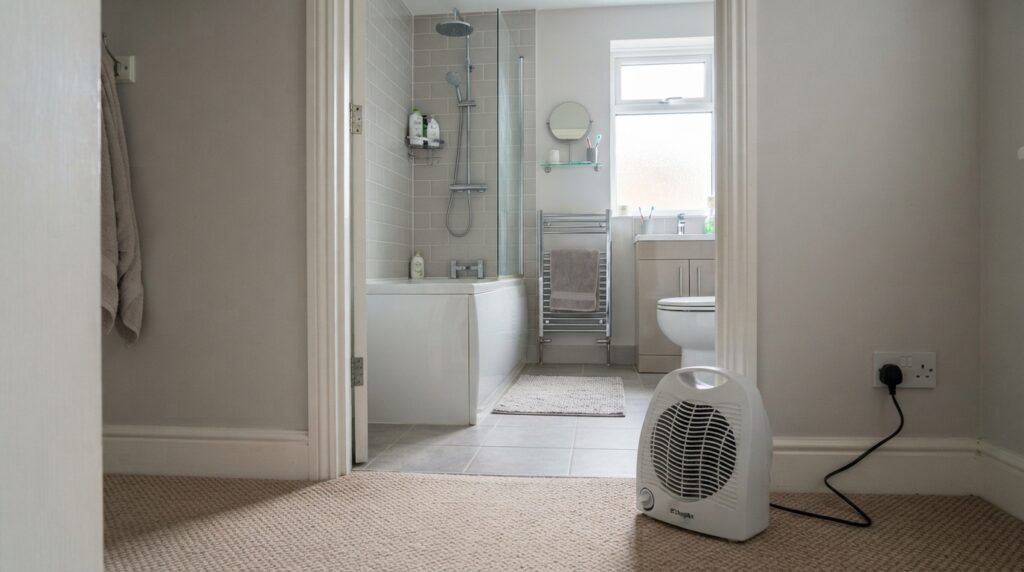
In almost every UK bathroom, no. The Wiring Regulations don’t allow ordinary sockets within 2.5 metres of the edge of a bath or shower tray — shaver sockets are the main exception — so most bathrooms have nowhere safe to plug a heater in, and an extension lead from the landing isn’t a workaround. The safe way to heat a bathroom is with a fixed appliance: a wall-mounted fan heater or an electric towel rail with a splash-proof rating (IPX4 or better, often listed as IP24), wired in by a registered electrician on a fused spur with RCD protection. In England, work that needs a new circuit, or that alters wiring close to the bath or shower, is notifiable under Part P of the Building Regulations.
A cold bathroom on a January morning is one of the small miseries of a British winter, and a plug-in fan heater looks like the obvious fix. It’s also one of the most common ways people put themselves at risk at home. Here’s exactly what the rules say, why they exist, and the safe ways to get a warm bathroom without breaking them.
Why bathrooms have their own electrical rules
Bathrooms combine water, steam, wet floors and people with bare, wet skin. Electrical Safety First explains that wet skin reduces the body’s resistance, which means a fault that might give you a jolt in a dry living room can be far more dangerous in a bathroom. That’s why the Wiring Regulations (BS 7671) treat a room containing a bath or shower as a “special location” with stricter rules than the rest of the house.
The bathroom zones, explained simply
The regulations divide a bathroom into zones based on how likely each area is to get wet. NICEIC, one of the UK’s main electrical certification bodies, describes them like this:
- Zone 0 is anywhere inside the bath or shower tray that can hold water.
- Zone 1 is the area directly above the bath or shower tray, up to the highest fixed shower head or 2.25 metres from the floor, whichever is higher.
- Zone 2 stretches 600mm out from the edge of zone 1, and the same height.
- Outside the zones, Electrical Safety First says only the general rules apply — but that doesn’t make it a dry room.
Anything electrical in the zones needs protection against water, shown by its IP rating. NICEIC says IPX7 is required in zone 0, and IPX4 or IPX5 (splash-proof) in zones 1 and 2. The second digit is the one that matters for water: 4 means protected against splashing from any direction. You’ll often see it written as IP24 — the 2 refers to protection against fingers and objects, the 4 to splashes.
The socket rule: 2.5 metres
In practice, very few British bathrooms are big enough to fit a socket 2.5 metres away from the bath or shower, which is why most have none at all. The shaver socket by the mirror is designed only for low-power shavers and toothbrushes, and won’t run a heater.
Why an extension lead isn’t a workaround
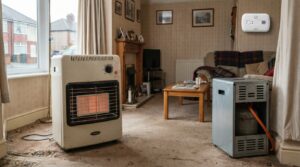
The obvious next idea is to run a lead in from the landing. Electrical Safety First’s advice is specific: if there are no sockets, don’t use extension leads to power electrical appliances in the bathroom, because it increases the risk of electric shock. It also advises against powering any heater from an extension lead, because they can easily be overloaded — a heater draws a lot of current for a long time. Humberside Fire & Rescue gives the same advice for all heaters: plug them into the wall, not an extension, and never use portable heaters in bathrooms at all.
There’s also the practical problem. A trailing flex across a wet floor is a trip hazard and a water hazard at the same time, and the door can’t close properly on it.
What if my bathroom does have a socket far enough away?
A few large bathrooms and en suites do have a socket that’s genuinely more than 2.5 metres from the bath or shower. The regulations allow that socket to exist, but that’s not the same as it being a good place for a portable heater. Fire service advice is still not to use portable heaters in bathrooms, because steam, towels, damp floors and a heater that can be knocked over are a poor combination. If you want heat in a bathroom, a fixed, splash-proof appliance is the right tool.
The safe ways to heat a bathroom
1. A wall-mounted bathroom fan heater
These are designed for the job: mounted high on the wall, splash-proof, usually with a pull cord or timer so they’re not left running. They give fast heat for the 15 or 20 minutes you’re actually in the room. Dimplex’s installation instructions for its bathroom heater are typical of what’s required: the supply must be connected through a switched fused spur, the bathroom must be protected by a suitable RCD, and installation must be carried out by a qualified electrician.
2. An electric towel rail
A towel rail gives gentle background warmth, dries towels, and helps the bathroom dry out after showers, which matters for mould. Many electric models are filled with oil or another fluid and heated by an element; they’re usually low wattage compared with a fan heater, so they’re better at keeping the room from getting cold than at warming it up quickly.
3. Your central heating
If there’s a radiator or a central-heating towel rail already, make sure it’s actually working. Bleeding it and checking the valve is free often makes a big difference — see our radiator bleeding guide.
Installing one: Part P and why it needs an electrician
In England, Approved Document P of the Building Regulations makes some electrical work “notifiable”, meaning it must either be done by a registered electrician who self-certifies it, or checked by building control. Notifiable work includes installing a new circuit, replacing a consumer unit, and any addition or alteration to existing circuits in a special location. The document defines that special location as the space around a bath or shower, extending 0.6 metres from the edge of the bath or shower tray and up to 2.25 metres high. NICEIC’s guidance is that any installation or alteration within zones 0, 1 or 2 is notifiable.
Electrical Safety First also says all circuits in or passing through bathrooms are now required to be protected by an RCD, and recommends using a registered electrician for any electrical installation work. The practical upshot: buy the heater, then get a registered electrician to fit it. They’ll give you the certificate you need, which also matters when you sell the house. If you’re unsure what counts as electrician work elsewhere in the home, our guide to when you need an electrician covers the basics.
What it costs to run
At Ofgem’s electricity price cap for October to December 2026 — 26.32p per kWh on direct debit — the sums are straightforward:
- A 2kW bathroom fan heater costs about 53p an hour, so a 15-minute blast before a shower is about 13p.
- A 175W electric towel rail costs about 4.6p an hour. Left on round the clock that’s about £1.11 a day, so a timer pays for itself quickly.
Check the wattage of the model you’re considering and multiply its kW figure by your own unit rate to get your figure.
Stiebel Eltron CK 20 Trend
Fast heat, made for bathrooms
2kW output
Weekly timer
Based on the manufacturer’s specification, this wall-mounted fan heater is rated IP24, has a 2kW output and a weekly timer, and is described as suitable as a standalone heater in bathrooms. The timer is the useful part for a family bathroom: it can warm the room before the morning rush and switch itself off. Like any fixed bathroom heater, it needs to be wired in by a registered electrician, and they’ll confirm where it can go relative to the zones.
Good for: quick heat before showers; bathrooms with no radiator; programming around a household routine.
Less good for: background warmth all day — at 2kW it’s expensive to leave running. It’s sold without a UK plug: in a bathroom, have a registered electrician connect it to a switched fused spur rather than fitting a plug, and budget for that.
Dimplex TRS175W electric towel rail
Gentle background warmth, dries towels
175W
Oil-filled
Listed as a splash-proof, IPX4-rated, oil-filled towel rail with a 175W output. That low wattage makes it cheap to run for long periods, and warm, dry towels and a drier room after showers both help keep mould at bay. It won’t heat a cold bathroom quickly on its own, so it works best as background warmth, or alongside a fan heater for the coldest mornings. As a fixed bathroom appliance, it should be installed by a registered electrician.
Good for: background warmth; drying towels; reducing bathroom damp; low running costs.
Less good for: warming a cold room fast. Fitting details aren’t given on the listing, so check them with your electrician before buying.
Don’t forget the moisture
A warm bathroom with nowhere for the steam to go is how black mould starts on the ceiling and around the window. Run the extractor fan during and after showers, keep the door closed so the steam doesn’t spread into cooler rooms, and wipe down the window. Our winter condensation and mould guide explains why this matters more in winter than in summer.
Frequently asked questions
Can I use a plug-in fan heater in my bathroom?
In almost all UK bathrooms, no. Ordinary sockets aren’t allowed within 2.5 metres of the edge of a bath or shower tray, Electrical Safety First advises against using extension leads in bathrooms, and Humberside Fire & Rescue’s advice is to never use portable heaters in bathrooms.
Can I use the shaver socket for a heater?
No. Shaver supply units are designed only for shavers and electric toothbrushes and can’t supply a heater. They’re allowed closer to a bath or shower because they contain a safety isolating transformer, which also limits them to very low power.
What IP rating does a bathroom heater need?
NICEIC says IPX4 or IPX5 is required in zones 1 and 2, and IPX7 in zone 0. Most bathroom heaters are rated IP24 or IPX4, and an electrician will position the heater according to its rating and the zones in your room.
Do I need an electrician to fit a bathroom heater?
Yes. In England, the work is notifiable under Part P if it needs a new circuit, or alters a circuit within 0.6 metres of the bath or shower tray. Either way, Electrical Safety First recommends a registered electrician for any installation work. Manufacturers such as Dimplex also require installation by a qualified electrician on a switched fused spur with RCD protection.
Sources
- Electrical Safety First — Bathroom electrical safety
- Electrical Safety First — Wiring Regulations help
- Electrical Safety First — Portable heaters
- NICEIC — Bathrooms and electrics
- GOV.UK — Approved Document P: electrical safety in dwellings
- Humberside Fire & Rescue Service — Electrical fire safety week
- NBS Source — Stiebel Eltron CK 20 fan heater specification
- Dimplex — BPH100M bathroom heater installation instructions
- Heatershop — Stiebel Eltron CK 20 Trend
- Air Con Centre — Dimplex TRS175W electric towel rail
- Voltimum, reporting IET guidance — Section 701: locations containing a bath or shower
- Ofgem — Energy price cap, October to December 2026
Related reading: our cheapest way to heat one room, winter condensation and mould guide and extension lead safety guide.
Compare the Stiebel Eltron CK 20 Trend bathroom heater at Amazon UK.