How to Flush the Toilet When the Water Is Off (UK), and Emergency Toilet Options
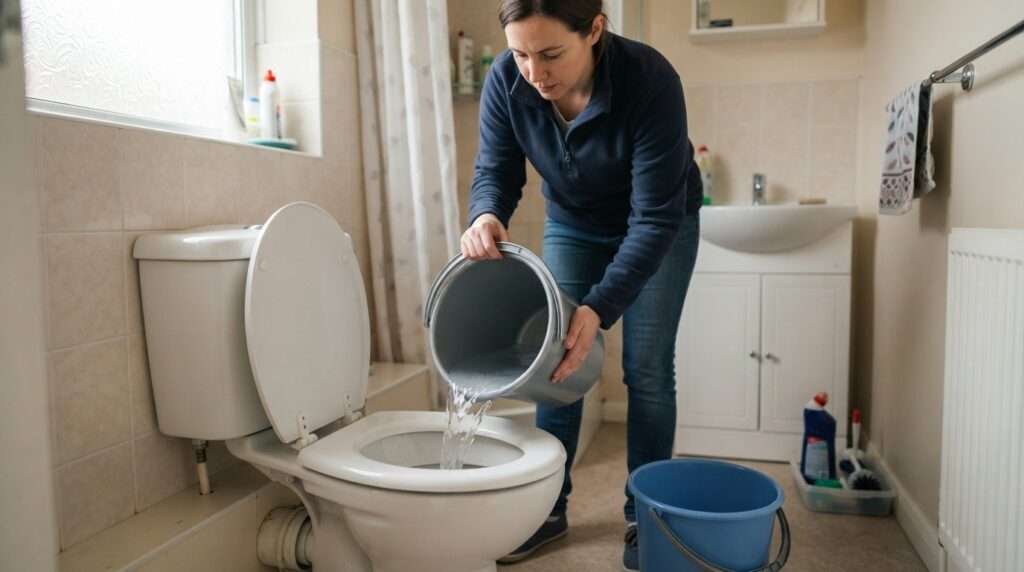
If your water is off but the sewers are working, you can still flush: fill a bucket and pour it into the toilet bowl. Use water you can’t drink, such as water from a water butt or used washing-up or bath water, and save bottled water for drinking. A toilet fitted since 2001 uses up to 6 litres a flush, older ones up to 9–13 litres. Don’t flush if sewage is flooding your home, if you have a macerator toilet and the power is off, or in a national power outage, when the UK Chief Medical Officers’ advice is that “the sewage system will not be working”. Then, use bags: seal them and put them out with your household waste. Never flush wet wipes.
Burst mains, frozen pipes and supply failures can leave a street without water for hours or days. And the government’s Be Ready campaign, launched in October 2026, asks every household to be ready for 3 days of disruption. Most advice stops at drinking water, but you’ll need the toilet long before you run out of that. Here’s how to flush without running water, when not to flush, and the emergency toilet options worth having.
How to flush with a bucket
A normal toilet doesn’t need electricity or water pressure to flush, just enough water poured in. Bristol Water’s advice for supply interruptions is to use your water butt or stored water “to flush the toilet by filling up a bucket” and pouring it into the bowl.
- Fill a bucket with water you won’t drink (see below).
- Pour it into the bowl in one go so it carries the waste away.
- Flush only when you need to. Every flush uses water you may need later.
- Wash your hands afterwards (see below).
How much water a flush needs
In England and Wales, the Water Supply (Water Fittings) Regulations 1999 say a flushing cistern fitted since 1 January 2001 can’t give more than 6 litres in a single flush. There’s an exception for some like-for-like replacements of older cisterns. Northern Ireland Water says pre-2001 cisterns use 9 litres, and older ones up to 13 litres.
| Toilet | Water per flush |
|---|---|
| Fitted since 2001 | Up to 6 litres |
| Fitted before 2001 | About 9 litres |
| Older cisterns | Up to 13 litres |
That adds up quickly. NI Water says about 30% of household water goes on flushing the toilet. Be Ready recommends 3 litres of drinking water per person per day. Wessex Water says 10 litres per person per day “should cover drinking, cooking and hygiene needs”, so you’ll need extra on top of that for flushing.
Which water to use
- Water butt water. Be Ready says it “can be used for flushing toilets or watering plants”, but “do not drink this water as it could contain bacteria or disease”.
- Used water. Kent Prepared, Kent’s emergency planning website, advises: “Use waste water which you can collect in a bowl to flush toilets.” Washing-up and bath water both count.
- Water you stored from the tap before a planned interruption. Bristol Water says to fill containers “ideally on the morning of the interruption”, and that “there’s no need to buy bottled water”.
Keep bottled water for drinking, cooking and anyone who needs it most, such as babies and people with medical needs.
When not to flush
If sewage is flooding your home
The Consumer Council for Water says: “Do not use any water in your home, including flushing toilets or running taps.” Flushing only pushes more sewage back up. Report it to your water company straight away.
In a national power outage
The UK Chief Medical Officers have prepared public health advice for a total power outage across Great Britain. It says: “You will not be able to flush the toilet. Do not try to in any way as the sewage system will not be working.” Instead, it advises collecting your poo in plastic bags, sealed and disposed of with normal household waste, “ideally in an outside bin if you have one”, then washing your hands.
That’s a worst case. In an ordinary local power cut, a standard toilet keeps flushing as long as water reaches the cistern. The exceptions are below.
If you have a macerator toilet
Macerator toilets, often fitted in basements and extensions, use an electric pump to push waste away. Saniflo’s North American FAQ says: “In the event of a power loss, do not use the toilet or any sanitary fixture connected to the pump”, as it won’t work until power is restored. Use another toilet or a bag until the power is back.
If your water is pumped
Some homes rely on an electric pump for water, such as a private borehole. The James Hutton Institute says boreholes tend to have an electricity supply to power the pump. Be Ready also warns that “mains water supply to your home could also be disrupted during and after power cuts”.
Never flush wet wipes
Water companies say only pee, poo and paper should go down the toilet. Southern Water says wet wipes are “one of the biggest causes of blockages in sewers”. When you’re flushing with a bucket, a blockage is the last thing you need.
Water UK’s “Fine to Flush” certification for wet wipes ended in March 2024, so don’t rely on any flushable claim. Put wipes in the bin.
Keeping hands clean without running water
The Chief Medical Officers suggest filling “a large bowl like a washing up bowl with water and add some soap or a household disinfectant” for handwashing, and using hand sanitiser “if it’s the only thing you have”. If someone has diarrhoea, give them a separate bowl.
Hand gel has limits. Northern Ireland’s nidirect says to use alcohol-based hand gel “only on visibly clean hands”, and the NHS says alcohol hand gels do not kill norovirus. If hands are dirty, or there’s a stomach bug in the house, use soap and water.
When the water comes back
- Discoloured water is common after an outage. Be Ready says to run the cold tap nearest your stopcock, usually the kitchen tap, and contact your water company if it doesn’t clear.
- Cloudy or white water is usually air. Scottish Water says it happens when air dissolves in the water under pressure, and it clears from the bottom of the glass upwards.
- Run only the cold kitchen tap at first. Scottish Water recommends “running only your cold water kitchen tap (no other taps or water using appliances) until this clears”. Then let the toilet cistern refill.
Emergency toilet options
For a short local water outage, a bucket flush is usually enough. If the sewers might be affected, or you want a backup for longer outages, these are the options:
| Option | Best for | Drawback |
|---|---|---|
| Bucket flush | Water off, sewers working | Uses lots of water |
| Toilet bags with absorbent gel | National power outage; sewer problems | Bags go in the bin, ideally an outside one |
| Bucket toilet with seat | Short outages; camping | Small capacity |
| Chemical toilet | Longer outages; caravans and boats | Must be emptied at a disposal point |
The kit worth buying
Kampa Khazi portable toilet
Best for: a simple bucket toilet with a proper seat
5-litre container
No chemicals needed
Retailer Towsure lists the Khazi with an adult-sized seat and lid and a 5-litre waste container. It’s chemical-free, so it “can be emptied in a standard toilet system” once your water is back. It measures 410 x 480 x 335mm. Line it with a toilet bag and you can follow the Chief Medical Officers’ bag advice too.
Good for: short outages; camping; a toilet you can sit on comfortably.
Less good for: a whole family for several days, as the 5-litre container fills quickly.
Toilet waste bags with gelling powder (such as Cleanwaste Toilet in a Bag)
Best for: when you can’t flush at all
Gelling powder
Works with any portable toilet
Several brands sell these kits. Cleanwaste’s Toilet in a Bag comes with 15 or 30 drawstring bags plus a gelling powder, and each treatment “gels 24 oz. of waste” (about 700ml). It says you can use the bags “with the Go Anywhere Portable Toilet, on the ground, or any portable toilet you choose”, including a bucket toilet. The gel turns liquid into a solid, so a sealed bag is easier to handle and bin.
Good for: a national power outage; sewer flooding; macerator toilets in a power cut.
Less good for: use without a seat. Cleanwaste is a US brand, so you may find other brands in stock at Amazon UK; check each kit’s instructions. Follow the Chief Medical Officers’ advice: seal the bags and put them in an outside bin.
Thetford Porta Potti 365
Best for: longer outages and campervans
15-litre flush tank
Waste level indicator
Thetford’s Porta Potti 365 is a flushing chemical toilet with a 21-litre waste tank, a 15-litre flush water tank, a piston pump and a waste level indicator. It weighs 4kg. The flush tank means it works with no mains water at all, and it doubles as a camping or campervan toilet the rest of the year. The smaller 145 has a 12-litre waste tank.
Good for: longer outages; anyone who also camps or has a caravan.
Less good for: emptying at home. Thetford’s manual says to take the waste tank “to an authorised waste disposal point”, and it needs its own additives and toilet paper. Anglian Water says the chemicals shouldn’t go straight into the sewer.
Frequently asked questions
Can you flush a toilet with a bucket of water?
Yes. If your water is off but the sewers are working, fill a bucket and pour it into the bowl. Use water butt water or used washing-up or bath water rather than drinking water.
How much water does it take to flush a toilet?
A toilet fitted since 2001 uses up to 6 litres a flush. Older cisterns can use 9 to 13 litres.
Can I flush the toilet in a power cut?
In an ordinary local power cut, a standard toilet flushes as long as water still reaches the cistern. Don’t use a macerator toilet without power, and in a national power outage the Chief Medical Officers’ advice is not to flush at all, as the sewage system won’t be working.
Can I put toilet waste bags in my wheelie bin?
The Chief Medical Officers’ advice for a national power outage is to seal bags of poo and dispose of them “with normal household waste, ideally in an outside bin if you have one”. Wash your hands afterwards.
Are wet wipes safe to flush?
No. Water companies say only pee, poo and paper should be flushed, and Water UK’s “Fine to Flush” certification ended in 2024. Put wipes in the bin.
Sources
- Bristol Water — Preparing for an incident; South West Water — Preparing for an incident
- GOV.UK Be Ready — Water supply interruptions or outages and Power cuts
- GOV.UK — UK CMOs: water and sanitation advice during a national power outage
- Kent Prepared — Loss of water supply; Wessex Water — Guidance for incidents
- legislation.gov.uk — Water Supply (Water Fittings) Regulations 1999, Schedule 2; NI Water — Saving water in the bathroom
- CCW — Sewer flooding: what to do if your home is affected
- Water UK — Fine to Flush certification to end; Southern Water — Bag it and bin it
- Saniflo — FAQs (North America); James Hutton Institute — What is a private water supply? A guide for users (PDF)
- nidirect — Washing your hands; NHS — Norovirus
- Scottish Water — Unplanned interruption factsheet (PDF)
- Towsure — Kampa Khazi portable camping toilet; Cleanwaste — Toilet in a Bag; Thetford — Portable toilets 2025 (PDF) and Porta Potti manual (PDF); Anglian Water — Disposal of chemical waste
Related reading: how to store emergency drinking water, how to lag pipes before winter and what should be in a home first aid kit.
Compare portable and emergency toilets at Amazon UK.