How to Spot a Fake Air Conditioner Discount (UK Consumer Guide)
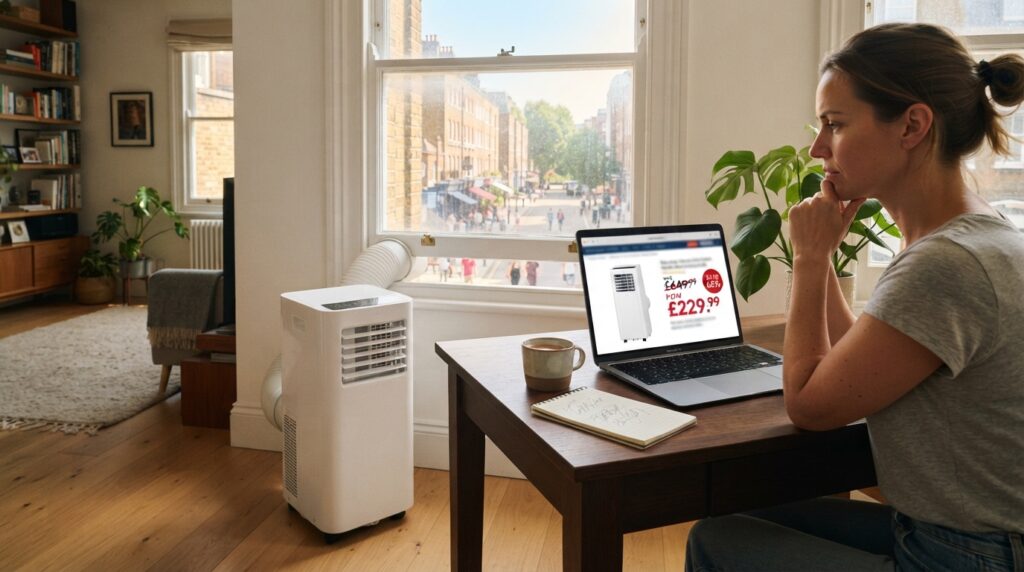
Check the price history, not the discount badge. A Which? analysis of 201 home and tech products advertised as Black Friday deals found that 92% were the same price or cheaper in the six months beforehand, and only 1% were at their cheapest on the day. A separate Which? investigation found 49% of tracked deals were not cheapest on Black Friday itself. UK rules do require a “was” price to reflect a genuine previous selling price offered for a meaningful period — but enforcement is after the fact, so the check is yours to do.
This applies to any product, but it’s worth writing specifically for air conditioning because the category has a particular vulnerability: people buy under time pressure during a heatwave, when judgement is worst and scarcity is real. That’s the ideal condition for a discount claim to go unexamined.
What the data actually shows
Two independent pieces of Which? research are worth knowing.
The first tracked 201 home and tech products advertised as Black Friday deals across UK retailers. In the six months before the event, 92% were available at the same price or cheaper. Only 1% were at their cheapest on Black Friday itself. Which?’s own conclusion was that access to deals all year round is no bad thing, but it means you should feel less pressured to buy on dedicated sales days — and that “time-limited” claims deserve scepticism, because it usually won’t be the last opportunity to buy at that price.
The second, earlier investigation tracked 178 deals across Amazon, AO.com, Argos, Currys and John Lewis, and found only 90 were cheapest on the day — 49% were not. Which? believed some retailers may have breached advertising rules by inflating “was” prices. In one example, a television’s advertised saving of £101 corresponded to an actual reduction of £1 on the day, while the same set had been available for £50 less for 18 days a couple of months earlier.
Neither finding means sales are worthless. Both mean the badge is not evidence.
What the rules actually require
UK pricing rules have tightened considerably, and it’s worth knowing where they stand.
The Digital Markets, Competition and Consumers Act 2024 (DMCCA) came into force in April 2025, replacing the previous Consumer Protection from Unfair Trading Regulations. It prohibits pricing practices that are false or misleading in a way likely to cause the average consumer to take a decision they wouldn’t otherwise have taken — and notably, a practice can be unfair because of its overall presentation even if every individual statement is factually correct.
It also gave the CMA direct enforcement powers for the first time: the ability to decide whether consumer law has been broken without going to court, to order compensation, and to fine businesses up to 10% of global turnover.
On reference prices, the CMA’s position is that a “was” price must reflect a genuine previous selling price offered for a meaningful period. Guidance for traders has long treated 28 consecutive days as the working benchmark. Advertisers are expected to consider how long the product was on sale at the higher price compared with the promotional period — and providing time-period information without unit sales data has been ruled insufficient to substantiate that a reference price was genuine.
Countdown timers and false urgency are explicitly in scope. Misleading countdown timers are a banned commercial practice under the DMCCA. In a cross-economy review of more than 400 businesses across 19 sectors, the CMA identified potential compliance concerns in 14 sectors, including drip pricing and misleading countdown timers, and in November 2025 opened its first DMCCA enforcement investigations alongside advisory letters to 100 firms.
The five checks
1. Look at the twelve-month price curve
Browser extensions and price-tracking sites plot an Amazon listing’s price over time. This single check answers the question the discount badge is designed to obscure: what has this actually cost over the past year?
What you’re looking for: whether the “was” price is a level the product genuinely sat at for months, or a brief spike that appeared shortly before the sale.
2. Apply the 28-day test
If the higher price only existed for a fortnight before the promotion, it isn’t a meaningful reference point. Some retailers display the date from which the “was” price was taken — where they do, read it.
3. Ignore the timer
If a countdown resets the following day, or the same “ends midnight” offer is still running next week, treat that as a red flag rather than a reason to hurry. Genuine stock and time limits must be accurate and verifiable.
4. Check the total price, not the headline
Under the DMCCA, mandatory charges must be included in the price shown upfront — drip pricing, where unavoidable fees appear later in the checkout journey, is prohibited. Air conditioners are bulky and delivery can be a meaningful cost, so confirm what you’re actually paying at checkout, and whether sale-item delivery or returns terms differ from the retailer’s normal ones.
5. Compare across retailers, not across time
A 40% discount at one retailer means nothing if another sells the same unit for less at full price. For a specific model, check two or three sellers before accepting any discount as good.
Category-specific traps for air conditioning
BTU inflation. Capacity claims aren’t always comparable between brands, and an unusually cheap unit with an unusually high BTU figure deserves scrutiny. Size using our BTU calculator guide and treat outlier claims sceptically.
Missing accessories. Check the window kit and exhaust hose are included. Buying these separately afterwards erodes the saving, and a unit without a usable window kit is unusable.
“Air purifying” claims. Frequently describe nothing more than the standard mesh pre-filter every portable unit already has. Our air purification guide covers what genuine filtration would require.
Cooling-only sold as year-round. Only reverse-cycle heat pump models heat. “3-in-1” or “4-in-1” typically means cool, fan, dehumidify — not heat. Our heat pump guide covers the distinction.
Buying the wrong size because it’s the discounted one. The most expensive mistake available. An undersized unit runs continuously without reaching a comfortable temperature, costing more in electricity while performing worse.
Where the genuine value is
The reliable saving in this category isn’t a discount percentage — it’s buying out of season. Demand collapses after September and doesn’t recover until May, so retailers clear seasonal stock in autumn and winter at prices that don’t need a badge to be good.
The corollary: during a declared heatwave, prices firm and stock disappears. UK retailers reported air conditioner and fan supply running low during the June 2026 heatwave amid a buying frenzy. Our buying timing guide covers the calendar.
What to buy, once the price checks out
MeacoCool MC Series 9000
Known quantity
51–55 dB
~£349
British brand
Part of why we keep recommending established brands: a long price history to check against, published specifications that hold up, and accessible UK support if something goes wrong. Right-sized for most UK bedrooms up to around 25m².
ElectriQ Eco Silent 12000
Genuine heat pump
53 dB
A-rated
Heat pump
A genuinely reverse-cycle unit rather than a “4-in-1” that doesn’t actually heat — worth knowing when comparing against listings that use the language loosely. Suits rooms up to around 28m².
If you think a price claim was misleading
- Report to the ASA if the issue is an advertisement, including online listings and marketing emails.
- Report to Trading Standards, via the Citizens Advice consumer service, for pricing practices generally.
- The CMA takes intelligence on pricing practices, and has been actively enforcing since April 2025.
All three are linked in the sources below.
Frequently asked questions
Are Black Friday air conditioner deals ever genuine?
Yes — and this category is better than most, because late November is a genuine seasonal low for demand. The point isn’t that all sales are fake; it’s that the badge doesn’t tell you which is which. Check the curve.
Is a price-tracking extension safe to install?
Reputable ones are widely used, but they do see your browsing on shopping sites by design. Check permissions and reviews before installing, and prefer well-established tools over obscure ones.
What if the price drops shortly after I buy?
Some retailers operate price-promise schemes; most don’t obligate a refund of the difference. Check the specific retailer’s policy at the point of purchase rather than assuming.
Does this apply to marketplace sellers as well as the retailer itself?
Yes. The CMA’s final price transparency guidance confirms that responsibility extends across the commerce chain — including online marketplaces, price comparison sites and influencers, not only the direct seller.
Compare current prices, stock and reviews on portable air conditioners at Amazon UK.
Sources
- Statista / Which? — Black Friday price analysis UK (201 products; 92% same price or cheaper; 1% cheapest on the day; Which? commentary)
- BBC News — Black Friday: Which? warns ‘bargain’ hunters to beware (178 deals; 49% not cheapest; 28-day rule; retailer examples)
- CMA / GOV.UK — CMA launches consumer protection drive on online pricing practices (400-business review; 14 sectors; banned practices; 10% turnover fines)
- Chartered Trading Standards Institute — Guidance for Traders on Pricing Practices (DMCCA; misleading pricing; overall presentation test)
- Advertising Standards Authority — Make a complaint
- Citizens Advice — Report to Trading Standards
- GOV.UK — Accepting returns and giving refunds: the law
Related reading: our Black Friday guide, January sales guide, and buying timing guide.