Does Heat and Humidity Damage Vinyl Records, Books and Guitars?
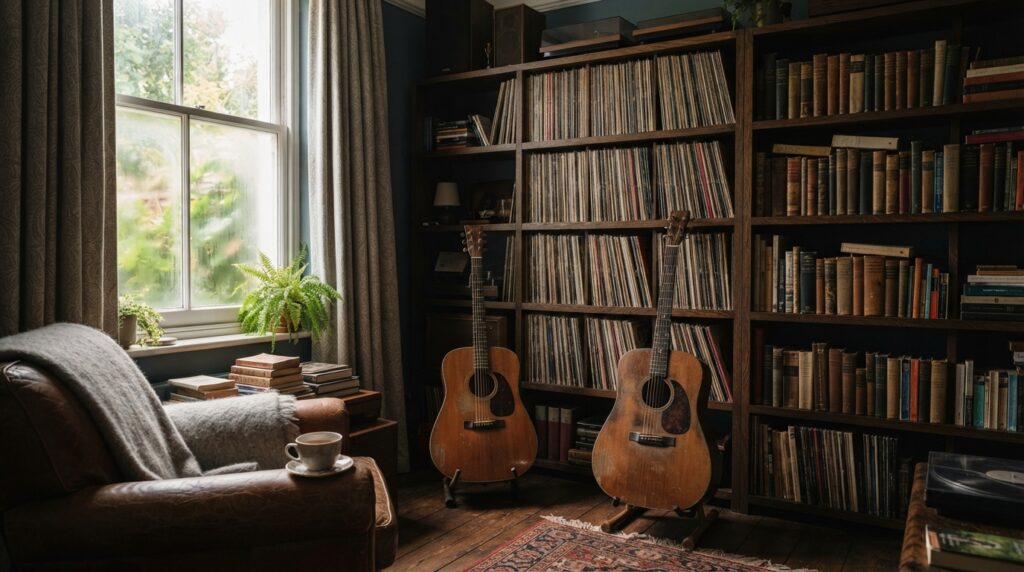
Yes, and the damage is cumulative rather than dramatic. The Library of Congress recommends storing books somewhere cool (around 21°C or below) at 30–55% relative humidity, and records somewhere cool and drier still, around 35–40%. Taylor Guitars puts the ideal for instruments at 45–55%. Notice how much those ranges overlap: a room that’s comfortable for you at a stable temperature and middling humidity is broadly right for all three. The real enemies are sustained warmth, high humidity, and repeated swings between extremes — which is exactly why lofts, garages and conservatories are the worst places in a British house to keep any of it.
Most people worry about a heatwave in terms of sleep and electricity bills. If you’ve got a record collection, a wall of books or an instrument you care about, there’s a quieter cost that only shows up years later. None of this requires a climate-controlled vault — but it does mean thinking about which room things live in.
Books: warmth speeds up the chemistry
The Library of Congress’s guidance for home collections is that a cool environment, around 21°C (70°F) or below, at 30–55% relative humidity is safe for most books. The reason is that those conditions slow the ageing of paper and cover materials, protect against mould growth, and reduce physical stress on the binding. Extended warm temperature combined with high humidity does the opposite and accelerates deterioration.
Its advice on where is blunt: attics, basements and garages are discouraged, because they have unsuitable temperatures and humidity and a higher risk of leaks and floods. That’s a fair description of a British loft in July, and of a lot of boxed-up book storage. It also warns against anywhere with frequent extreme swings in temperature or humidity, which matters more than most people expect — stability is its own form of protection.
Vinyl: cool, dry, and standing up straight
Its storage advice is just as specific: store discs upright, on edge, with sturdy immovable dividers every 4–6 inches that support the entire face of the disc in its sleeve. Warmth and leaning are what combine to warp a record. A shelf of records leaning at an angle in a hot room in August is the classic way to ruin a collection slowly.
Guitars and other wooden instruments: humidity more than heat
Taylor Guitars recommends 45–55% relative humidity. Too much moisture and the wood swells: the company describes glue joints failing, the finish lifting, neck angles going bad, action rising so the instrument becomes hard to play, and the tone going dull and lifeless from the extra water the wood is holding. It notes that some of that distortion can remain permanently even after repair.
The timescale is worth knowing, because it explains why people miss it. Taylor puts over-humidification at several weeks of exposure at 80–90% relative humidity, or several months at 60–70%. That isn’t a heatwave problem so much as a whole-summer problem, and in a damp UK house it can be a year-round one. The recommended defences are storing instruments in their cases, using silica gel, running a dehumidifier, and monitoring with a digital hygrometer.
What all three have in common
- Stability beats perfection. A room that sits steadily at 22°C and 50% humidity is kinder than one that swings from cold and damp to hot and dry every day.
- Know the number before you fix anything. All three sets of guidance are expressed in relative humidity, which you cannot judge by feel.
- The worst rooms are the obvious ones. Lofts, garages, conservatories and anywhere against an external wall that gets damp. Our loft heat guide explains why the top of the house runs hottest.
- Keep things out of direct sun and away from radiators and any air conditioner’s warm exhaust.
Rechargeable silica gel dehumidifier tubs
For cupboards, cases and shelves rather than whole rooms
Dried out and reused repeatedly
Sized for enclosed spaces
Silica gel is one of the options Taylor lists for controlling moisture around instruments, and the rechargeable tub version is the practical form for a home: it sits in an enclosed space, absorbs moisture, and is then dried out in an oven or on a plug and used again. It’s for small, closed volumes — a guitar case, a cupboard, a cabinet of records — not for a whole room, which needs a proper dehumidifier. Check the stated coverage on the listing against the space you’re actually treating.
Good for: instrument cases, cupboards and display cabinets; places with no socket; reusable and low-cost over time.
Less good for: rooms of any size, where you want a real dehumidifier instead. It also needs recharging on a routine, which is easy to forget.
Where air conditioning actually helps
An air conditioner does two useful things here at once: it lowers the temperature, and it removes humidity as a normal part of cooling. For a room holding books, records or instruments in a hot, sticky spell, that combination moves conditions towards all three recommended ranges rather than away from them. The caveats are the ones above — keep the warm exhaust and the cold airflow away from the things themselves, and don’t let the room swing wildly between air-conditioned and sweltering, since the guidance for all three warns about fluctuation. If damp rather than heat is your year-round problem, our air conditioner versus dehumidifier comparison is the more useful read.
Frequently asked questions
What humidity should I keep a room at for records and books?
The Library of Congress suggests about 35–40% relative humidity for records and 30–55% for books, both in a cool, stable environment. Taylor Guitars recommends 45–55% for instruments, so a room held steadily in the mid-40s suits a mixed collection reasonably well.
Is a loft a bad place to store books and records?
Yes. The Library of Congress specifically discourages attics, basements and garages because of unsuitable temperatures and humidity and the higher risk of leaks and floods.
Can high humidity really damage a guitar?
Taylor Guitars describes wood swelling, glue joints failing, finish lifting, neck angles changing and tone going dull, with some distortion remaining permanently. It puts the timescale at several weeks at 80–90% relative humidity or several months at 60–70%.
Why do records warp in summer?
Heat softens the disc, and anything that pushes it out of flat while it’s warm — leaning on a shelf, stacked flat, or up against a warm surface — does the rest. The Library of Congress recommends storing discs upright on edge with dividers every 4–6 inches, away from radiators and vents.
Sources
- Library of Congress — Storing your books
- Library of Congress — Care, handling and storage of audio discs
- Taylor Guitars — Symptoms of a wet guitar
Related reading: our dehumidifier guide, room thermometer and hygrometer guide and why your house smells musty in summer.
Compare current rechargeable silica gel dehumidifier tubs at Amazon UK.