Best Gutter Cleaning Tools Before Winter (UK)
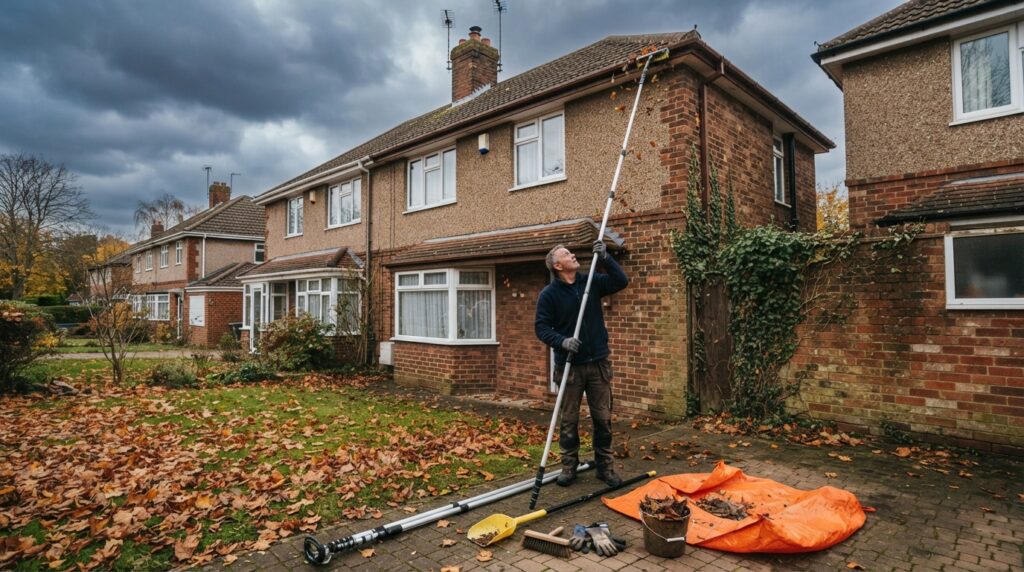
Gutters full of autumn leaves are what turn winter rain into damp walls, and freeze into ice dams that lift roof tiles. The three tools worth owning: a hooked gutter scoop on a long telescopic pole for bungalows and low sections, a gutter attachment for a wet-and-dry vacuum for anyone with a serious build-up, and a curved gutter hose attachment for a final flush. Do it once in late October or early November, after the leaves have dropped but before the first freeze. If you have to use a ladder, get someone to foot it.
A gutter’s job is to move a lot of water away from your walls very quickly. Blocked with leaves, twigs and moss, it spills water directly onto the brickwork, which stays wet all winter, and freezes back into blocks that push roof tiles off their battens. Clearing them is one of the highest-value autumn tasks. Here’s the kit that makes it doable without a ladder for most homes.
The safety point first
Every autumn brings a wave of ladder-fall injuries. Before spending a penny on tools, decide whether you’re comfortable working at the height your gutters sit at. If you’re not, hire someone. If you are, don’t work alone: someone to foot the ladder, and someone to know you’re up there, is the minimum. Never lean out to reach further — move the ladder.
Tool 1: telescopic gutter scoop
A hooked scoop on a lightweight telescopic pole is the “from-the-ground” option. It works well on single-storey extensions, bungalows, garages and porch roofs. You stand on the lawn and drag debris out of the gutter section by section, dropping it on a tarp for easy tidy-up. Doesn’t need power, doesn’t need a ladder, doesn’t cost much.
A telescopic gutter scoop and pole
Clears low gutters from the ground
Hooked scoop pulls leaves out
Breaks down for storage
Look for a pole that extends to a real working height once you factor in a metre of your own reach — a “6m” pole plus a person is enough for most bungalows and single-storey extensions. Aluminium or fibreglass poles are stiffer than plastic and don’t sag as they extend. A hooked scoop is more useful than a rigid one, since it can drag debris rather than push it. Store it in a garage or shed — poles left outside kink in frost.
Good for: single-storey extensions, garages, bungalows; renters and first-time DIYers; keeping both feet on the ground.
Less good for: reaching two-storey gutters or over-conservatory sections. Very compacted moss may need a stiffer tool.
Tool 2: wet-and-dry vacuum gutter attachment
If your gutters get badly clogged every year — overhanging trees, moss growth, the whole “handful of black sludge” experience — a wet-and-dry vacuum with a curved gutter attachment pole is the tool worth owning. You clip the extension pole and hooked nozzle onto a standard wet vac, stand at ground level, and suck the whole gutter clean. It handles wet leaves that a scoop just pushes around.
A wet-and-dry vacuum gutter attachment
Suck out wet leaves without climbing
Curved nozzle reaches into the gutter
Extension pole for height
Check that the attachment fits your specific wet vac’s hose diameter before buying — common UK sizes are 32mm and 35mm. Look for a rigid extension pole rather than a flexible hose, because a flexible one won’t hold its shape at height. Wet leaves are heavy, so use a vac with a decent capacity or empty it often. If you don’t own a wet vac, this becomes an expensive one-off — consider hiring one for a day.
Good for: gutters near overhanging trees; wet compacted debris; anyone who already owns a wet-and-dry shop vac.
Less good for: households with no wet vac (a whole vac plus attachment gets expensive). Won’t reach onto very high roofs.
Tool 3: gutter hose flush attachment
A curved hose-end that hooks over the gutter edge and points water back along the gutter is the final-flush tool: run water through it to shift the last of the fine grit and check the downpipes are clear. It’s cheap, tidy and works with an ordinary garden hose. Not enough on its own for a badly clogged gutter, but useful as the finishing step after scooping or vacuuming.
The routine
- Late October or early November, after the leaves have dropped from the trees over your house, but before the first sustained frost.
- Lay a tarp under the work area so debris is easy to gather.
- Scoop or vacuum gutter section by section, working from the closed end towards the downpipe.
- Check the downpipes aren’t blocked at the top. A downpipe brush on a rod clears the first metre; anything worse needs a professional.
- Flush with a hose at the closed end to confirm water runs freely to the drain.
- Check the water hits the drain, not your patio.
Prevention: gutter guards
Mesh or brush inserts that sit in the gutter are supposed to keep leaves out while letting water through. They work — up to a point — but they don’t stop small debris and moss, and they need lifting out periodically anyway. For homes surrounded by mature trees they may be worth it; for others, an annual clear is usually the more practical option.
When to call a professional
- Two-storey and taller houses, or anything over 4–5 metres.
- Steep or slippery ground below the gutter run.
- Blockages inside downpipes or hoppers that don’t clear with a rod.
- Visible damage to gutters — sagging, leaking joints, split sections — that needs replacement, not cleaning.
- Any suspicion of asbestos gutters on older properties — do not disturb them yourself.
Frequently asked questions
When should I clean gutters in the UK?
Once a year at minimum, in late October or early November, after the trees have dropped their leaves but before the first sustained frost. Homes surrounded by mature trees may need a second clear in spring.
Can I clean gutters without a ladder?
For single-storey extensions, garages and bungalows, yes — a telescopic gutter scoop or a wet-vac gutter attachment lets you work from the ground. For two-storey and taller houses, you either need a proper ladder with someone footing it, or a professional.
Are gutter guards worth fitting?
They help but don’t eliminate cleaning — small debris still gets through, and moss grows on top. In homes surrounded by mature trees they can extend the interval between clears; elsewhere an annual clean is usually the practical option.
Sources
- HSE guidance on ladder safety — Safe use of ladders and stepladders
Related reading: our storm-proofing your home, pipe lagging guide and 10 checks before turning on your heating.
Compare current telescopic gutter cleaning tools at Amazon UK.