Can You Run a Portable Air Conditioner From a Battery Power Station?
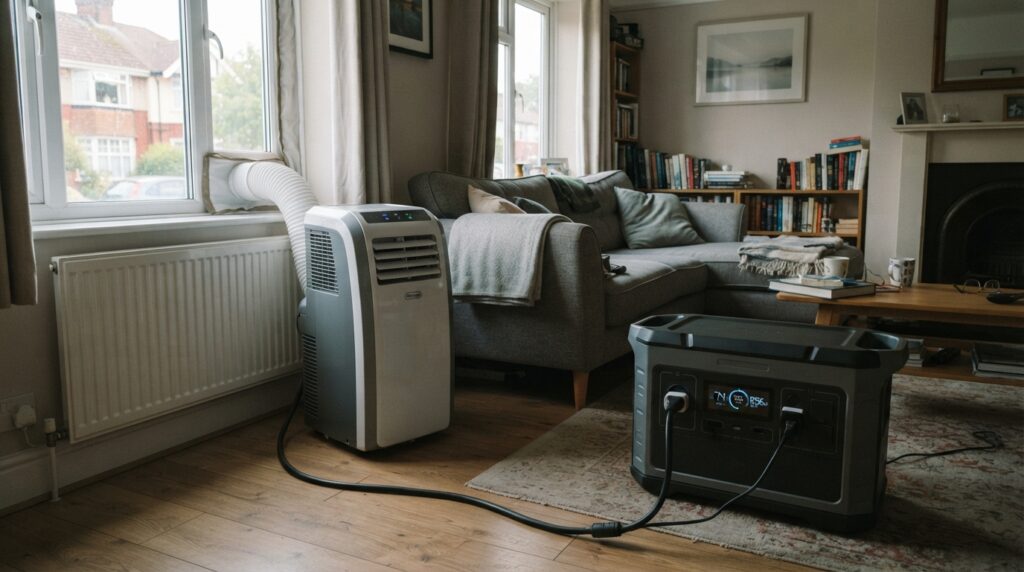
Technically yes, if the station’s continuous output rating and surge rating both comfortably exceed what your unit demands. Practically, the sums are sobering: air conditioners are among the most power-hungry things in a home, and a station large enough to run one for a full night costs considerably more than the air conditioner did. It makes sense for off-grid, campervan, boat and marquee use, and for pairing with solar. It doesn’t make sense as a way to dodge your electricity bill.
Battery power stations have become far more capable and far more common, and this question comes up every summer. Here’s how to work out whether yours can do it — and whether it’s worth it.
The two numbers that decide it
Look at your power station’s specification for both. Either one being too low means it won’t work.
1. Continuous output (watts)
The sustained load the inverter can deliver. It must exceed your air conditioner’s running wattage, with headroom.
Find your unit’s wattage on the rating plate. Portable air conditioners commonly sit somewhere in the region of 750W to 1,400W depending on capacity, though check yours rather than assuming.
2. Surge output (watts)
This is the one people miss. A compressor draws a spike of current at startup, well above its running figure. If the station can’t supply that spike, it’ll cut out the moment the compressor engages — often after appearing to work fine on fan mode.
Look for a stated surge or peak rating. If the specification doesn’t mention one, be cautious.
Working out the runtime
Simple arithmetic, and worth doing before buying anything.
- Take the station’s capacity in watt-hours (Wh).
- Divide by your unit’s running wattage.
- Reduce by roughly 10–15% for inverter losses.
Example: a 1,000Wh station running a 1,000W air conditioner gives you roughly one hour at full draw, less losses. A 2,000Wh station gives roughly two.
The mitigating factor: an air conditioner doesn’t run at full draw continuously. Once the room reaches temperature the compressor cycles, so real-world runtime is longer than the worst case — sometimes substantially, in a well-sealed room. But a hot room on a hot night means less cycling and more running.
To run one through a full summer night you’re looking at a large, expensive station. Do the arithmetic before you buy, not after.
Where it genuinely makes sense
- Campervans, motorhomes and conversions — the main use case, particularly with a rooftop solar setup and a decent leisure battery bank.
- Boats and narrowboats, where shore power isn’t always available. Our narrowboat guide covers the wider considerations.
- Marquees, gazebos and event spaces without mains access.
- Allotment sheds, workshops and garden buildings with no supply.
- Solar pairing at home — charging the station on free daytime generation and running the unit in the evening. This is the one home case with a real logic to it, and our solar guide covers whether it stacks up.
- Time-of-use tariffs — charging overnight on a cheap rate and discharging during the expensive part of the day. Worth modelling against your actual tariff before committing.
Where it doesn’t
- As a cheaper way to run air conditioning at home. You’re paying to store electricity you already bought, with conversion losses at both ends. Unless you’re arbitraging a genuine tariff difference or using surplus solar, it costs more.
- As power cut backup for cooling. Runtime is short, and cooling isn’t usually the priority during an outage. Our power cut guide covers what actually matters — and note that most grid-tied solar shuts down in a power cut unless specifically fitted with backup capability.
- To avoid an electrician. If the real problem is that there’s no socket in the room, the answer is a socket — not a battery. Our electrical safety guide covers why.
Making a small station go further
If your capacity is limited, this is where the effort pays off:
- Buy the smallest unit that will do the job. Counterintuitive, but a correctly sized unit that cycles beats an oversized one. Our BTU sizing guide covers it.
- Seal the space properly. In a van or small room, every gap is load you’re paying for from a finite battery. This matters far more off-grid than on mains.
- Insulate and shade first. Reflective window covers on a van make an enormous difference and cost nothing to run.
- Pre-cool while you’re plugged in or generating, then let the space coast.
- Use eco or sleep mode if the unit has one.
- Set a realistic temperature. Every degree lower is more compressor runtime and less battery. Our temperature guide covers sensible settings.
- Consider a fan instead overnight. A fan draws a tiny fraction of the power and can run all night on a modest station. For many situations that’s the honest answer.
Battery station versus petrol generator
Both come up for off-grid cooling. They’re not equivalent.
- Battery station: silent, no fumes, usable indoors, no fuel, limited runtime, higher cost per watt-hour.
- Petrol generator: long runtime with fuel, cheaper per watt, but noisy, and must never be run indoors or in any enclosed space.
For a campsite or a boat, the battery station usually wins on liveability — you can run it at 2am without a CO risk or a row with your neighbours.
Frequently asked questions
Can I run one from my car’s 12V socket?
No. A car accessory socket typically supplies a small fraction of what an air conditioner needs. You’d need a substantial inverter wired directly to the battery, and running that with the engine off would flatten it quickly.
Will a “solar generator” run it all day for free?
Only if your panel array can generate as fast as the unit consumes, which needs considerably more panel area than most portable kits provide. In practice you charge when the sun’s strong and draw down when it isn’t. Treat headline claims sceptically and check the panel wattage against your unit’s draw.
What about a 12V DC air conditioner?
DC units designed for vehicles and boats avoid the inverter losses and are generally more efficient for off-grid use. They’re a different product from a domestic portable and are usually installed rather than plugged in. Worth investigating if this is for a van or boat rather than a house.
My station has the right wattage but the unit still cuts out. Why?
Almost always the startup surge exceeding the inverter’s peak capability, or a low-battery cut-off. Check the surge rating, and check whether the station reduces output at low charge.
Compare current prices, stock and reviews on portable air conditioners at Amazon UK. Check the wattage on the listing against your power station’s continuous and surge ratings before ordering.
Sources
- Electrical Safety First — Electrical safety around the home
- Electrical Safety First — Lithium-ion battery safety
- HSE — Carbon monoxide in the home (generator safety)
- Energy Saving Trust — Solar panels
- Ofgem — Energy price cap (unit rates for cost comparisons)
Related reading: our generator guide and narrowboat guide.