“Self-Evaporating” Air Conditioners: Do You Still Have to Empty the Tank?
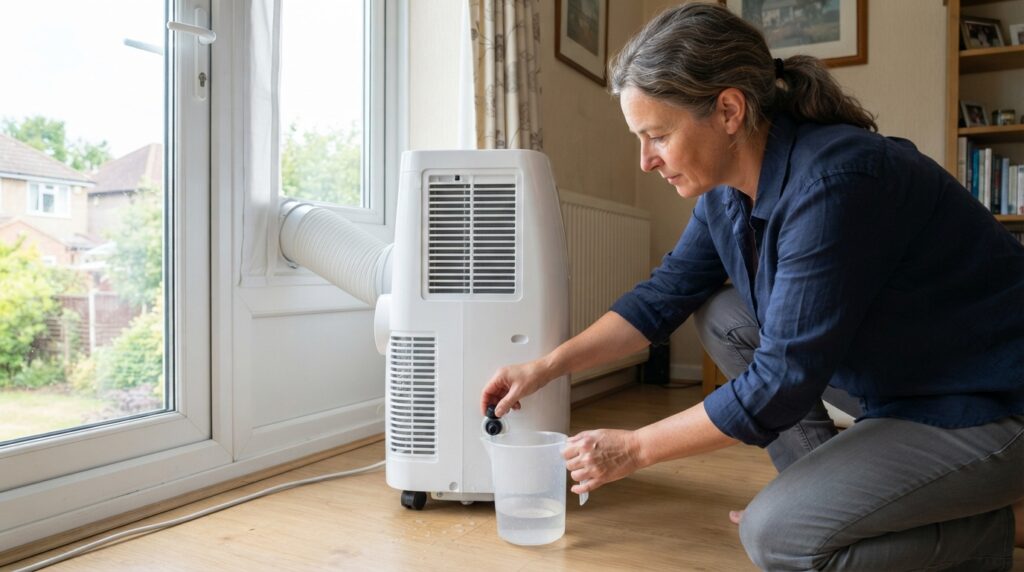
Usually you’ll empty it far less often — sometimes never in a dry spell — but “self-evaporating” doesn’t mean “no water, ever”. These units recycle condensate onto the hot condenser coil and blow the resulting vapour out through the exhaust hose. That works well when the air is moderately humid. On a muggy British day the unit collects water faster than it can evaporate it, the reserve tank fills, and the machine shuts down until you drain it — often at 3am. The reliable fix isn’t a particular model; it’s setting up continuous drainage.
This is one of the more misleading phrases in portable air conditioner marketing, and it causes a specific and irritating failure: the unit stops overnight and you wake up hot.
Where the water comes from
Every air conditioner dehumidifies as an unavoidable by-product of cooling. Warm room air passes over a cold evaporator coil, and moisture in that air condenses onto it — the same reason a cold drink sweats on a summer day.
That water has to go somewhere. Older portable units simply collected it in a tank for you to empty. Modern ones try to be cleverer.
How self-evaporating actually works
The condensate is picked up and sprayed or slung onto the hot condenser coil — the part that’s rejecting heat to outside. The water evaporates there and leaves through the exhaust hose as vapour.
There’s a genuine bonus: evaporating that water absorbs heat from the condenser, which makes the unit slightly more efficient. It’s a sensible bit of design, not just a convenience feature.
The limit is that the condenser can only evaporate water at a certain rate. If the room air is humid enough that condensate arrives faster than that, the surplus goes into a reserve tank. Fill the tank and the unit stops, usually with a “tank full” light or error code.
Why UK weather is the awkward case
Self-evaporation works best in moderate humidity. British heatwaves are frequently muggy — and a muggy night is exactly when you’re most likely to be running the unit for eight hours unattended.
So the pattern people report is consistent: fine during the day, shuts down in the small hours of a humid night. It isn’t a fault, and it isn’t a bad unit. It’s the design meeting conditions it can’t fully handle.
Our “feels like” guide covers why UK humidity varies so much between hot spells.
The fix: continuous drainage
Almost every portable air conditioner has a drain port, and most people never use it. It’s the single best thing you can do about this problem.
How it works: instead of collecting water, you attach a hose to the drain port and run it somewhere it can discharge. The unit then never fills, never shuts down, and needs no attention.
Where to run it:
- Out of the window alongside the exhaust hose, into a drain, gutter or a border — the simplest option, and it’s clean water.
- To a floor drain or shower tray if the unit’s near a bathroom.
- Into a container — better than nothing, though you’re back to emptying something, just a bigger something.
- To a condensate pump if there’s no downhill route. These are inexpensive, commonly used with fixed air conditioning and boilers, and they lift water to where it can drain.
Which mode you’re in matters
Water production varies considerably with what the unit is doing:
- Cooling mode — normal condensate production.
- Dry / dehumidify mode — deliberately maximises moisture removal, so the tank fills fastest. Many units require the drain hose to be connected in this mode. Our dry mode guide covers when to use it.
- Fan mode — no compressor, so no condensate.
- Heat pump / heating mode — produces condensate too, sometimes in different volumes and from a different part of the unit. Check your manual, because the drainage arrangement can differ.
Reading the specification honestly
Terms you’ll see, and what they mean in practice:
- “Self-evaporating” — recycles most condensate. Has a reserve tank. Will still fill in humid conditions.
- “Fully self-evaporating” / “no drainage required” — treat as marketing. Under sustained high humidity there’s a limit, and every such unit still has a shut-off.
- “Continuous drainage option” — this is the specification that actually matters. Look for it.
- “Auto shut-off when tank full” — a safety feature, not a flaw. Better than water on your floor.
When comparing models, the useful question isn’t how good the self-evaporation is — it’s whether continuous drainage is supported and easy to access. A unit with a well-placed drain port beats one with slightly better evaporation.
Looking after the tank and drain
- Empty and dry the tank at the end of the season. Standing water in a sealed unit over winter is the main cause of the musty smell people meet the following June — our smell guide covers it, and our storage guide covers the full routine.
- Check the drain port isn’t blocked by dust or debris.
- Keep the filter clean. A clogged filter reduces airflow, which affects coil temperature and how the unit handles moisture. Our maintenance guide covers the routine.
- Don’t drink the condensate or use it in an aquarium. It’s collected off a coil that’s had household air blown across it. Fine for watering ornamental plants or topping up an outside container, not for anything else.
If yours is leaking rather than filling
Different problem. Water appearing on the floor rather than in the tank usually means a blocked or disconnected internal drain line, the unit isn’t level, or a seal has failed. Our leaking water guide works through the causes.
Frequently asked questions
How often will I actually have to empty it?
Enormously variable — anywhere from never on a dry week to every few hours on a muggy night in dry mode. That variability is exactly why continuous drainage is worth setting up rather than hoping.
Can I leave it running overnight without draining?
On a self-evaporating unit in moderate humidity, usually yes. On a humid night, this is precisely when it shuts down. If you rely on it overnight — and bedroom cooling is where it matters most — set up continuous drainage.
Does the water tell me anything about my home?
A lot of water means high indoor humidity, which is worth knowing. Persistent high humidity contributes to condensation and mould — our damp guide covers it. A cheap hygrometer gives you the actual figure.
Can I use the water on the garden?
For ornamental plants, generally fine. Not for edibles, drinking, pets or fish — it’s been in contact with a coil and whatever your household air carries.
Compare current prices, stock and reviews on portable air conditioners at Amazon UK. Look for a continuous drainage option in the specification — it matters more than the self-evaporation claim.
Sources
- Met Office — Humidity
- Energy Saving Trust — Home appliances and energy use
- GOV.UK — Damp and mould: health risks
Related reading: our leaking water guide and maintenance guide.