Can I Plug a Portable Air Conditioner Into an Extension Lead?
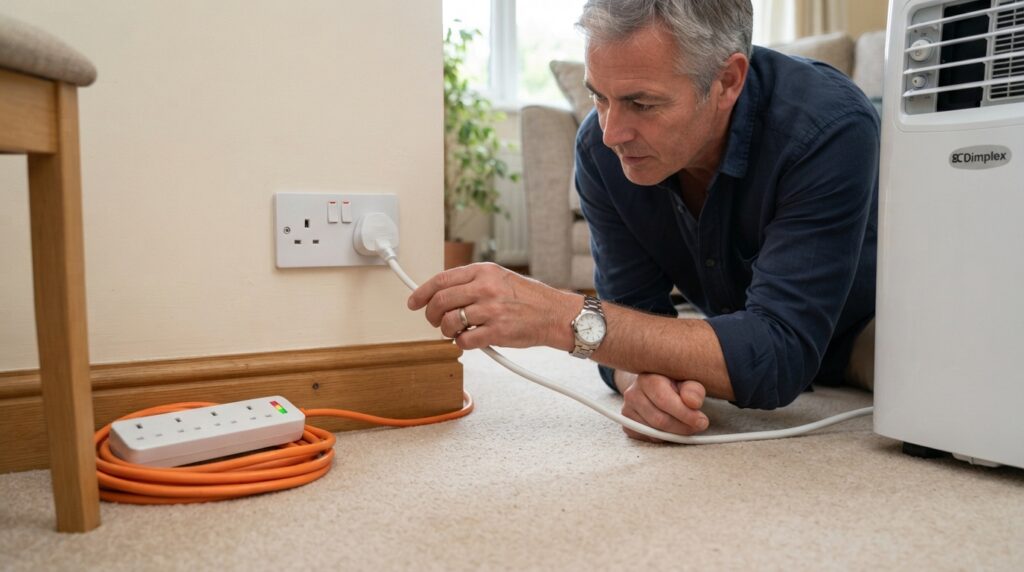
Manufacturers generally advise against extension leads, and they have good reason. The issue isn’t that it always fails — it’s that the failure mode is a fire. If your unit trips the breaker or blows a fuse, that’s almost always the circuit telling you something true: either too much load on one circuit, a coiled reel overheating, or a genuine fault. Treat a repeated trip as a fault to diagnose, not an inconvenience to work around.
This is one of those questions where the popular answer online is more relaxed than it should be. Here’s the version that takes the risk seriously.
Why air conditioners are different from most appliances
Two characteristics combine badly with cheap extension leads.
Sustained high current. A kettle draws a lot but for two minutes. An air conditioner draws a significant load for six hours at a stretch, often overnight while everyone’s asleep. Heat builds in a marginal connection over time.
Startup surge. The compressor draws a spike of current when it kicks in, considerably above its running figure — and it does this repeatedly, every time it cycles. That repeated surge is hard on connectors and is a common reason for nuisance tripping.
Add that a portable unit sits on the floor, often near a window, with the lead running across a room where it can be trodden on or trapped under a door, and you have the conditions that cause electrical fires.
Working out the load
Two minutes with a calculator tells you where you stand.
- Find the wattage on the rating plate or in the manual.
- Divide by 230 (UK mains voltage) to get amps.
A 1,000W unit draws roughly 4.3A. A 1,400W unit roughly 6A. That’s within a 13A plug’s rating on its own — but the plug isn’t the only limit. What matters is everything else on the same circuit and the same extension.
A typical UK ring final circuit serves a whole floor or a large part of one. Add an air conditioner to a bedroom already running a desktop PC, monitors, chargers and a heater, and you can approach the limit.
The coiled cable reel problem
This deserves its own section because it’s the one that catches people out, and it’s genuinely dangerous.
An extension reel left coiled generates heat that cannot escape. The windings sit against each other, and the heat produced by the current flowing through them has nowhere to go. Reels carry two ratings for this reason — a much lower one when wound, a higher one when fully unwound.
Running an air conditioner for hours off a partly-wound reel can melt the insulation inside the drum, where you can’t see it happening. Fire services deal with the consequences every year.
If you use a reel: unwind every last turn. Not most of it.
If your unit keeps tripping the breaker
Work through this in order. Don’t just reset it repeatedly — a breaker that trips is doing its job.
1. Identify what actually tripped
At the consumer unit, look at which switch has moved:
- An MCB (single circuit switch) → overload or short circuit on that circuit
- An RCD (usually a larger switch with a test button, covering several circuits) → an earth leakage fault, which is a different and more serious matter
An RCD tripping repeatedly when a specific appliance runs points to a fault in that appliance. Stop using it and get it checked.
2. Reduce what’s on the circuit
Unplug other high-draw items in the same area and try again. If it holds, you had an overload rather than a fault.
3. Remove the extension from the equation
Plug directly into a wall socket. If the tripping stops, the extension was the problem — either underrated, coiled, faulty, or overloaded.
4. Check the appliance itself
- A clogged filter makes the compressor work harder and run longer. Clean it — our maintenance guide covers it.
- An iced-up coil can cause the unit to labour. Our frozen coils guide covers the causes.
- Restricted airflow at intake or exhaust.
5. Call an electrician
If it still trips on a bare wall socket with nothing else running, that’s either a faulty appliance or a circuit problem. Both need someone qualified. A registered electrician can be found via NICEIC, NAPIT or the Electrical Competent Person register.
Doing it properly
If your only socket is across the room, the right fix isn’t a longer lead — it’s another socket.
Having an electrician add a socket is not expensive, it’s permanent, and it removes the trip hazard of a cable across a floor. In England and Wales, adding a new circuit is notifiable work under Part P of the Building Regulations; a registered electrician can self-certify. Our installation law guide covers the wider regulatory picture.
Worth doing if this is a room you’ll cool every summer.
Smart plugs: check the rating
Worth flagging, because it’s a common and hazardous mistake.
Plenty of smart plugs are rated well below 13A. Putting a high-wattage air conditioner through one that isn’t rated for it is exactly the kind of sustained overload that causes fires.
Check the maximum load on the smart plug before using it with an air conditioner or a heater. If it doesn’t clearly state a rating that comfortably exceeds your appliance’s draw, don’t use it. Our smart plugs guide covers this in more detail — they’re genuinely useful for scheduling, but only within their rating.
Frequently asked questions
Can I use it with a surge protector strip?
Only if the strip’s total rating comfortably exceeds the appliance’s draw and nothing else is plugged in. Most consumer surge strips are designed for computers and low-draw electronics, not sustained high-current appliances. A wall socket is better.
What size extension lead do I need if I have no choice?
A single heavy-duty lead with a clearly stated rating well above your appliance’s draw, the shortest length that reaches, fully unwound, with nothing else on it. Check the cable’s own rating, not just the socket count. If you can’t confirm the rating, don’t use it.
Is it safe to run overnight?
On a wall socket with a sound plug and a clean filter, this is normal use. On an extension lead, in a room where everyone’s asleep, with no working smoke alarm, it isn’t. Test your smoke alarms — that advice applies whatever you plug in.
Why does it trip only when the compressor starts?
The startup surge. If the circuit is close to its limit, that spike pushes it over. Reducing other load on the circuit usually resolves it; if it doesn’t, get an electrician to look.
Does a bigger BTU unit draw more power?
Generally yes. But an undersized unit running flat out for twelve hours can use more electricity overall than a correctly sized one that cycles. Our sizing guide covers getting it right.
Compare current prices, stock and reviews on portable air conditioners at Amazon UK. Check the wattage on the listing so you know what you’re asking your circuit to carry.
Sources
- Electrical Safety First — Overloading sockets (includes the socket overload calculator)
- Electrical Safety First — Extension leads
- National Fire Chiefs Council — Home fire safety
- GOV.UK — Approved Document P: Electrical safety
- Electrical Competent Person Register — Find a registered electrician
- NICEIC — Find a contractor
Related reading: our running cost guide and generator and power guide.