Do Ceiling Fans Need to Spin the Other Way in Summer?
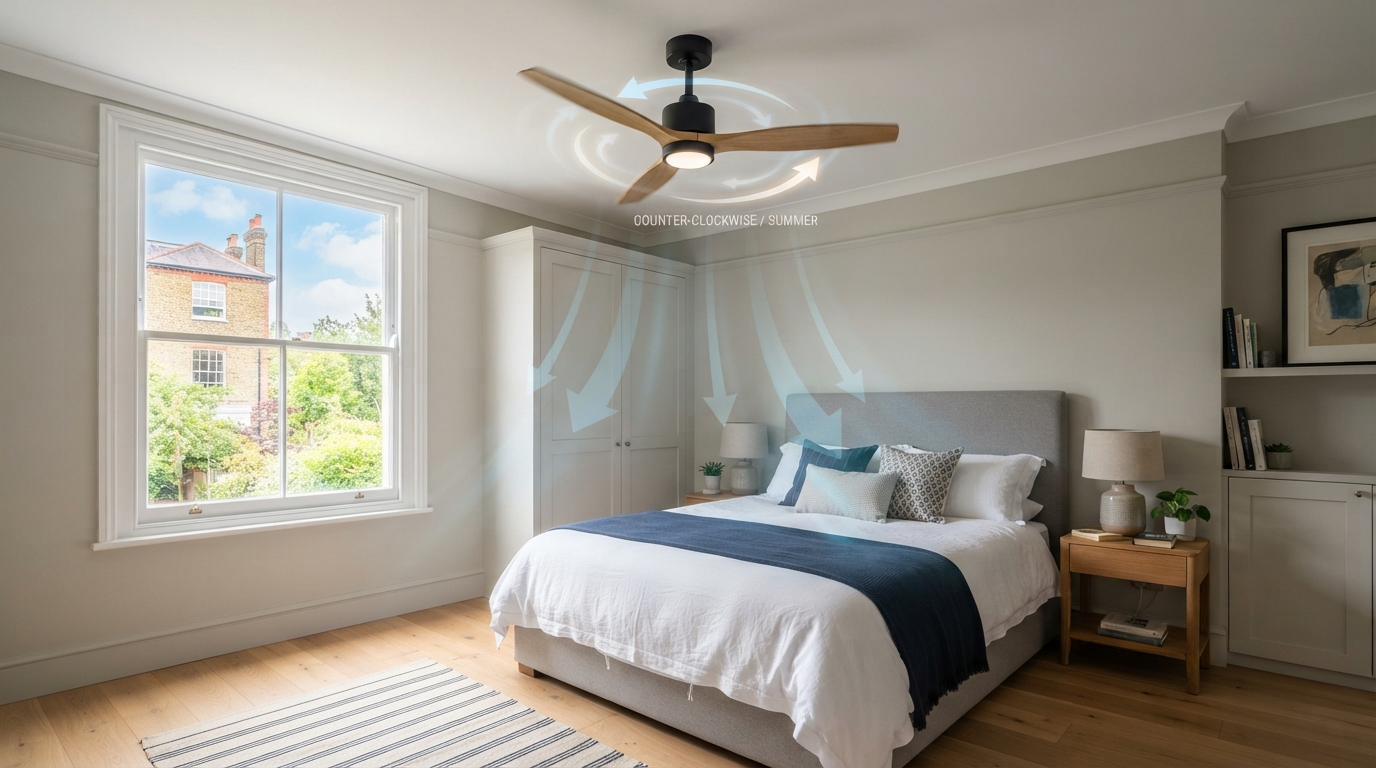
Yes — and for summer you want it blowing air straight down at you. In summer a ceiling fan should turn counter-clockwise when you look up at it, which pushes air downwards and creates the breeze that makes you feel cooler. In winter you reverse it to clockwise, on a low speed, which draws air up the middle of the room and eases the warm air pooled at the ceiling gently down the walls without creating a draught you can feel. Most fans have a small reverse switch on the motor housing, or a button on the remote. The easiest check takes five seconds: stand underneath it — if you feel a breeze on your face, it’s in summer mode.
This is one of the few bits of home-cooling folklore that’s completely true, and it costs nothing to act on. Here’s the mechanism, how to switch it, and an honest assessment of how much the winter setting actually achieves in a British house.
Summer mode: you want the downdraught
The key thing to hold onto is that a fan does not cool the air — it cools you. Moving air across your skin speeds the evaporation of sweat and carries warm air away from the surface of your body, which can make you feel several degrees cooler than the thermometer says. Our fan types guide covers this in more detail.
So in summer the whole objective is to get moving air onto people. Counter-clockwise rotation (viewed from below) drives a column of air straight down into the room, which is exactly what you want. Run it on a higher speed too — more airflow means more of that cooling effect.
Winter mode: destratification, not draught
The reverse setting works on a completely different principle, and it’s worth understanding rather than just flipping the switch on faith.
Warm air is less dense, so it rises and collects in a layer at the ceiling — a phenomenon called stratification. In a heated room that’s wasted warmth sitting where nobody benefits from it, and it’s more pronounced the higher your ceiling. Running the fan clockwise on a low speed pulls air up through the centre of the room and pushes that warm ceiling layer outwards and gently down the walls, mixing it back into the living space.
The critical detail is low speed. The entire point is to move the warm air without creating airflow you can feel — because a felt draught in winter makes you cooler, which is the opposite of what you’re after. If you can feel a breeze in winter mode, slow it down.
How to tell which way yours is turning
- Stand directly underneath it with the fan running at a decent speed.
- If you feel air pushing down on you, it’s counter-clockwise — summer mode. Correct for now.
- If you feel little or nothing directly below but notice air movement nearer the walls, it’s in winter (updraught) mode.
Watching the blades to judge the direction is surprisingly unreliable — the eye gets fooled by the blade angle and the motion. Feeling for the downdraught is much more dependable.
How to switch it over
- A physical slide switch on the motor housing — the most common arrangement. A small toggle on the body of the fan above the blades.
- A remote control button, often marked with a circular arrow or labelled “reverse” or “forward/reverse”.
- An app or smart control on newer DC-motor fans.
- Some older or cheaper fans don’t reverse at all. If there’s no switch and nothing in the manual, yours may be single-direction — in which case make sure it’s installed to give a downdraught, since summer cooling is the more valuable of the two functions.
Honestly: how much does the winter setting achieve?
The summer downdraught is straightforwardly effective — you feel it immediately, and it’s a genuine comfort gain for very little electricity.
The winter setting is more situational, and it’s oversold in a lot of articles. The benefit scales with ceiling height. In a room with a high, vaulted or double-height ceiling — a converted barn, a Victorian room with tall ceilings, a galleried landing — there’s a substantial warm layer up there and mixing it down makes a real difference to comfort and can let you run the heating a touch lower. In a standard modern room with a ceiling around 2.4m, there’s much less stratification to begin with, so the gain is modest at best. It’s free to try, but don’t expect it to transform a normal-height room.
The rule that matters more than direction
Turn a ceiling fan off when you leave the room. Because it cools people rather than air, a fan running in an empty room achieves nothing at all except adding a trace of motor heat and using electricity. This is the single most common ceiling fan mistake, and it costs more over a summer than getting the direction wrong.
The exception is winter destratification mode, where the point genuinely is to move the room’s air rather than to cool an occupant — though even then there’s little reason to run it in a room nobody’s using.
Getting more from a ceiling fan
- Size it to the room. A fan with too small a span for a large room won’t move enough air to be felt properly.
- Mounting height matters. Too close to the ceiling restricts airflow into the blades; too low is a hazard. Follow the manufacturer’s clearance guidance, and use a drop rod on a high or sloped ceiling.
- Clean the blades. They collect a remarkable amount of dust on the upper surfaces, which then gets flung around the room when you switch to a higher speed — and unbalanced dust build-up contributes to wobble. Wipe them at the start of the season.
- Fix a wobble. Wobble usually means an unbalanced blade set or loose fixings. Most fans come with small balancing weights, and tightening the blade screws often solves it. Persistent wobble is worth investigating rather than ignoring.
- Combine it with everything else. A fan makes a room feel cooler but doesn’t reduce the heat coming in — shading and night ventilation do that, as our no-AC cooling guide explains. A fan alongside an air conditioner also lets you set a higher, cheaper temperature while feeling just as comfortable.
Fitting one
Installing a ceiling fan is fixed electrical work and needs to be done properly — new or altered circuits in a home are notifiable under Building Regulations Part P, and a fan needs a ceiling fixing capable of carrying a moving load, which a standard plasterboard rose is generally not. Use a qualified electrician. If you’re in a rented property you’ll need the landlord’s permission, and in a leasehold flat check your lease. Our fan types guide compares ceiling fans with the freestanding options if fitting one isn’t practical.
Frequently asked questions
Which way should a ceiling fan turn in summer?
Counter-clockwise when viewed from below, so it pushes air downwards and you feel a breeze. Run it at a higher speed in summer — the airflow on your skin is what cools you.
How do I check the direction without guessing?
Stand underneath it while it’s running. If you feel air pushing down on you, it’s in summer mode. Watching the blades is unreliable because the motion and blade angle fool the eye.
Does the winter setting really work?
It genuinely helps in rooms with high or vaulted ceilings, where a lot of warm air collects up top. In a standard 2.4m room there’s much less stratification and the benefit is modest. Run it slowly either way, so you don’t create a draught.
Does a ceiling fan cool a room?
No — it cools people by moving air over skin. In an empty room it does nothing useful, so switch it off when you leave. It pairs well with air conditioning, letting you use a higher set point comfortably.
My fan has no reverse switch — is that a problem?
Not really. Some fans are single-direction. Summer downdraught is the more valuable function by far, so as long as it blows air down when running, you have the setting that matters.
Sources
- Energy Saving Trust — Keeping your home cool in summer
- GOV.UK — Approved Document P: Electrical safety
- NHS — Heat exhaustion and heatstroke (fans in extreme heat)
Related reading: our fan types guide and fan vs air conditioner guide.
A pedestal or tower fan gives you the same airflow with no installation. Compare current options at Amazon UK.