Emergency Kit for Dogs and Cats: What Your Pet Needs for 3 Days (UK)
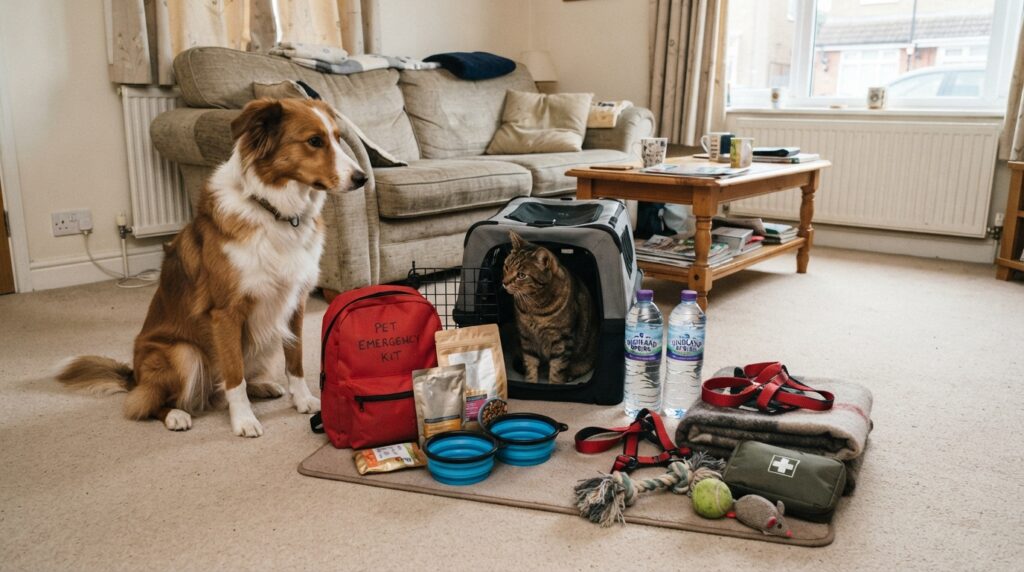
The government’s Be Ready checklist lists “pet food and bottled water”. Council emergency planners go further and recommend keeping at least 3 days’ food and water per pet, food in an airtight, waterproof container, plus medication, a lead or carrier, poo bags or litter, vet and vaccination records and a recent photo. Vets say dogs typically drink 20–70ml per kg of body weight a day, so allow up to 2.1 litres for a 10kg dog or 6.3 litres for a 30kg dog over 3 days. Cats Protection says a 4kg cat needs about 200ml a day. Check your pet’s microchip details are up to date, and plan where your pet would go, as not every emergency rest centre accepts animals.
Since the government launched its Be Ready campaign on 22 October 2026, households have been asked to prepare for 3 days of disruption, such as a power cut, flood or water outage. But the checklist gives pets just one line. If you have a dog or cat, they need their own kit: their own water, food that won’t spoil, their medicines, and a way to move them safely if you have to leave home. This guide brings together the advice from UK councils, animal charities and fire services.
What the government’s checklist says
Be Ready lists “pet food and bottled water” under “pet products”. Its other pages add:
- Water: “Additional water might be needed to make up baby formula, for medical devices and for pets.” Its 3 litres a day is per person, so pet water is on top.
- Flooding: “Move your family, vehicles, pets and important items to safety, for example upstairs or to higher ground.”
- Assistance animals: “Have a plan for your assistance animal”. Their grab bag should hold “supplies of food and water, a lead/harness, necessary medicines”, and they should wear “a collar with an identification tag”.
The 3-day pet emergency kit
This list draws on the pet emergency plans published by UK councils and local resilience forums, including Forest of Dean District Council and Norfolk Prepared, and on advice from PDSA, Blue Cross and the RSPCA.
| Item | Why |
|---|---|
| Food for at least 3 days | Forest of Dean District Council says to store it “in an airtight, water-proof container” |
| Water for at least 3 days | “Specifically for your pets”, on top of your own |
| Bowls | PDSA suggests collapsible bowls |
| Medication | An extra supply, plus the details needed to get more |
| Lead, harness or carrier | PDSA says to always have a carrier for cats and small pets |
| Poo bags, litter and tray | Plus newspaper or paper towels |
| Documents in a waterproof bag | Microchip number, vet details, vaccination records, insurance |
| A photo of you with your pet | Norfolk Prepared says it “will help you prove ownership” if you’re separated |
| Bedding and a favourite toy | Blue Cross says stressed animals “welcome something that smells of home” |
| Pet first aid kit | Ask your vet what’s right for your pet |
How much water does your pet need?
Davies Veterinary Specialists says textbooks put normal water intake for dogs at “20-70 ml/kg body weight per day”. To be safe, we’ve used the top of that range. For cats, Cats Protection says a 4kg cat needs about 200ml a day and a 6kg cat about 300ml.
| Pet | Per day (up to) | For 3 days (up to) |
|---|---|---|
| 5kg dog | 350ml | 1.05 litres |
| 10kg dog | 700ml | 2.1 litres |
| 20kg dog | 1.4 litres | 4.2 litres |
| 30kg dog | 2.1 litres | 6.3 litres |
| 40kg dog | 2.8 litres | 8.4 litres |
| 4kg cat | 200ml | 600ml |
| 6kg cat | 300ml | 900ml |
Our calculation: dog weight x 70ml a day, x 3 days. Dogs drink more after exercise, in warm rooms, or if they eat dry food. Cats Protection says cats on wet food get “much of their water intake from their diet”. Round up, and add a little extra for washing bowls. For how to store water, see our guide to storing emergency drinking water.
Storing pet food for emergencies
- Dry food: Royal Canin says dry food “should be stored in their original bags and resealed between feeding”, inside “a dry, airtight plastic or steel container with a lid”. Purina says to keep it “in a cool, dry place, away from moisture, sun and heat”, and to avoid mixing packs in one container.
- Wet food: once opened, Royal Canin says to refrigerate it and use it within two days. In a power cut, your fridge won’t stay cold for long, so keep small tins or pouches that your pet will finish in one meal.
- Rotate it. Use the oldest food in everyday feeding and replace it, so your emergency stock stays in date. If your pet is on a special diet, keep extra of that food, as you may not find it in the shops during an emergency.
Medication and prescriptions
Forest of Dean District Council advises keeping “an extra supply of any medicine including any details that may be needed to re-supply”. Don’t let a repeat prescription run low going into winter.
If you’d like to buy medicine elsewhere, the Royal College of Veterinary Surgeons says vets can make “a reasonable charge” for a written prescription. During 2027, new Competition and Markets Authority rules will cap this charge at £21.40 for the first medicine. A written prescription for a vet-only medicine (POM-V) is usually valid for 6 months. Blue Cross warns: “never give pets human medicine as it could be fatal.”
Microchip and ID: check your details now
If your pet gets lost in an emergency, an up-to-date microchip gives you a better chance of getting them back. GOV.UK says:
- “All dogs in the UK must be microchipped and registered by the time they’re 8 weeks old.”
- In England, cats must be microchipped and registered by 20 weeks old, and “this includes cats that usually only stay indoors”. In Scotland, Wales and Northern Ireland, microchipping cats is optional.
- “You’re responsible for keeping your pet’s microchip information up to date, for example if you move house.” You can be fined up to £500 if your dog or cat isn’t microchipped when they need to be.
Dogs also need a collar tag. In England, Scotland and Wales, under the Control of Dogs Order 1992, dogs in public must wear a collar with the owner’s name and address on it or on a tag. Blue Cross recommends that all cats and dogs have both a microchip and an ID tag.
If you have to leave home
Evacuation is when pet planning matters most. The Environment Agency says “many centres will allow you to bring your pet”, but council policies vary:
- Fife Council says that at its rest centres, “you won’t be able to bring your pets”, and “only support animals will be allowed”.
- Forest of Dean District Council says that “depending on the location of the Rest Centre, animals may not be able to be accommodated”, but assistance animals “will, of course, be permitted”.
- Blue Cross says “some human shelters don’t allow animals so ring your local authority to check its policy.”
So arrange a back-up now, such as a friend or relative who would take your pet. If you leave, PDSA says to “take your pets and their emergency supplies with you”, with your dog’s collar and ID tag on. Blue Cross says to avoid leaving animals behind, “even if you think you’ve created a safe place for them”.
In a flood, the RSPCA says to bring small animals inside and, if possible, upstairs. If animals are stranded or in danger, “don’t try to rescue them yourself”. Call the RSPCA on 0300 1234 999 between 8am and 6pm, or the fire and rescue service on 999.
Pets in a winter power cut
- Dogs and cats: PDSA suggests “a few extra blankets for their bed” and to “raise beds off the floor, so they’re not sitting in a cold draught”. SP Energy Networks says “most pets will not be affected by a power interruption”.
- Small pets: PDSA says “all small pets should have extra bedding over winter”. The RSPCA says to move guinea pigs indoors in temperatures below 15°C.
- Tropical fish: UK Power Networks recommends a filter that can run off a battery-powered air pump, wrapping the tank in blankets, and disturbing the water surface for five minutes each hour. It also says to feed less, or not at all, while the power is off.
A basic pet first aid kit
Blue Cross suggests a self-adhesive or crepe bandage (5cm wide), surgical tape, cotton wool, non-adhesive absorbent dressings, blunt-ended curved scissors, a thick towel, an Elizabethan collar and sterile saline. It also says: “The best action for all emergency situations is to contact the vet.” Keep your vet’s number, and their out-of-hours number, on paper with your kit.
The kit worth buying
Kurgo Collaps-A-Bowl
Best for: a bowl that fits in a grab bag
Folds under 1 inch
Food-grade silicone
Kurgo says this bowl holds 24oz (about 710ml), collapses to less than an inch high, and is made of food-grade silicone that’s PVC and BPA free. It’s dishwasher safe on the top rack. Folded flat, it slips into a grab bag or coat pocket, and it doubles as a walk bowl the rest of the year.
Good for: grab bags; walks; car kits.
Less good for: food and water at once, as it’s a single bowl, so buy two. A big dog’s daily water (up to 2.1 litres for a 30kg dog) means several refills.
Curver Petlife airtight dry food container (23L)
Best for: keeping a stock of dry food fresh
Airtight seal
Small and large lid openings
Curver’s maker Keter lists this container at 23 litres, or 10kg of dry food, and says it’s “100% airtight”. It has two handles and a lid with a small and a large opening, and it stacks. A 54-litre, 20kg version adds wheels. Put the food in the container in its original bag, as Royal Canin advises.
Good for: storing a few weeks of dry food at home; rotating your stock.
Less good for: grab bags, as it stands 50cm tall. Care advice differs between sellers on whether it’s dishwasher safe, and some zooplus UK reviewers say the lid catch feels flimsy.
Steroplast Stero-Paws animal first aid kit
Best for: a compact pet first aid kit
Includes tick twister
13.5 x 10 x 8cm bag
Steroplast’s kit comes in a 13.5 x 10 x 8cm bag. It holds a cohesive bandage, a 5cm conforming bandage, a foil blanket, nitrile gloves, a resuscitation aid, scissors, two sterile eyewash pods, a gauze swab, saline wipes, a tick twister and tweezers.
Good for: grab bags; walks; a starting point for a fuller kit.
Less good for: anything more than minor injuries. There’s only one of most items, so top it up with extra dressings and bandages, and add anything your vet recommends.
Frequently asked questions
What should be in a pet emergency kit?
At least 3 days’ food and water, bowls, medication, a lead or carrier, poo bags or litter, vet and vaccination records, a photo of you with your pet, bedding or a toy, and a pet first aid kit.
How much water should I store for my dog?
Vets say dogs typically drink 20–70ml per kg a day. To be safe, allow 70ml per kg: about 2.1 litres for a 10kg dog over 3 days, or 6.3 litres for a 30kg dog.
Can I take my pet to an emergency rest centre?
It depends on your council. The Environment Agency says many centres allow pets, but some councils, such as Fife, don’t. Assistance animals are usually allowed. Check with your local authority, and arrange a back-up place for your pet.
Does my cat need to be microchipped?
In England, yes: cats must be microchipped and registered by 20 weeks old, including indoor cats. It’s optional in Scotland, Wales and Northern Ireland, but still recommended.
How do I keep my pet warm in a power cut?
Give them extra blankets and raise their bed off the floor, away from draughts, as PDSA advises. Give small pets extra bedding, and move outdoor hutches somewhere sheltered and out of draughts. The RSPCA says to bring guinea pigs indoors below 15°C.
Sources
- GOV.UK Be Ready — Be ready for emergencies, Water supply interruptions, Flooding and Advice for disabled persons and carers
- Forest of Dean District Council — Guidance for pet owners in an emergency (PDF); Norfolk Prepared — Prepare your pets for emergencies; Fife Council — Ready pets
- PDSA — Flood safety for pets, Winter advice and Household fire risks
- Blue Cross — Pets and floods, Flooding and pets (PDF), Basic first aid (PDF) and Pet emergency first aid tips
- RSPCA — Floods and Guinea pig environment
- Environment Agency — Personal flood plan
- Davies Veterinary Specialists — Increased drinking in dogs and cats; Cats Protection — How much water should cats drink?
- GOV.UK — Get your dog or cat microchipped; legislation.gov.uk — Control of Dogs Order 1992
- Royal Canin — FAQs; Purina — How should I store my pet’s food?
- RCVS — Consumer rights and freedom of choice and How long are written prescriptions valid for?; CMA — Veterinary Services Market Investigation Order 2026 (PDF)
- SP Energy Networks — Looking after your pets (PDF)
- Cambridgeshire Fire and Rescue — A fire in the home; UK Power Networks — Tropical fish in a power cut
- Kurgo — Collaps-A-Bowl; Keter — Curver dry food container; zooplus UK — Curver dry dog food container and reviews; Wayfair UK — Curver pet dry food container; Steroplast — Stero-Paws animal first aid kit
Related reading: how to store emergency drinking water, keeping dogs and cats cool when they’re home alone, keeping rabbits and guinea pigs cool and emergency kit items that expire.
Compare collapsible pet bowls and travel kits at Amazon UK.