How to Make Up Baby Formula in a Power Cut or When the Water Is Off (UK)
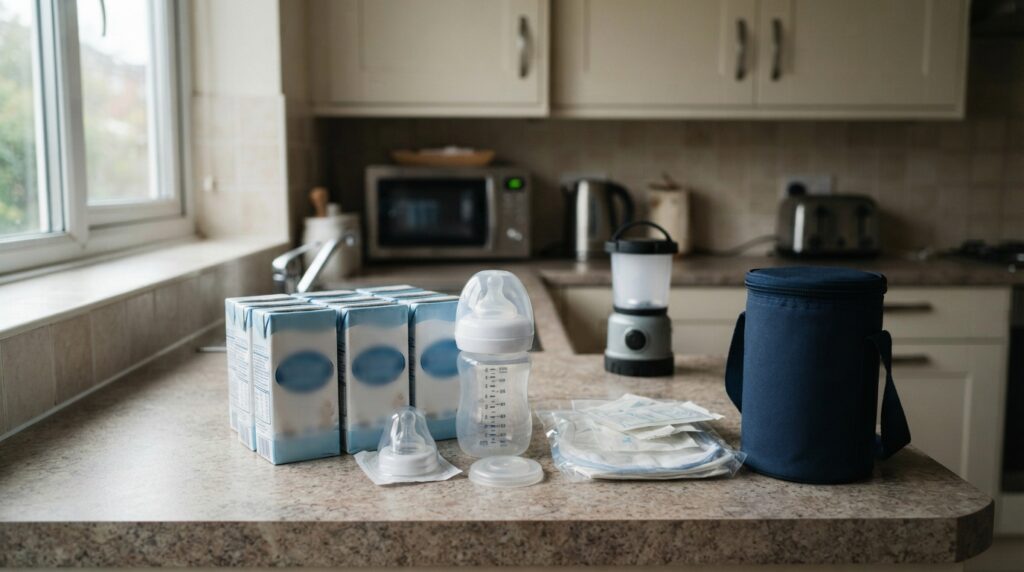
If you formula feed, keep some ready-to-feed liquid formula in your emergency kit. New Food Standards Agency (FSA) guidance, published on 2 November 2026, says that if both the water and electricity are off, use ready-to-feed “where possible as it does not require preparation with boiled water”. Bottles and teats still need to be sterilised, and you can do that without electricity using a cold-water sterilising solution. If you have to use powder, the water must still be boiled, for example on a gas hob, and used while it’s at least 70°C. That includes bottled water, which the FSA says “is not sterile”. Never use a camping stove or barbecue indoors. If you’re unsure what’s right for your baby, ask your health visitor or midwife, or call NHS 111.
The government’s Be Ready campaign, launched on 22 October 2026, asks households to be ready for 3 days without power or water. For most of us, that means bottled water and tins. With a formula-fed baby, it’s harder: powdered formula normally needs a kettle, clean tap water and a steriliser, and a power cut or a water outage can take away all three. This guide follows the FSA’s new guidance and NHS advice on what to do instead.
What the new FSA guidance says
On 2 November 2026, the FSA published guidance on preparing infant formula “where the mains water supply is not available, has been disrupted or is unsafe due to contamination”. The key points:
- “Where access to safe water is limited, use ready-to-feed formula where possible if you are formula feeding.”
- If water and electricity are both off, ready-to-feed is the first choice because it needs no boiled water.
- If you have to use powder, “the safest option is to use water that has been boiled using an alternative safe heating method, such as a gas cooker or other suitable appliance”.
- “Bottled water is not sterile and should be boiled before using it to make up infant formula.”
- “Tap water that has become unsafe should not be used for washing or rinsing feeding equipment.”
The government’s Be Ready checklist says the same: “Ready-made or ‘ready-to-feed’ formula is best, as you may not be able to boil water to make up powdered formula safely.”
Option 1: ready-to-feed formula
The NHS says “ready-to-feed liquid infant formula is sterile until it has been opened”, so it’s the safest choice when you can’t boil water. To use it safely:
- Use sterilised bottles and teats. The NHS says that with ready-to-feed formula, “all feeding equipment still needs to be sterilised”. Starter packs with pre-sterilised, single-use teats avoid this step.
- Check the stage. First infant formula is suitable from birth. The NHS says follow-on formula “should never be fed to babies under 6 months old”.
- Once it’s opened, follow the maker’s instructions. The NHS says to store opened formula at the back of the fridge on the top shelf for no longer than 24 hours. If your fridge isn’t working, open a fresh bottle or carton for each feed.
- Don’t keep leftovers. The NHS says “leftover formula should be discarded at the end of a feed”, and unused formula “should be thrown away if it has been kept at room temperature for over 2 hours”.
The catch is cost. The NHS says ready-to-feed “tends to be more expensive” than powder. You don’t need weeks’ worth, though: enough for 3 days is what Be Ready is asking for. Keep it with your kit, and use the oldest packs in everyday life before their best before date, replacing them as you go.
Option 2: powdered formula when the power is off
Powdered formula is not sterile. The FSA warns that unless it’s made with water that’s hot enough, “harmful bacteria which may have contaminated the formula powder during manufacture will survive”. So the rules don’t change in an emergency:
- Boil the water another safe way. The FSA says gas cookers “may continue to function” in a power cut, while electric and induction hobs won’t. Many gas hobs have electric ignition, so you may need a match or lighter to light them. Follow your cooker’s instructions, and be aware that some gas ovens won’t work without power.
- Use it while it’s at least 70°C. The NHS says to let boiled water cool “for no more than 30 minutes so that it remains at a temperature of at least 70C”. Water at that temperature kills harmful bacteria.
- Boil bottled water too. If tap water isn’t safe, use still bottled water and boil it. The FSA says to choose the lowest sodium still water you can. If natural mineral water is the only option, choose one with sodium below 200mg/l, sulphate below 250mg/l and dry residue at 180°C below 500mg/l, and avoid any labelled as not suitable for infants.
- Make up fresh feeds. Make one feed at a time, when your baby needs it.
- Cool it safely. The FSA says to cool the bottle “(with the lid on) under safe cold running water”. The cap keeps the cooling water away from the teat. If your tap water isn’t safe, use bottled water for this. Then test the temperature on the inside of your wrist before you feed your baby, as the NHS advises.
Using a vacuum flask
If you can boil water once, a flask can keep it hot for later feeds. The NHS says: “If the flask is full and sealed, the water will stay above 70C for several hours.” The FSA says the flask “does not need to be sterilised, but it should be clean, and only used for your baby.” Store the powder separately in a clean, dry container, and only mix it with the water when you’re ready to feed.
How long made-up feeds last
| Where you keep it | Use within |
|---|---|
| In a working fridge | 24 hours |
| In a cool bag with an ice pack | 4 hours |
| At room temperature | 2 hours |
These limits come from the FSA, but only for when you have no other option. It says to “use your prepared feed right away after making it up”, and that storing made-up formula “is not recommended as a regular approach”. A fridge without power only stays cold for up to 4 hours, so don’t count it as a working fridge. If there’s no ice pack or working fridge, use made-up formula within 2 hours.
If there’s a boil water notice
A boil water notice means your tap water is still running but isn’t safe to drink without boiling. Anglian Water’s advice is that “babies shouldn’t be given unboiled tap water at any time”, and that “tap water mixed with sterilising tablets shouldn’t be used”, so make sterilising solution with cooled boiled water or bottled water instead. The Drinking Water Inspectorate says boiled water is needed to “clean feeding equipment”. For powdered formula, the water still needs to be at least 70°C when you make up the feed, so don’t let it cool fully first.
Boiling tap water under a boil water notice is fine for formula. The Breastfeeding Network says: “Water with a boil notice can be used like normal tap water once boiled.”
Being told to stop using your water altogether is different. Don’t use that water for feeds, even if you boil it. The Drinking Water Inspectorate says to “drink bottled water or an alternative supply provided by your water company or water provider”. Use ready-to-feed formula, or boiled bottled water for powder.
Sterilising bottles without electricity
Electric and microwave steam sterilisers won’t work in a power cut. The NHS recommends sterilising feeding equipment until your baby is at least 12 months old, and says a dishwasher “will clean it but it does not sterilise it”. Whatever method you use, clean everything first. The NHS says to wash bottles and teats in hot, soapy water, and the FSA says to make sure equipment is visibly clean before you sterilise it. Use safe water for this. Without power, you have two options:
- Cold-water sterilising solution. The NHS says to leave equipment in the solution “for at least 30 minutes”, make sure no air bubbles are trapped, and “change the sterilising solution every 24 hours”. Product times vary, so follow the instructions on the pack. You’ll need safe water for this, but the Breastfeeding Network says bottled water used for sterilising “does not have to be safe for formula preparation”.
- Boiling on a gas hob. The NHS says to boil equipment in a large pan “for at least 10 minutes, making sure it all stays under the surface”. Teats wear out faster this way.
If you can’t sterilise bottles at all, the Breastfeeding Network says one option is to cup feed with disposable cups, which “should ideally be brand new in a sealed packet and should only be used once”. Ask your health visitor or midwife how to do this safely.
Clean hands
Wash your hands before making a feed. If you can’t, the FSA says “alcohol-based hand sanitiser may provide an alternative”.
If you breastfeed
Breastfeeding is the most resilient option in an emergency. The Breastfeeding Network says it “does not rely on supply chains or require clean water or energy for preparation and cleaning”. The Chief Medical Officers’ advice is to keep feeding “when they are asking for breast milk as usual”.
If you usually use an electric breast pump, the Breastfeeding Network says you may need to hand express, and that “freshly expressed breastmilk is safe at room temperature for up to 6 hours”.
A baby feeding emergency kit
- Ready-to-feed formula for at least 3 days, in the right stage.
- Pre-sterilised teats, or clean bottles and teats you can sterilise.
- Cold-water sterilising tablets or fluid, and a sterilising tub.
- Extra bottled water for sterilising, washing equipment and cooling feeds. Be Ready says “additional water might be needed to make up baby formula”.
- A clean vacuum flask kept only for your baby.
- A cool bag and ice packs.
- Hand sanitiser, plus the nappies and wipes on the Be Ready checklist.
The kit worth buying
SMA First Infant Milk liquid starter pack
Best for: feeds with no boiling or sterilising
6 pre-sterilised teats
From birth
SMA says this pack “contains 6 x 70 ml plastic bottles with 6 NUK pre-sterilised orthodontic teats”, with size 1 teats for babies from 0 to 6 months. You screw a teat onto a bottle and feed, so you don’t need to boil water or sterilise anything. Once opened, SMA says to use it straight away or store it in the fridge (5°C or below) for up to 24 hours. Kendamil and Aptamil also sell 70ml ready-to-feed starter packs.
Good for: emergency kits for newborns; the first days of a power cut or water outage.
Less good for: bigger babies, as 70ml bottles are small. It costs more than powder, it’s first infant milk only, and the bottles and teats are single use only. SMA also warns the teats are made from natural rubber latex, which can cause allergic reactions.
Milton sterilising tablets
Best for: sterilising without electricity
15-minute soak
Lasts 24 hours
Milton says to add one tablet to 5 litres of cold water, and that after 15 minutes “everything is sterilised”. The solution is effective for 24 hours, and the tablets can be divided into quarters to make smaller amounts. They come in packs of 28 or 40, and need no electricity.
Good for: power cuts; travel; a backup to an electric steriliser.
Less good for: a water outage, as you need water for the solution. Milton now also recommends rinsing items with cooled boiled water before use, and warns that the tablets can release chlorine gas if mixed with other products.
Milton cold water steriliser
Best for: a tub that works with tablets or fluid
Up to 6 standard bottles
No power needed
Milton says this 5-litre tub holds up to 6 standard bottles or 5 wide-neck bottles, with a lid and a submerger that keeps everything under the solution. It works with Milton tablets or fluid, so it keeps working in a power cut.
Good for: anyone with an electric steriliser who wants a backup.
Less good for: saving water: it takes 5 litres to fill, and you change the solution every 24 hours. Milton’s Combi version also works in a microwave, but only when you have power.
Frequently asked questions
Can I use bottled water to make baby formula in an emergency?
Yes, but it still needs boiling. The FSA says bottled water “is not sterile and should be boiled before using it to make up infant formula”. Only use natural mineral water if it’s the only option, and choose one with sodium below 200mg/l, sulphate below 250mg/l and dry residue at 180°C below 500mg/l.
Can I make up formula with cold water if I can’t boil it?
No. Powdered formula isn’t sterile, and the NHS says water needs to be at least 70°C to kill harmful bacteria. If you can’t boil water, use ready-to-feed formula.
How long does ready-to-feed formula last once opened?
Follow the maker’s instructions. The NHS says opened formula should be stored at the back of the fridge on the top shelf for no longer than 24 hours. Without a working fridge, use it straight away. Throw away anything your baby doesn’t finish at the end of the feed, and any unused formula left at room temperature for over 2 hours.
How do I sterilise baby bottles without electricity?
Use a cold-water sterilising solution, following the product instructions, and change it every 24 hours. Or boil the equipment in a pan on a gas hob for at least 10 minutes, keeping everything under the water.
Can I boil water on a camping stove in a power cut?
Never indoors. The Chief Medical Officers warn there’s “a very high risk of carbon monoxide poisoning” from camping stoves and barbecues used inside, and most are designed for outdoor use only. A gas hob is safer, with the room ventilated and a working carbon monoxide alarm.
Sources
- Food Standards Agency (GOV.UK) — Preparing infant formula safely during water supply disruptions and when travelling and Food safety in a power cut
- GOV.UK Be Ready — Be ready for emergencies and Water supply interruptions or outages
- NHS — How to make up a feed, How to use formula, Sterilising baby bottles, Formula milk: common questions and Types of formula
- GOV.UK — UK CMOs: food and nutrition advice during a power outage and water and sanitation advice
- Drinking Water Inspectorate — Receiving a boil water notice; Anglian Water — Boil notice FAQs
- Breastfeeding Network — Feeding your baby in an emergency situation
- SMA — First Infant Milk liquid starter pack; Milton — Sterilising tablets and Cold water steriliser
Related reading: how to store emergency drinking water, what should be in a home first aid kit and keeping a nursery comfortable safely.
Compare ready-to-feed formula starter packs at Amazon UK.