What Should Be in a Home First Aid Kit? A UK Checklist
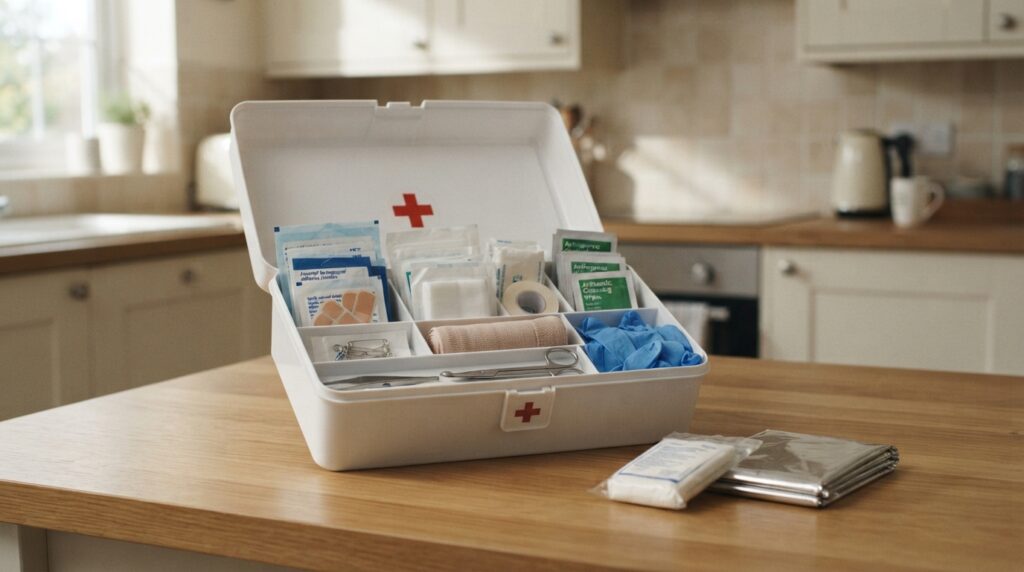
NHS advice is to keep a first aid kit with plasters, bandages, sterile dressings, antiseptic, eyewash solution, medical tape, tweezers and a thermometer, alongside a medicine cabinet with pain relief, oral rehydration salts, antihistamines, anti-diarrhoea tablets and indigestion remedies. St John Ambulance adds disposable gloves (latex-free where possible), a triangular bandage, scissors and a foil blanket, and says to check the kit every six months. Keep medicines somewhere cool, dry and out of children’s reach. That means not the bathroom or next to the cooker. Return out-of-date medicines to a pharmacy.
Most homes have a drawer with a few plasters, half a packet of paracetamol and a thermometer with a flat battery. That works until someone slices a finger on a Sunday night, or a child spikes a temperature at 3am. Here’s what NHS services, St John Ambulance and the British Red Cross say a home kit should contain, where to keep it, and the ready-made kits worth buying.
First aid kit vs medicine cabinet
It helps to think of two separate things:
- The first aid kit deals with injuries: cuts, grazes, burns, sprains, splinters and things in eyes.
- The medicine cabinet deals with common illnesses: pain, fever, allergies, diarrhoea and indigestion.
Many ready-made “first aid kits” contain no medicines at all, so you’ll usually need to add those yourself.
The home first aid kit checklist
This combines the NHS lists with St John Ambulance’s first aid kit checklist:
| Item | What it’s for | Recommended by |
|---|---|---|
| Plasters in assorted sizes | Small cuts and grazes | NHS, St John Ambulance |
| Sterile dressings | Larger wounds and heavier bleeding | NHS, St John Ambulance |
| Bandages (roller and triangular) | Holding dressings in place; supporting sprains; a sling | NHS, St John Ambulance |
| Antiseptic (cream or wipes) | Cleaning around minor wounds | NHS |
| Eyewash solution and a sterile eye pad | Rinsing grit or dust out of an eye | NHS (eyewash), St John Ambulance (eye pad) |
| Medical tape | Securing dressings | NHS, St John Ambulance |
| Tweezers | Splinters | NHS |
| Thermometer | Checking for a fever | NHS |
| Disposable gloves | Protecting you and the casualty | St John Ambulance |
| Scissors | Cutting tape, dressings and clothing | St John Ambulance |
| Foil (aluminium) blanket | Keeping someone warm | St John Ambulance |
| Face shield or pocket mask | Rescue breaths during CPR | St John Ambulance |
St John Ambulance recommends latex-free gloves where possible, and a “clean, waterproof box” for a home or car kit.
The medicine cabinet checklist
NHS England’s advice for keeping well lists:
- Pain relief, “such as aspirin, paracetamol and ibuprofen for aches, pains and high temperatures”.
- Never give aspirin to children aged 15 or under. The NHS says it can cause a rare but serious condition called Reye’s syndrome.
- Oral rehydration salts, “to replace lost minerals and fluid after a fever or vomiting and diarrhoea”.
- Anti-diarrhoea tablets, which relieve the symptoms “although these will not help with the underlying cause”.
- Antihistamines, “which can help with allergies”.
- Indigestion remedies.
The NHS Black Country Integrated Care Board’s list, based on Royal Pharmaceutical Society advice, also includes decongestants, antihistamine cream and sunscreen of at least SPF15 with UVA protection.
For children
The NHS Healthier Together children’s list adds paracetamol and ibuprofen in liquid or tablet form, rehydration sachets, antihistamines, antiseptic cream, sun cream and sore throat lozenges or spray. A few points from NHS pages:
- Children’s paracetamol and ibuprofen come as a liquid, also called oral suspension. The NHS says to “always check the packet or leaflet that comes with your medicine” and to use the syringe or spoon that comes with it.
- Healthier Together says ibuprofen may not be suitable for a child with asthma, so check with a pharmacist or GP.
- For children, the NHS says to use a digital thermometer placed in the armpit, and NICE guidance says not to routinely take temperatures in the mouth for children under 5.
- Pharmacy own-brand medicines “are cheaper and work just as well”.
Where to keep it
The bathroom cabinet is the classic spot, but NHS advice says otherwise. United Lincolnshire Hospitals NHS Trust says to “avoid storage near sources of heat or humidity like kitchens, bathrooms, sinks or radiators”, and to “keep medicine in a childproof place and out of reach of children and pets”. The Black Country ICB says “a high, lockable cupboard in a cool, dry place is ideal”.
Keep the first aid kit somewhere everyone in the house knows about and can reach quickly. A high kitchen cupboard away from the cooker, or a hallway cupboard, works well. Many families keep a second, smaller kit in the car.
Check it every six months
St John Ambulance says “the kit itself doesn’t go out of date, but the materials inside can”, and recommends reviewing it every six months. Kits kept somewhere hot, like a car, need checking more often. A handy reminder is to check it when the clocks change in March and October.
For out-of-date medicines, the NHS advice is not to put them in household waste or flush them down the toilet. Instead, “place them in a clear plastic bag, seal it and take them back to your local pharmacy”.
Burns: what to do first
For burns and scalds, the most important first step needs no kit at all. The NHS says to hold a burn under cool running water for 20 minutes, then cover it loosely with cling film, and not to put creams, oils or butter on it. St John Ambulance’s burns advice says “do not use ice, creams or gels”.
The NHS says to call 999 or go to A&E for burns that are very large or deep, on the face, genitals or bottom, or caused by chemicals or electricity. Call 111 for advice on any burn to a child under 5.
When a first aid kit isn’t enough
- 999 is “for life-threatening emergencies like serious road traffic accidents, strokes and heart attacks”. If someone is unresponsive and not breathing normally, St John Ambulance says to “call 999 or 112 for emergency help and start CPR straight away”.
- NHS 111 “can help if you think you need medical help right now”, and is the number to use if you’re not sure whether to call 999. NHS 111 online is for people aged 5 and over; for a child under 5, call 111.
Learn the basics for free
A kit is only useful if you know what to do with it. The British Red Cross has a free first aid app covering “over 20 first aid skills”, plus a free Baby and Child First Aid app, and free online learning you can do at your own pace. Its free workshops don’t give you a qualification. St John Ambulance runs free in-person first aid awareness sessions in England for schools and community groups, and has first aid advice on its website. Its app has been withdrawn from app stores, so use the website instead.
Why it matters: the Royal Society for the Prevention of Accidents (RoSPA) says 7,751 people died after an accident at home in England in 2019, 55% of all accidental deaths. In 2022/23, more than 740,000 people in England were admitted to hospital after an accident of any kind, and falls accounted for 61% of those admissions.
Ready-made kits worth buying
St John Ambulance Home First Aid Kit
Best for: a compact starter kit for the kitchen drawer
4 sterile dressings
15 x 8.5 x 20cm
St John Ambulance lists this kit with 20 washproof plasters, two medium (7.5 x 10cm) and two large (10 x 12cm) sterile dressings, four wound-cleansing wipes, a triangular bandage, nitrile gloves, a finger dressing and a first aid booklet. It’s small, so add tweezers, tape, eyewash and a thermometer to complete the NHS list.
Good for: small households; a first kit for a new home or student flat.
Less good for: families who want everything in one box. St John Ambulance doesn’t list it as meeting a British Standard.
St John Ambulance Small Workplace First Aid Kit (BS 8599-1:2019)
Best for: a fuller kit for a family home
40 plasters, 6 pairs of gloves
Includes a burn dressing and foil blanket
BS 8599-1 is the British Standard for workplace first aid kits. The HSE notes that following it is voluntary, but it’s a good benchmark for a well-stocked kit. St John Ambulance says this small kit conforms to BS 8599-1:2019 and includes 40 plasters, six pairs of nitrile gloves, a 10 x 10cm hydrogel burn dressing, a foil blanket, scissors and two eye pads, in a 27.5 x 17.5 x 9cm case.
Good for: larger families; homes with a workshop, garage or home business.
Less good for: a car glovebox, as it’s bulkier. Vehicle kits have their own standard, BS 8599-2.
Braun ThermoScan 7 ear thermometer (IRT6520)
Best for: quick temperature checks on children
Pre-warmed tip
Backlit display
A thermometer is on every NHS list. According to a UK medical supplier’s listing, the ThermoScan 7 has Age Precision settings for 0–3 months, 3–36 months and over 36 months, a pre-warmed tip, a backlit display and last-reading recall, and comes with 21 hygiene caps and two AA batteries.
Good for: families with children over 4 weeks old (NICE advises an under-arm digital thermometer for younger babies).
Less good for: anyone on a tight budget, since a basic digital thermometer does the job for much less. You’ll need replacement hygiene caps.
Frequently asked questions
What should be in a basic home first aid kit?
NHS advice lists plasters, bandages, sterile dressings, antiseptic, eyewash solution, medical tape, tweezers and a thermometer. St John Ambulance adds disposable gloves, scissors, a triangular bandage and a foil blanket.
Should I keep medicines in the bathroom?
NHS advice is to avoid places with heat or humidity, including bathrooms and kitchens, and to use a cool, dry cupboard out of children’s reach. A high, lockable cupboard is ideal.
How often should I check my first aid kit?
St John Ambulance recommends every six months, and more often for kits kept somewhere hot, such as a car.
What do I do with out-of-date medicines?
Don’t bin them or flush them. Seal them in a clear plastic bag and take them back to your local pharmacy.
Is there a free first aid app?
Yes. The British Red Cross has a free first aid app covering over 20 skills, and a free Baby and Child First Aid app.
Sources
- NHS England — Keeping you well
- NHS Black Country ICB — Keep a well-stocked medicine cabinet at home
- NHS Healthier Together — What to keep in your medicine cabinet
- United Lincolnshire Hospitals NHS Trust — Storing medicines at home
- NHS — Paracetamol for children and Ibuprofen for children
- NHS — When to call 999 and When to use 111
- St John Ambulance — What to put in a first aid kit and Do first aid kits expire?
- St John Ambulance — CPR advice and Burns and scalds
- NHS — Burns and scalds, Aspirin for pain relief and Fever in children
- NICE — Fever in under 5s (NG143)
- British Red Cross — First aid apps and Learn first aid
- HSE — What to put in your first aid kit
- RoSPA — Safer Lives, Stronger Nation
- St John Ambulance shop — Home First Aid Kit and Small Workplace First Aid Kit
- WMS — Braun ThermoScan 7 IRT6520
Related reading: our storm-proofing guide, keeping medicines safe in hot weather and a year-round temperature plan for elderly parents.
Compare St John Ambulance first aid kits at Amazon UK.