Keeping Medicines Safe in a Heatwave
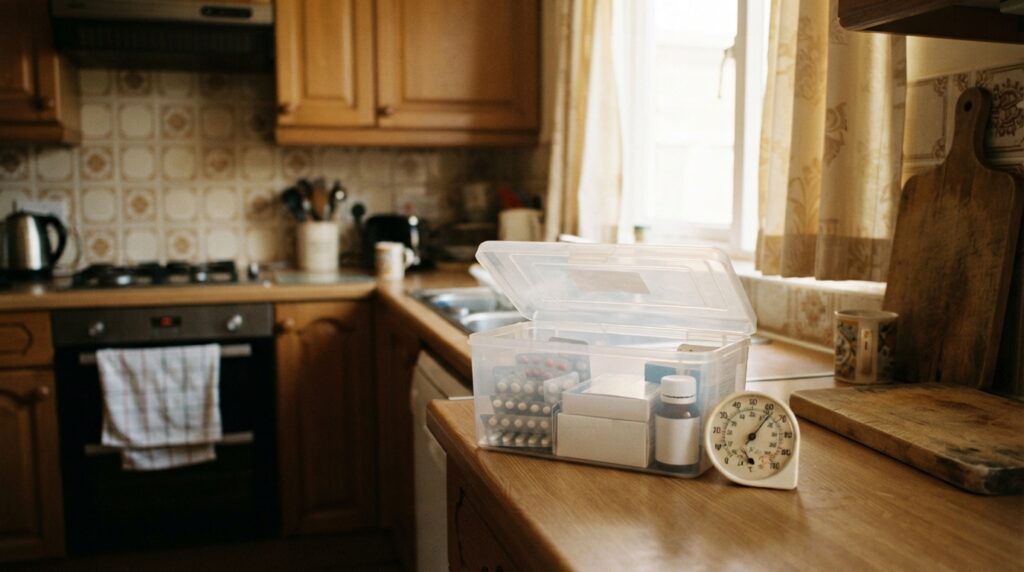
Most medicine packaging specifies storage below a stated temperature — commonly 25°C or 30°C — and a UK bedroom or bathroom in a heatwave can exceed that comfortably. The two things worth doing are reading the storage instruction on your own packaging, which is the only place the answer for your medicine actually lives, and moving medicines out of the hottest places, which are usually the bathroom cabinet, a sunny windowsill, a car, and a handbag. If a medicine needs refrigerating, a power cut is the situation to plan for.
This gets very little coverage and it matters, particularly for the people most at risk in hot weather anyway.
Where the answer actually is
On your packaging and in the patient information leaflet. Storage conditions vary by medicine, and generic advice can’t tell you what yours needs.
Look for a line such as “store below 25°C”, “store below 30°C”, “store in a refrigerator”, or “do not refrigerate”. Some medicines have no temperature instruction at all. Some have specific requirements after opening that differ from before.
If the leaflet has gone, the packaging usually still carries it — and a pharmacist can tell you in a minute.
The hottest places in a home, and why they’re the wrong ones
People store medicines in exactly the places that get hottest.
- The bathroom cabinet. Traditional, and poor — bathrooms combine heat with humidity, and moisture affects some medicines as much as temperature.
- A kitchen cupboard near the oven, kettle, or above the hob.
- A windowsill, or anywhere in direct sun.
- A car. A parked car in summer reaches temperatures far above anything in a house, and it does so quickly. Never leave medicines in one, even briefly.
- A handbag or rucksack carried in the sun.
- A conservatory, loft room or south-facing bedroom — the hottest rooms in most homes.
Better places: a cupboard or drawer in a north-facing room, downstairs, away from windows and heat-generating appliances. A ground-floor hallway cupboard is often the most temperature-stable spot in a house.
Keep them out of reach of children wherever you put them — that requirement doesn’t relax in hot weather.
Measuring, rather than guessing
You can’t tell whether a cupboard exceeds 25°C by feel. A cheap thermometer left where you store medicines, ideally one that records a maximum, tells you in a couple of days.
That’s worth doing once. If the answer is comfortably below the stated limit, you stop worrying. If it isn’t, you know to move them. Our thermometers guide covers options, and the same device is useful for judging when to open windows.
Refrigerated medicines
Some medicines must be kept refrigerated, usually within a stated range. Points worth knowing:
- Don’t put them in the freezer or against the back wall of the fridge where things freeze. Freezing damages some medicines irreversibly.
- Fridge temperature varies by shelf. The door is the warmest place and swings most.
- A fridge thermometer is inexpensive and tells you whether yours is actually in range — many domestic fridges aren’t.
- Some medicines can be out of the fridge for a defined period — but the period varies enormously, and this is exactly the question for a pharmacist rather than a general article.
Power cuts
The scenario worth planning for in advance rather than in the moment.
Keep the fridge door shut. A closed fridge holds temperature far longer than people expect; opening it to check is what causes problems.
Register for the Priority Services Register. Free, takes minutes, and it’s specifically designed for households where someone relies on electrical medical equipment or has other vulnerabilities. It gets you advance notice of planned outages and priority updates during unplanned ones. Register with both your network operator and your supplier — they’re separate lists.
Report the cut on 105, free from any UK phone, and tell them if medicine refrigeration is affected.
Ask a pharmacist afterwards whether the medicine is still usable, rather than deciding yourself. Our heatwave power cut guide covers the wider situation, and our power cut kit guide covers preparation.
Signs a medicine may have been affected
Not exhaustive, and not a substitute for asking:
- Tablets or capsules that have become soft, sticky, discoloured, cracked or fused together
- Creams, ointments or gels that have separated or changed texture
- Liquids that have changed colour, become cloudy, or developed particles
- Suppositories or pessaries that have softened
- Anything that smells different from usual
- Packaging that has been in direct sun or a hot car
If in doubt, don’t use it — ask a pharmacist. And don’t flush unwanted medicines or put them in the bin; take them back to a pharmacy, which will dispose of them properly.
Medicines and heat: the other half
Beyond storage, there’s a separate issue worth raising with a healthcare professional.
Some medicines can affect how the body copes with heat — for instance by influencing sweating, hydration, blood pressure or how the body regulates temperature. Others may need particular attention to fluid intake in hot weather.
This is not something to work out from an article, and definitely not a reason to stop taking anything. But it is a good reason to have a short conversation with your GP or pharmacist before summer, particularly if you take several medicines, are older, or have a heart, kidney or circulatory condition.
UKHSA’s heat mortality reporting consistently shows the highest rates in the oldest age groups, and people managing long-term conditions are among those most affected. A pre-summer medication review is a reasonable thing to ask for.
A short pre-summer checklist
- ☐ Read the storage instruction on each medicine you keep at home
- ☐ Move anything stored in a bathroom, sunny room or near an appliance
- ☐ Put a thermometer where you store them, for a couple of days
- ☐ Check the fridge is actually in range if anything needs refrigerating
- ☐ Register for the Priority Services Register if anyone qualifies
- ☐ Save 105 in your phone
- ☐ Ask a pharmacist about anything you’re unsure of
- ☐ Ask about a medication review if you take several and are worried about heat
- ☐ Never leave medicines in a car
Frequently asked questions
My bedroom gets to 28°C. Is that a problem?
It depends entirely on the medicine, which is why the packaging is the place to look. If it says store below 25°C and your room reaches 28°C, move them somewhere cooler and ask a pharmacist whether what you have is still fine.
Can I keep tablets in the fridge to be safe?
Not unless the packaging says to. Some medicines are damaged by cold or by the humidity in a fridge, and “do not refrigerate” appears on packaging for a reason. Ask a pharmacist rather than assuming cold is safer.
What if a medicine has been in a hot car?
Don’t use it until a pharmacist has advised. Cars reach temperatures well beyond anything a storage instruction contemplates.
Does an air conditioner help?
Keeping a room within a medicine’s storage range is a legitimate use of cooling, and it’s one of the better arguments for cooling a specific room. But moving the medicines to a naturally cooler cupboard is free and usually sufficient — try that first.
Sources
- NHS — How should I store my medicine?
- NHS — Heatwave: how to cope in hot weather
- NHS — Pharmacy services
- MHRA — Medicines and Healthcare products Regulatory Agency
- UKHSA — Adverse Weather and Health Plan
- Ofgem — Priority Services Register
- Energy Networks Association — Power Cut 105
Related reading: our elderly heatwave guide and heat health alerts guide.
Related guides



Compare current prices, stock and reviews on portable air conditioners at Amazon UK. Prices and stock move fast in a heatwave, so it is worth checking before you commit.
Browse air conditioners →