Rock Salt, Grit or De-Icer? What to Put on an Icy Drive or Path (UK)
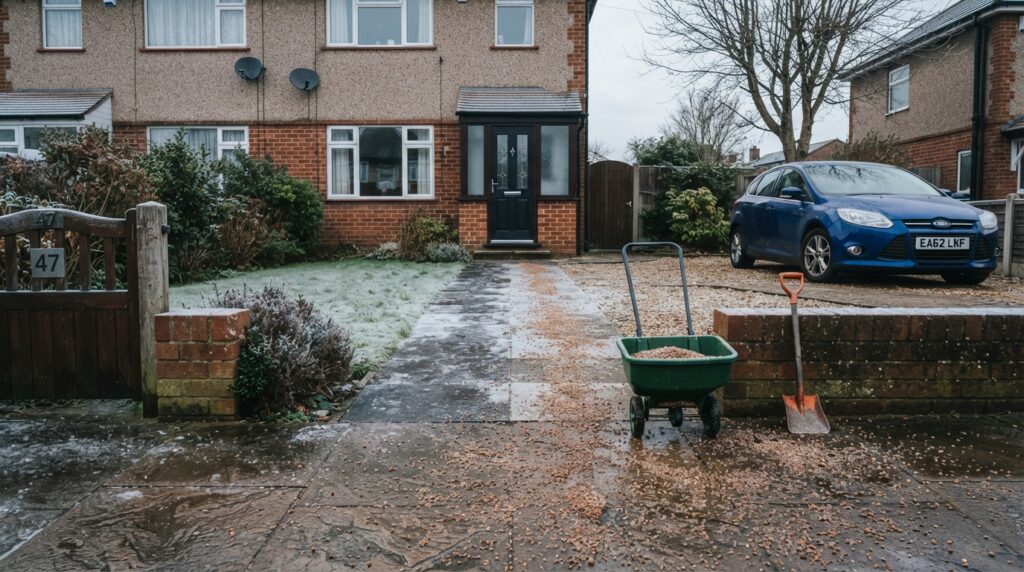
Plain salt does the job for most homes. That can be brown rock salt (what councils call grit), white de-icing salt, or even the ordinary table or dishwasher salt the Met Office says you can use. Put it down before the frost: Gloucestershire County Council suggests a thin covering the evening before, and the Met Office suggests about a tablespoon per square metre. Salt works by lowering the temperature at which water freezes, but Coventry City Council says that below -5°C its effectiveness is reduced. Never use water, which can refreeze as black ice. Don’t take salt from council grit bins for your drive: GOV.UK says that salt is for keeping roads clear, and one council warns you could be prosecuted. Keep salt off plants and lawns, use it sparingly on paving, and remember that any salt can poison pets, so sweep up the excess and wipe paws after walks.
The first hard frost of winter always seems to arrive the morning you need to leave early. A bag of salt in the shed and ten minutes the evening before makes all the difference. Here’s what to buy, how much to use, when to put it down, and how to avoid damaging your paving, your plants or your pets, based on advice from the Met Office, GOV.UK, councils and the RSPCA.
Rock salt, grit, white salt: what’s the difference?
“Grit” is simply what councils call rock salt. Coventry City Council says grit is “the generic term for ‘rock salt'”, and the RSPCA describes rock salt as “a mixture of salt (sodium chloride) and grit”. Here’s how the options compare:
| Option | What it is | Best for | Watch out for |
|---|---|---|---|
| Brown rock salt | Salt mixed with grit. UK retailer Stone & Surfaces says the brown salt it sells is British-mined and meets BS 3247, the British Standard for de-icing salt | Drives and larger areas: the same retailer says it’s generally the more cost-effective option | More visible residue than white salt |
| White de-icing salt | Purer salt. Peacock Salt sells it as marine salt that’s “almost 100% pure sodium chloride”, also to BS 3247 | Paths, steps and front doors, where you don’t want brown mess walked in | Almost pure salt: the RSPCA says even a small amount of pure salt can be very dangerous to pets |
| Table or dishwasher salt | Ordinary salt from the kitchen cupboard | Steps and short paths: the Met Office says you can use it | Same rules as any salt: keep it off plants and grass, and away from pets |
| Sand or ash | Grip, not de-icing | When you’ve run out of salt: GOV.UK says it will provide grip underfoot | The Met Office says it’s less effective at preventing icing |
| CMA de-icer | Calcium magnesium acetate, a de-icer that isn’t based on sodium chloride | Natural stone paving: natural stone supplier Bridge Street Stone recommends it instead of rock salt | Follow the product’s instructions (the supplier says it works best mixed with warm water). A Canadian road trial found it worked much less well below -6°C |
How salt works, and when it stops working
Coventry City Council explains that grit “works by lowering the temperature at which water freezes”. It also needs spreading around to work properly: the council says it relies on people walking on pavements, or vehicle tyres on roads, to spread it over the surface. On a quiet drive with no traffic overnight, that means spreading it evenly yourself.
Salt has limits:
- Very cold nights. Coventry says: “Below -5 degrees centigrade, the effectiveness of grit is reduced and pavements/roads may still freeze.”
- It prevents more than it cures. Gloucestershire County Council says salt “helps prevent the re-freezing of water that can create black ice”, but warns that “salt does not remove snow or compacted ice.”
- Rain washes it away. Coventry notes that rain or snow can wash salt off, leaving surfaces likely to ice over again. It says salting ideally happens after rain but before the water freezes.
If a deep freeze is forecast, our guide to what triggers a UK cold snap explains the warning signs to watch for.
How to grit your drive or path, step by step
- Salt the evening before a frost. Gloucestershire County Council suggests scattering “a thin covering of salt the evening before”, and pre-treating if snow or ice is likely.
- If it snows, clear it early. GOV.UK says to do it early in the day, because fresh, loose snow is easier to move. The Met Office suggests clearing a path down the middle first, then shovelling snow to the sides, without blocking paths or drains.
- Then salt what’s left. The Met Office says “a tablespoon for each square metre you clear should work”. Gloucestershire puts it as a small handful per metre of path, and says a 20kg bag treats about 400 metres of pavement. A drive measuring 3m by 6m is 18 square metres, so that’s about 18 tablespoons by the Met Office’s rule of thumb. The Met Office says to cover a cleared path with salt before nightfall so it doesn’t refreeze overnight.
- Use more on steps and slopes. GOV.UK and the Met Office both say to pay extra attention to steps and steep paths, where more salt may help.
- Let the sun help. The Met Office says any sunshine during the day will help melt the ice underneath, so clearing in the morning makes the most of it.
Can I use salt from the council grit bin?
Not for your drive. GOV.UK says: “do not use the salt from salting bins as this is used to keep roads clear.” Derbyshire County Council is explicit that its grit “is for use to clear public pavements and roads only” and “is not for use on private property”, adding: “If you are caught taking grit or salt for use on private property, such as driveways, you may be prosecuted.” Rules vary: GOV.UK’s general advice is not to use salting-bin salt at all, while some councils, such as Derbyshire, say theirs is for public pavements and roads only. Either way, it isn’t for your drive, so buy your own.
Could I be sued for clearing the pavement outside my house?
It’s a common worry, and the official answer is reassuring. GOV.UK says it’s unlikely that you’ll be sued or held responsible if someone is injured on a path or pavement if you’ve cleared it carefully. The Met Office’s snow code says: “Don’t be put off clearing paths because you’re afraid someone will get injured.” We’re not lawyers, so treat this as the government’s general guidance rather than legal advice. It doesn’t say which parts of the UK it covers, so in Scotland or Northern Ireland, check your council’s advice too. The key word is “carefully”: clear properly, salt afterwards so it doesn’t refreeze, and never use water.
Protecting your plants, paving and pets
Plants and lawns
The Met Office says: “Be careful not to spread salt on plants or grass as it may damage them.” Keep it off borders and the edge of the lawn, and sweep up spills.
Block paving
Paving installer Discover Paving says salt “can indeed cause damage to block paving”, depending on several factors. It mentions efflorescence, a white, powdery deposit that can appear on paving, which it says is generally not harmful to the paving itself. Its advice: use salt sparingly, use a spreader to distribute it evenly, and sweep up any excess once the ice has melted. It also notes that salt is less effective in very cold temperatures. On the hardest frosts, add sand or ash, which GOV.UK says will provide grip underfoot.
Natural stone patios and paths
Natural stone supplier Bridge Street Stone warns that “rock salt acts like bleach when it touches natural stone”, leaving stains and a speckled look, and that it can degrade the mortar holding the slabs in place, so they work loose. It recommends calcium magnesium acetate (CMA) instead, which it says is safe for plants and pets and does not damage natural stone. It says CMA works best mixed with warm water, so follow the product’s own instructions, and never pour plain water on ice. CMA has limits too: a Canadian road trial by Ontario’s transport ministry found its success rate fell substantially below -6°C. If you have an expensive stone patio, check with whoever supplied or laid it before salting.
Dogs and cats
The RSPCA’s everyday advice is simple: wipe your dog’s pads, paws and tummy after every walk in gritted conditions. It also suggests dog boots to protect paws from rock salt, grit and antifreeze, and a non-toxic balm on the pads to prevent cracking. On your own drive, use only as much salt as you need and sweep up what’s left once the ice has gone.
Look after your neighbours, and your own feet
The Met Office suggests offering to clear around neighbours who may struggle, and checking on elderly or disabled neighbours during cold weather. If you look out for an older relative, our year-round temperature plan for elderly parents covers the winter side too. And for the walk to the shop or the school run on untreated pavements, a pair of ice grips is cheap insurance.
Peacock Salt white de-icing salt (10kg)
Best for: paths, steps and front doors
Conforms to BS 3247:2011
Bags from 10kg
Peacock Salt, a UK salt supplier, describes its white de-icing salt as marine salt that’s “almost 100% pure sodium chloride” and conforms to BS 3247:2011, the British Standard for de-icing salt. It says the salt “does not leave behind the same messy residue” as brown grit, and that it’s free-flowing and suitable for spreaders.
Good for: front paths, steps and doorways where brown grit would get trodden indoors; spreading by hand or with a spreader.
Less good for: homes with pets or toddlers unless you sweep up afterwards, as it’s almost pure salt; very hard frosts, as Coventry’s warning about reduced effectiveness below -5°C applies to all salt; natural stone, plants and lawns.
Yaktrax Walk ice grips
Best for: icy pavements you can’t grit
Sizes XS to L
For packed snow and ice
Yaktrax says the Walk fits over your everyday shoes and uses 1.2mm high-strength steel coils to give “360 degrees of traction on ice and snow”. It’s designed for commuters, shoppers and anyone walking on icy pavements, which makes it a sensible thing to keep by the door for older relatives too.
Good for: school runs, dog walks and the walk to the bus stop on untreated pavements.
Less good for: indoors or on smooth floors: Yaktrax says “Never wear Yaktrax® indoors” and warns of a risk of slipping on smooth floors. It also says they’re only for use on packed snow and ice, so take them off when you reach clear ground.
Musher’s Secret paw wax
Best for: dogs walked on gritted pavements
Thin layer, 2–3 times a week
Use alongside wiping paws
The RSPCA suggests a non-toxic balm on your dog’s pads to prevent cracking in winter. Musher’s Secret is a paw wax, and its maker says it creates “a seamless barrier” to help protect your dog’s pads against the harsh chemicals used on industrial salt. The maker says to apply a thin layer two to three times a week and rub it in, with extra applications in snowy conditions, and that it absorbs in a few moments. It describes the wax as non-toxic and “100% edible”.
Good for: dry, cracked pads in winter; dogs that won’t tolerate boots.
Less good for: replacing the RSPCA’s main advice. The barrier claim is the maker’s own, not an independent test, so you still need to wipe paws, legs and tummy after every gritted walk.
Frequently asked questions
Is rock salt the same as grit?
Near enough. Coventry City Council says grit is “the generic term for ‘rock salt'”, and the RSPCA describes rock salt as a mixture of salt and grit. White de-icing salt is purer salt without the grit.
Can I use table salt on my drive?
Yes. The Met Office says you can use ordinary table or dishwasher salt, and that about a tablespoon for each square metre you clear should work. Keep it off plants and grass.
What temperature does rock salt stop working?
It doesn’t stop at a single point, but Coventry City Council says that below -5°C its effectiveness is reduced and surfaces may still freeze. In very cold spells, sand or ash at least adds grip, although the Met Office says they’re less effective at preventing icing.
Can I take salt from a council grit bin for my driveway?
No. GOV.UK says not to use salt from salting bins because it’s used to keep roads clear, and Derbyshire County Council warns that people caught taking grit for private property such as driveways may be prosecuted.
Is rock salt dangerous for dogs and cats?
It can be. The RSPCA says rock salt is a danger to dogs and cats if they lick it from their paws or fur, and that even a small amount of pure salt can be very dangerous, so the same goes for white and table salt. Wipe paws, legs and tummy after walks, and if you think your pet has eaten salt, get it to a vet immediately. Don’t try to make it vomit.
Will salt damage my block paving or patio?
It can. A paving installer says salt can damage block paving, so use it sparingly and sweep up the excess. A natural stone supplier warns rock salt can stain natural stone and weaken the mortar, and recommends a CMA de-icer instead.
Sources
- GOV.UK — Clear snow from a road, path or cycleway
- Met Office — Clearing your path or driveway: the snow code
- Gloucestershire County Council — How to clear snow and grit a path or driveway
- Coventry City Council — About rock salt
- Derbyshire County Council — Grit bins and salt heaps
- RSPCA — Dog poisoning
- RSPCA — Winter and cold weather care for dogs
- Discover Paving — Does salt damage block paving?
- Bridge Street Stone — Don’t use rock salt to clear your outdoor natural stone paving
- Stone & Surfaces Direct — White salt vs brown rock salt
- Peacock Salt — White de-icing salt
- Yaktrax UK — Yaktrax Walk
- Musher’s Secret — Will Musher’s Secret help protect against ice salt?
- Musher’s Secret — Musher’s Secret paw wax (application instructions)
- Ontario Ministry of Transportation, via TRID — The effectiveness of calcium magnesium acetate de-icer under severe operating conditions (1992)
Related reading: our storm-proofing guide, will winter 2026/27 be the coldest for years? and best gutter cleaning tools before winter.
Compare white de-icing salt at Amazon UK.