Air Conditioning in a House With a Wood Burner: What You Need to Know
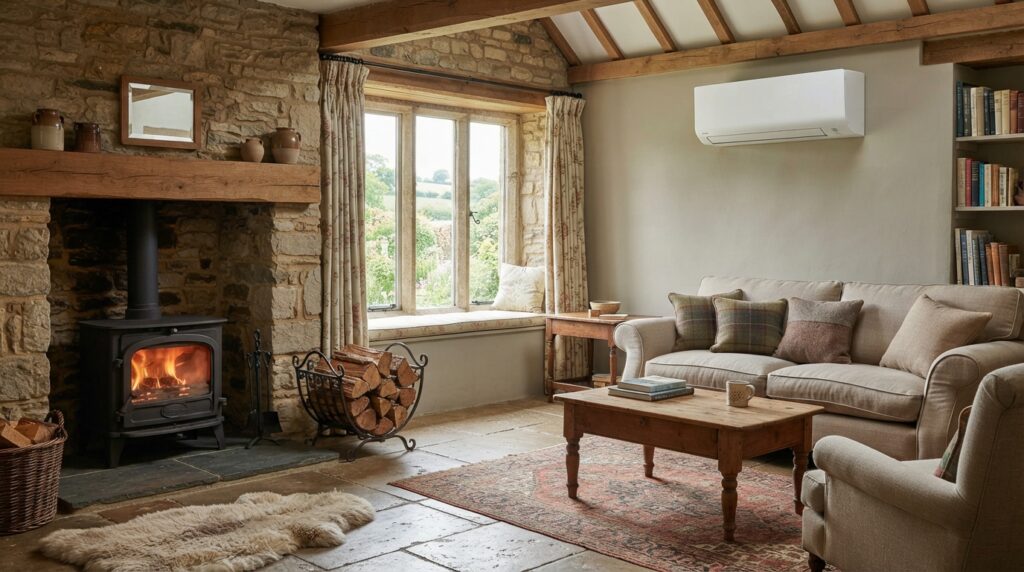
These two things interact in a way most people don’t expect. A single-hose portable air conditioner expels indoor air outside, which creates slight negative pressure in the room. In a well-sealed house with a wood burner, negative pressure can in principle interfere with the flue’s draught. Don’t run a single-hose unit in the same room as a lit stove, never block the stove’s dedicated air vent, and fit a CO alarm. In summer, when the stove isn’t lit, the interaction is a different and much smaller issue — but the vent still stays unblocked.
Wood burners are common in the middle-aged British home, and portable air conditioning is becoming so. Nobody talks about how they interact, and there’s one genuine safety point worth understanding.
How a wood burner actually breathes
A stove needs air. It draws combustion air from the room, burns it, and exhausts flue gases up the chimney. That flow is driven by draught — the pressure difference created by hot gases rising in the flue.
Draught is not a strong force. It’s a modest pressure difference, and it can be disrupted.
Because modern homes are far more airtight than the ones stoves were originally designed for, Building Regulations require a dedicated permanent air supply for solid fuel appliances above a certain output, and for any appliance in a sufficiently airtight dwelling. That’s the air vent or airbrick you may have in the room — often a round grille in the wall or floor near the stove.
That vent is not optional and it is not a draught. It’s a safety-critical part of the installation.
The negative pressure problem
Here’s the interaction.
A single-hose portable air conditioner takes air from the room, uses it to cool the condenser, and blows it outside through the hose. That air leaves the house permanently. Replacement air is drawn in through whatever gaps exist — and the room ends up at slightly lower pressure than outside.
Our hose configuration guide covers this in detail as an efficiency problem. With a fuel-burning appliance in the same space, it becomes a safety consideration as well.
If the pressure in the room drops enough, it can in principle work against the flue’s draught. In the worst case that means spillage — combustion gases, including carbon monoxide, entering the room instead of going up the chimney.
The same mechanism is why powerful extractor fans in kitchens are a recognised concern in homes with open-flued appliances.
Why this rarely bites in practice — and when it does
For most households the two things simply don’t overlap. You run the stove in January and the air conditioner in July.
The situations where they genuinely can coincide:
- Shoulder seasons. A chilly evening after a warm day, with the stove lit and the air conditioner still running or recently used.
- Open-plan layouts. Cooling a kitchen-diner that’s open to a lounge with a stove means one connected air volume, even if the appliances are metres apart.
- Different rooms, same house. In a very airtight house, a unit running upstairs can in principle affect pressure downstairs, though the effect diminishes with separation and closed doors.
- Someone else lights the stove while the unit is running elsewhere. Worth mentioning to everyone in the household rather than assuming.
Dual-hose units avoid the pressure issue
A dual-hose unit draws its condenser air from outside through an intake hose and expels it back outside. No net air is removed from the room, so no negative pressure develops.
That makes dual-hose the technically preferable choice in a house with an open-flued appliance. It’s also more efficient generally, for the same reason. The trade-offs — bulk, cost, two hoses to vent — are covered in our hose guide.
A fixed split system also avoids it entirely, since no room air is involved in rejecting heat.
Even with a dual-hose unit, the CO alarm and the unblocked vent still apply. Belt and braces.
The summer question: what to do with the chimney
A separate and much less dangerous interaction, but a practical one.
An open flue is a permanent hole in your building envelope. In summer it works against cooling: the stack effect pulls air up and out, and a portable air conditioner ends up partly cooling air that disappears up the chimney.
What you can reasonably do:
- Close the stove’s air controls and door when it’s not in use. On a modern closed stove this substantially reduces the airflow path, and it’s the safest option because nothing is physically obstructing the flue.
- For a genuinely disused open fireplace, a chimney balloon or sheep reduces the loss — but only if the fireplace is truly out of commission, and you should leave some ventilation so the flue stays dry. Never fit one to a flue serving an appliance that might be used.
- Never obstruct a flue serving a working appliance. If there’s any chance someone lights it, leave the flue clear.
- Have the chimney swept annually regardless. It’s a fire and CO safety measure, not just housekeeping, and many insurers expect it.
The wider ventilation point
This connects to our draught-proofing guide, and it’s the same principle: seal draughts, not ventilation.
The vent serving a stove, the airbricks ventilating a suspended floor, extractor fans and trickle vents are all deliberate provision. Blocking them to make a room easier to heat or cool trades a small comfort gain for a genuine safety risk.
If a stove vent is causing an unpleasant cold draught in winter, the answer is repositioning or a different vent type discussed with a HETAS-registered installer — not blocking it.
Frequently asked questions
Can I use a portable air conditioner in a room with an unlit stove?
Yes — with no combustion happening there’s no flue gas to spill. Keep the air vent clear anyway, close the stove door and air controls to reduce airflow up the flue, and make sure nobody lights it while the unit is running.
Do I legally need a CO alarm?
Requirements vary by nation and tenure, and have been extended in recent years — in England, for example, landlords must ensure a CO alarm is fitted in rooms with a fixed combustion appliance other than a gas cooker. Regardless of the letter of the law, fitting one where any fuel-burning appliance exists is basic safety. Check current requirements for your situation.
What are the symptoms of carbon monoxide poisoning?
Headache, dizziness, nausea, breathlessness, confusion and tiredness — easily mistaken for flu, but without a temperature. A key clue is symptoms improving when you leave the house and returning when you come back, or several people in the household affected at once. Get out into fresh air and call 999 if anyone is unwell.
Does this apply to a gas fire too?
Yes — the negative pressure concern applies to any open-flued fuel-burning appliance, including gas fires and some boilers. Gas appliances should be serviced annually by a Gas Safe registered engineer.
Is a heat pump unit a better option in a house with a stove?
For winter heating, a reverse-cycle unit is a sensible complement — it can take the chill off a room without lighting the stove for a short evening. Just note that in heating mode a single-hose unit still moves air, so the same rule applies: not in the same room as a lit fire.
Sources
- GOV.UK — Approved Document J: Combustion appliances and fuel storage systems (air supply and flue requirements)
- GOV.UK — Approved Document F: Ventilation
- HSE — Carbon monoxide in the home (symptoms, risks)
- Gas Safe Register — Carbon monoxide safety
- NHS — Carbon monoxide poisoning
- HETAS — HETAS (solid fuel appliance installation and servicing)
- GOV.UK — Smoke and carbon monoxide alarms: landlord guidance
Related reading: our hose configuration guide and draught-proofing guide.
Related guides


Compare current prices, stock and reviews on portable air conditioners at Amazon UK. Prices and stock move fast in a heatwave, so it is worth checking before you commit.
Browse air conditioners →