Single-Hose vs Dual-Hose Portable Air Conditioners: Which Actually Cools Better?
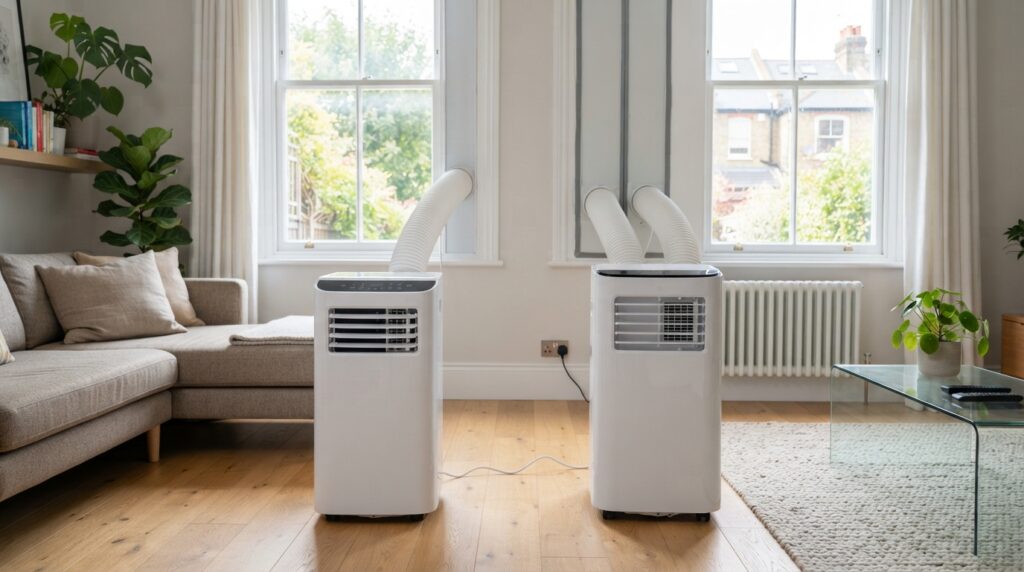
A dual-hose unit is more efficient, and the reason is well documented. A single-hose unit uses air from inside your room to cool its own workings, then blows that air outside. That creates slight negative pressure, so warm air gets pulled back in through every gap — from other rooms, around doors, and through the window opening. The US Department of Energy, whose test procedure accounts for this, says single-duct units typically generate higher rates of this infiltration than comparable dual-duct units, reducing both capacity and efficiency. A dual-hose unit draws its cooling air from outside through a second hose, so it doesn’t suck warm air in. But dual-hose units are harder to find in UK shops, bulkier, and still depend on a well-sealed window. For most people, a correctly sized single-hose unit with a proper window seal works well.
This is one of the most debated points in portable air conditioning, and it’s often argued with more heat than light. Here’s how both designs actually work, what the evidence shows, and what it means for choosing one.
What every portable air conditioner has to do
An air conditioner doesn’t create cold. It moves heat from inside the room to outside. Inside the unit, one set of coils absorbs heat from your room’s air, and another set — the condenser — gets rid of that heat. The condenser needs a steady flow of air across it to carry the heat away, and that hot air must end up outside. That’s what the hose is for. The difference between single-hose and dual-hose designs is simply where the condenser’s air comes from.
How a single-hose unit works
The US Department of Energy’s test procedure describes single-duct units as drawing all of their condenser air from the room being cooled, and discharging it outside. So the unit is doing two things at once: cooling your room’s air, and pumping some of that same air out of the building.
Air pushed out has to be replaced. The DOE’s 2016 rule explains that infiltration from outside the cooled space happens because of the negative pressure created as condenser air is exhausted outside. Consumer Reports describes the effect the same way: warm, unconditioned air flows in from nearby rooms into the space you’re trying to cool. Which? makes a related point about the window itself: running the hose through an open window lets some warm air back in through the gap.
How a dual-hose unit works
A dual-hose unit adds a second hose that brings outside air in to cool the condenser, then sends it back out through the exhaust hose. Your room’s cooled air stays in the room. Because the unit isn’t pumping room air outside, it doesn’t create the same negative pressure, and much less warm air is drawn in to replace it.
How much difference does it actually make?
More than the spec sheet suggests, but less than the most dramatic claims online. The DOE states that single-duct units typically generate higher rates of infiltration air than comparable dual-duct units, and that this affects both capacity and efficiency. Research for California’s utilities reached the same conclusion: because of infiltration air, single-duct units are typically less efficient than dual-duct ones.
In practice, the gap is biggest when it’s much hotter outside than inside, when the room is leaky, and when the window around the hose isn’t sealed. In a mild British summer, in a well-sealed room, a single-hose unit performs much closer to its rating.
The trade-offs of dual-hose
- Harder to find. Many popular UK models are single-duct — Meaco’s MC Series Pro range, for example, uses a single 15cm duct.
- Two hoses to route, a larger window panel, and more to store in winter.
- The badge isn’t always accurate. Check the manual or spec sheet for a separate intake and exhaust duct, rather than relying on a listing title.
- It still needs a sealed window. A dual-hose unit with a gaping window opening loses much of its advantage.
Getting the most from a single-hose unit
- Seal the window properly. A fabric or panel seal kit closes the gap Which? warns about. Our window seal kit guide covers the options, including awkward windows.
- Keep the hose short and straight. Every metre and bend makes the unit work harder. See our extension hose guide.
- Close the room’s door and draught-proof obvious gaps, so replacement air isn’t pulled from a hot hallway or the rest of the house. Our draught excluder guide helps.
- Size it correctly. An undersized single-hose unit runs flat out and loses the most to infiltration. Use our BTU calculator.
- Shade the room first. Keeping sun off the windows reduces the load before the unit starts.
The picks
A proper window seal kit for a single-hose unit
The biggest improvement for the least money
Fabric or panel designs
Works with most portable units
If you already own a single-hose unit, or you’re buying one because that’s what’s available, sealing the window opening is the most useful thing you can add. It deals directly with the warm air Which? says gets back in through the gap. Fabric seals fit casement and tilt windows; panel kits suit sliding and sash windows. Measure your window before buying.
Good for: any single-hose unit; closing the window gap; renters, since it’s removable.
Less good for: infiltration through the rest of the room, which a window seal can’t fix. Fabric seals can make the window awkward to close quickly.
A dual-hose unit, chosen on its documentation
For hot rooms where efficiency matters most
Less negative pressure
Check the manual, not the title
If you’re cooling a very hot room, such as a loft bedroom or a sunny top-floor flat, a dual-hose unit’s efficiency advantage is worth having. Because genuine dual-duct units are harder to find in UK shops and listing titles aren’t always accurate, confirm in the manual or manufacturer’s spec sheet that it has a separate intake duct before you buy. Our dual-hose guide explains what to look for.
Good for: the hottest rooms; large temperature differences between inside and out; leaky older rooms.
Less good for: small rooms in a mild summer, where a well-sealed single-hose unit is close enough. Two hoses and a bigger window panel take more space.
Frequently asked questions
Is a dual-hose portable air conditioner better than a single-hose?
It’s more efficient. The US Department of Energy says single-duct units typically generate higher rates of infiltration air than comparable dual-duct units, which reduces capacity and efficiency. Whether it’s worth it depends on how hot the room gets and how well you can seal it.
Why does a single-hose air conditioner pull warm air into the room?
It uses room air to cool its condenser, then blows that air outside. The air it removes has to be replaced, so warm air is drawn in through gaps from other rooms, doors and the window opening.
Can I make a single-hose unit work better?
Yes. Seal the window around the hose, keep the hose short and straight, close the room’s door, draught-proof obvious gaps, and make sure the unit is sized correctly for the room.
How do I know if a unit is really dual-hose?
Check the manual or the manufacturer’s spec sheet for separate intake and exhaust ducts. Don’t rely on the listing title alone.
Sources
- US Department of Energy, Federal Register — Test procedures for portable air conditioners (2016)
- eCFR — 10 CFR 430, Appendix CC
- US Department of Energy, via Justia — Notice of data availability, portable air conditioners (2014)
- Consumer Reports — Best portable air conditioners
- Which? — How to buy an air conditioner
- Meaco — Portable air conditioners
Related reading: our dual-hose guide, not cooling properly troubleshooting and portable versus split system guide.
Compare current window seal kits at Amazon UK.