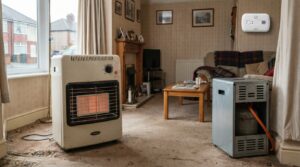
How to Keep Insulin and Other Fridge Medicines Cold in a Power Cut (UK)
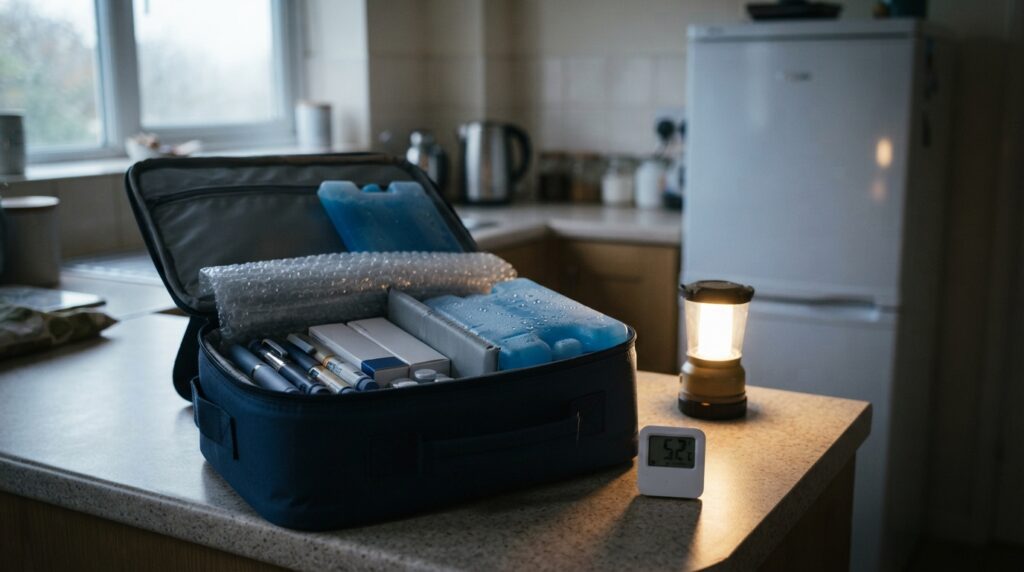
Keep the fridge door shut. The Food Standards Agency says a fridge should stay cold for up to 4 hours in a power cut. Insulin you’re already using doesn’t need the fridge: the NHS says in-use insulin can be kept at room temperature for 4 or 6 weeks, depending on the brand, and most leaflets say below 30°C. The bigger risks are freezing and overheating. If you move medicines to a cool bag, don’t let them touch ice packs. Insulin that has been frozen must be thrown away. If you’re not sure whether a medicine is still OK, check the leaflet and ask a pharmacist. If you or someone you live with relies on fridge medicines, join the free Priority Services Register.
Storm season brings power cuts, and for anyone who keeps insulin, GLP-1 pens, biologic injections or eye drops in the fridge, the first question is: will my medicine be OK? The good news is that most power cuts are short, and many fridge medicines can handle room temperature for a while. Here’s what the NHS, Diabetes UK and the medicine leaflets actually say, and how to plan ahead.
Step 1: keep the fridge shut
The Food Standards Agency’s power cut advice says to keep fridge and freezer doors closed as much as possible, and that “your fridge should stay cold for up to 4 hours”. A full freezer stays frozen for up to 48 hours (24 hours if it’s half full). So for a short cut, leaving everything where it is and not opening the door is usually the best plan.
A fridge thermometer helps you know where you stand. If the power has been off for hours, a min/max thermometer shows how warm the fridge got while you weren’t looking.
Step 2: know which medicines can handle room temperature
Insulin
The NHS says to keep insulin cartridges in the fridge until you start using them, and that once in use, “you can keep it out of the fridge at room temperature for either 4 or 6 weeks, depending on which brand you’re using”. Diabetes UK adds that “some insulins may need to be stored slightly differently”. Here’s what a few leaflets say about pens in use:
| Insulin (example) | In use, out of the fridge | Temperature limit |
|---|---|---|
| NovoRapid FlexPen | Up to 4 weeks | Below 30°C |
| Humalog 200 KwikPen | Discard after 28 days (don’t keep the in-use pen in the fridge) | Below 30°C |
| Lantus SoloStar | Up to 4 weeks (don’t refrigerate the in-use pen) | Not above 30°C |
| Tresiba 200 FlexTouch | Up to 8 weeks | Not above 30°C |
Unopened spares are the ones to protect. They’re meant to be kept in the fridge at 2–8°C (Diabetes UK says 2–6°C is ideal). If your fridge has been off for a long time and your spares have warmed up, check the leaflet for that product, or ask your pharmacist whether they’re still OK to use. Some leaflets (NovoRapid, Tresiba and Lantus, for example) allow a pen carried as a spare to be kept at room temperature for the same time as one in use. The NHS suggests writing the date on the packaging when insulin comes out of the fridge.
Other common fridge medicines
| Medicine (example) | What the leaflet says about room temperature |
|---|---|
| Ozempic pen | After first use, can be kept for 6 weeks below 30°C (or in the fridge). Unused pens go in the fridge |
| Mounjaro KwikPen | Up to 30 days, not above 30°C, after first use, then discard |
| Humira pen (adalimumab) | A single pen up to 25°C for a maximum of 14 days, protected from light. It must then be used or discarded, even if it goes back in the fridge |
| Chloramphenicol eye drops | The NHS says to store them in a fridge |
Some liquid medicines also need the fridge. For example, the NHS says liquid co-amoxiclav, an antibiotic made up by the pharmacy, should be kept in the fridge but not allowed to freeze. Check the label, and ask your pharmacist if a power cut lasts a long time.
Step 3: don’t freeze it, don’t cook it
Heat is the other risk. The NHS says that “if it gets too warm the insulin may not work properly”. Diabetes UK says heat-damaged insulin may have a brownish colour, and clear insulin may become cloudy, and it shouldn’t be used. The Lantus leaflet says not to use the pen if the insulin is “cloudy, coloured or has particles”. Some insulins are meant to look cloudy, so check your leaflet for how yours should look. In a winter power cut, heat is less likely, but keep medicines away from radiators, stoves, candles and sunny windowsills.
If insulin has been out of the fridge too long, the NHS says to return it to your pharmacy to dispose of it.
Step 4: join the Priority Services Register
The Priority Services Register (PSR) is a free list kept by energy suppliers and network operators. UK Power Networks (which covers London, the East and the South East) lists people who “have refrigerated medicines” among those eligible, and Diabetes UK says that if you live with diabetes, you are eligible to be added to the Priority Services Register. Being on the register can mean priority information during power cuts and extra help. Ofgem says to contact your energy supplier or your network operator to join. You can find your network operator through the PSR website.
Save 105 in your phone too. It’s the free power cut number in England, Scotland and Wales.
If you run out or your medicine is spoiled
The NHS says pharmacies “can provide certain emergency medicines to patients even if they don’t have a prescription, but you may need to pay”. You can also use NHS 111 online or call 111, or contact your GP. Don’t go without insulin: the NHS says not to stop taking it or skip doses. If you can’t get a replacement, call your diabetes care team or 111 straight away. Call 999 or go to A&E if you have high ketones or symptoms of diabetic ketoacidosis (DKA), such as being sick, breathing more deeply than usual, fruity-smelling breath, or feeling very sleepy or confused.
Diabetes UK’s travel advice is a useful model for emergencies too: always carry insulin, other diabetes medication, device spares and hypo treatments, and take extra supplies. Keeping a spare few days’ worth that you rotate through means one spoiled batch isn’t a crisis.
The kit worth having
FRIO insulin cooling wallet
Best for: keeping in-use insulin at room temperature without ice
Activated with cold water
Sizes from 1 pen to 8 pens
FRIO wallets use crystals that cool by evaporation after you soak the inner wallet in cold water. FRIO’s instructions say they keep insulin at 18–26°C for a minimum of 45 hours, even in a constant 37.8°C, and can be reactivated by soaking again. Sizes listed by the Diabetes UK Shop range from an Individual wallet for one pen to an Extra Large that holds eight. Note that this is room temperature, not fridge temperature. It’s ideal for in-use insulin and for spares you’re carrying, not for long-term storage of unopened stock.
Good for: power cuts, grab bags and travel; no freezer or ice needed.
Less good for: keeping medicines at 2–8°C. FRIO says don’t put the wallet in a fridge or freezer, or in an airtight container.
Medicool Dia-Pak
Best for: a structured case with a cold pack
One large cold pack included
20.5 x 15.25 x 6.5cm
The Diabetes UK Shop lists the Dia-Pak as keeping contents at 15–25°C for up to 12 hours, depending on conditions, with one large cold pack included, in a 20.5 x 15.25 x 6.5cm case. The case gives space for pens, a meter and spares, all in one place you can grab.
Good for: organising diabetes kit in one bag; day trips and short cuts.
Less good for: long power cuts. Like FRIO, it’s designed for cool room temperature, not fridge temperature. Follow the instructions on how to use the cold pack so medicines don’t get too cold.
ETI max/min fridge and freezer thermometer (810-225)
Best for: knowing how warm the fridge got
High and low alarm
±1°C accuracy
Worthing-based maker ETI lists this digital thermometer with a range of -24.9 to 69.9°C, ±1°C accuracy, 0.1°C resolution, a max/min memory and an audible high/low alarm, running on a CR2032 battery. After a power cut, the max and min readings tell you whether your fridge stayed in the 2–8°C range, which is useful information to give your pharmacist.
Good for: anyone who keeps medicines in a home fridge; checking the fridge is cold enough day to day.
Less good for: anything beyond monitoring. It tells you the temperature, but doesn’t keep anything cold.
Frequently asked questions
How long can insulin be out of the fridge?
Insulin in use can usually be kept at room temperature for 4 to 6 weeks, depending on the brand, according to the NHS. Leaflets typically say below 30°C, and some insulins allow longer. Check your product’s leaflet.
How long does a fridge stay cold in a power cut?
The Food Standards Agency says a fridge should stay cold for up to 4 hours if you keep the door closed.
Can I put insulin in a cool box with ice packs?
Yes, but don’t let it touch the ice packs. Frozen insulin can’t be used. Diabetes UK says insulin shouldn’t come into contact with frozen plastic containers in a cool bag.
Can I join the Priority Services Register if I need fridge medicines?
Yes. UK Power Networks lists refrigerated medicines among its eligibility reasons, and Diabetes UK says everyone living with diabetes is eligible. Contact your energy supplier or network operator.
What if my insulin has been frozen or got too warm?
Don’t use insulin that has been frozen, or that looks different from normal (for example, a clear insulin that has gone cloudy or brownish). If you think it got too warm, check the leaflet and ask a pharmacist. Get a replacement quickly and don’t go without insulin.
Sources
- NHS — Storing and travelling with short-acting insulin and long-acting insulin
- Diabetes UK — What is insulin? and Travel
- electronic medicines compendium — NovoRapid FlexPen, Tresiba, Humalog 200 KwikPen, Lantus SoloStar (PDF)
- electronic medicines compendium — Ozempic (PDF), Mounjaro KwikPen, Humira pen
- NHS — Chloramphenicol and Emergency prescriptions
- GOV.UK — Food safety in a power cut
- UK Power Networks — Priority Services Register and partnership with Diabetes UK
- Diabetes UK — Priority Services Register
- NHS — Diabetic ketoacidosis and Co-amoxiclav
- Ofgem — Join your supplier’s Priority Services Register
- Priority Services Register — thepsr.co.uk
- FRIO — Insulin wallet instructions (PDF); Diabetes UK Shop — FRIO wallets and Medicool Dia-Pak
- ETI — Max/min fridge and freezer thermometer
Related reading: keeping medicines safe in a heatwave, keeping food and medicine safe in hot weather and our storm-proofing guide.
Compare FRIO insulin cooling wallets at Amazon UK.